The IEA’s Electricity 2026 Meets AI: What the World’s Top Power Outlook Says—And What It Doesn’t
IEA’s Electricity 2026 isn’t an AI report—but AI runs through it. Data centers drive demand, grids become the bottleneck, queues grow, and reliability risks rise. AI isn’t just adding load—it’s forcing new rules for how the grid is governed.
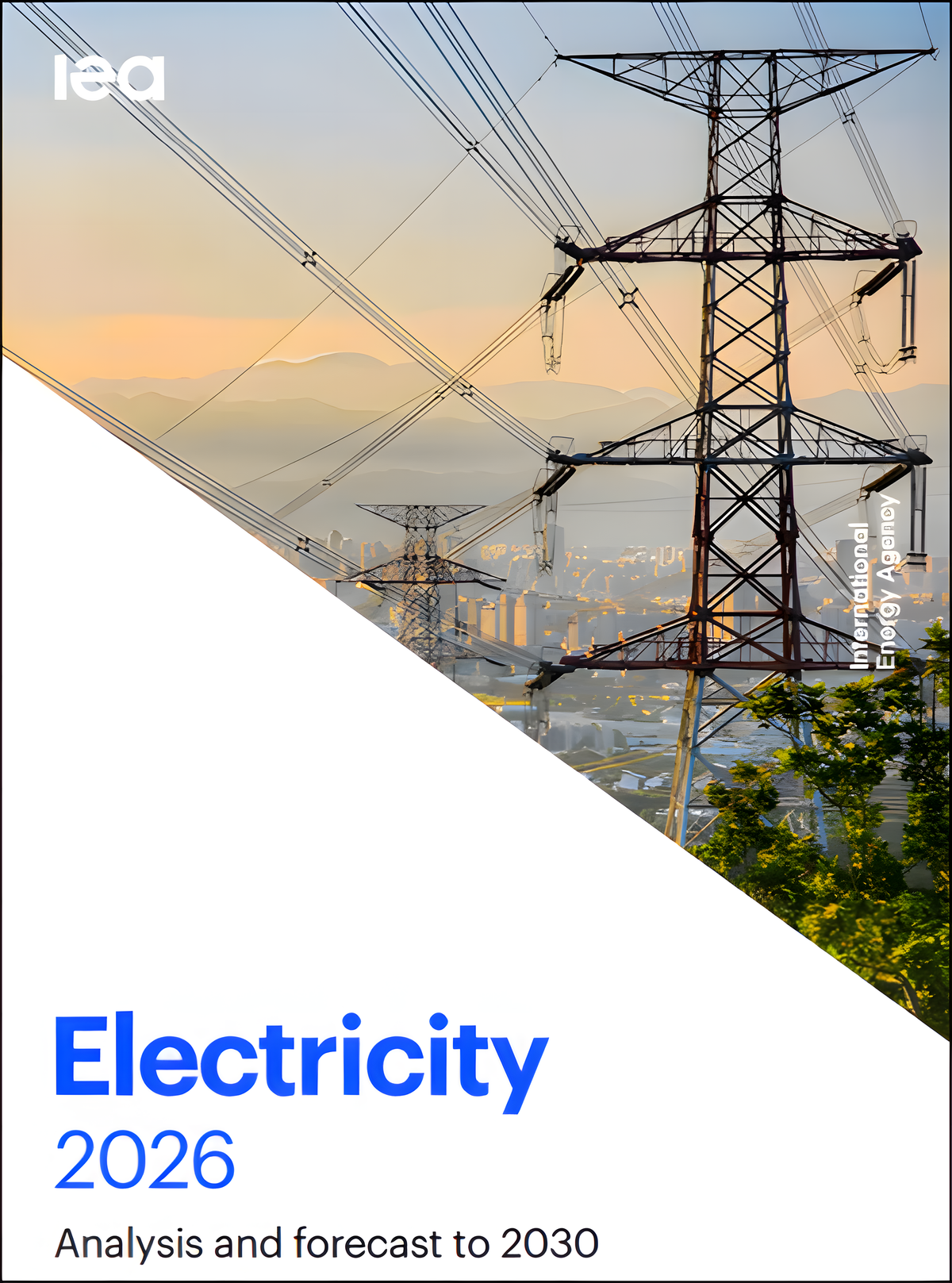
The IEA did not publish Electricity 2026 as an “AI report.” It is written, outwardly, as a standard power-sector outlook: demand, supply, prices, grids, flexibility, and security. Yet as you move through the document, artificial intelligence keeps showing up—not always by name, but as a new kind of electricity demand that refuses to behave like the loads grids were designed around.
In the executive summary, the IEA situates data centers alongside electric vehicles and other electrified end-uses as a driver of the renewed electricity growth in advanced economies (IEA, Electricity 2026, p. 9). That pairing matters. EVs are numerous and diffuse; data centers are fewer, enormous, and geographically concentrated. When the IEA says electricity demand is accelerating, it is also saying that grid planning is being dragged away from macroeconomics and toward a new reality: electricity growth now arrives in large, discrete chunks.
The report’s central message is that electricity demand is growing quickly and clean generation is scaling, but the system’s limiting factor is increasingly the network that connects them. In that frame, AI is not simply “another demand driver.” It is a stress test of the power system’s ability to allocate scarce grid capacity, manage congestion, preserve reliability, and price service fairly.
Demand
The IEA is unusually direct about the role of data centres in U.S. demand. In the regional discussion, the report notes that U.S. electricity demand growth over 2026–2030 is expected to average around 2% per year—more than twice the pace of the prior decade—and that “data centres’ electricity consumption is expected to account for almost half of the projected growth” (IEA, Electricity 2026, p. 155). The executive summary repeats this theme, again tying roughly half of the U.S. increase through 2030 to rapid data-centre expansion (IEA, Electricity 2026, p. 9).
That is the intersection point where “AI” becomes operationally real for grid planners. A national growth rate can be smoothed into generation additions and long-range plans. Half of incremental load arriving in the form of large, site-specific requests cannot.
The report also links this load growth to reliability planning. It cites the North American Electric Reliability Corporation’s 2025–2026 winter assessment, noting that winter demand is reportedly rising at the fastest rate in recent years, “especially in regions with new build data centers” (IEA, Electricity 2026, p. 155). The significance is not only energy use. It is timing and coincidence: winter peaks, cold snaps, and new large loads landing in the same regions.
China’s section makes the AI linkage less through headlines than through sectoral accounting. After describing a rebound in demand growth in the second half of 2025, the report states that demand in the “ICT and digital services subsector, which includes data centers and 5G networks, increased by 17% y-o-y” (IEA, Electricity 2026, p. 22). AI is not singled out as a separate category, but the report explicitly connects these demand trends to digital infrastructure.
The point is not merely that AI consumes power in China. It is that ICT electricity growth is moving quickly enough to appear in national demand statistics alongside industry, residential, and transport. That is a threshold moment—when a sub-sector becomes visible in the national ledger.
For the European Union, the report emphasizes the post-2022 decline and slow recovery, then projects a stronger growth path through 2030. In that outlook, it lists the expansion of data centers alongside EVs, heat pumps, and industrial electrification as key drivers (IEA, Electricity 2026, p. 170). Again, AI is present as part of an emerging composite of electrified growth: mobility, heating, and computation.
Supply
One of the report’s most important stylistic choices is that it rarely says “data centres require gas,” or “AI implies nuclear,” or “AI drives firm capacity needs.” Instead, it treats supply growth as a mix of renewables expansion, steady nuclear output, and ongoing system balancing needs. That choice reads neutral, but it has an implication: data center growth is not being treated as speculative, and it is not being treated as optional. It is treated as part of the load the system must serve.
In the U.S. regional narrative, the IEA places data centers next to “new industries with large loads such as semiconductor production and battery manufacturing” (IEA, Electricity 2026, p. 155). The pairing is revealing. Semiconductor fabs and battery plants tend to demand high-quality power and long-term reliability; data centVs demand high reliability and continuous service. Together, they strengthen the case for supply that is not only low-carbon, but firm and dispatchable.
The IEA’s electricity-system story remains a renewables story. But the AI/data-center story is an adequacy story. The intersection is where rapid renewables buildout meets a new class of steady, concentrated demand that magnifies the consequences of being wrong.
Grids
If the demand chapters establish that AI is changing the growth profile of electricity use, the grids chapter shows where that growth runs into physics, process, and governance.
The report is explicit that “large loads, and specifically data centers, play a key role in the growing connection queues in various regions,” adding that the growth in cloud services and artificial intelligence “partly explains these trends” (IEA, Electricity 2026, p. 60). This is one of the most direct AI references in the entire report. It sits not in a demand forecast section, but in a chapter about interconnection capacity and planning discipline.
The IEA then moves to the problem planners face immediately: separating real projects from speculative ones. Based on U.S. utility data, the IEA finds that “only around 20% of the data center connection requests” materialize in the short to medium term (IEA, Electricity 2026, p. 60). In Australia, an Oxford Economics estimate commissioned by AWS suggests that of 44 GW of data center connection requests, only 8 GW are likely to enter service (IEA, Electricity 2026, p. 60). In Brazil, requests surpassed 26 GW by November 2025, while only 6 GW were under review or at late stages according to EPE (IEA, Electricity 2026, p. 60).
This is the intersection of AI and grid governance in its most concrete form: queues are clogging, and the cost of misallocating capacity is rising. If connection offers are extended to phantom requests, real load and real generation are delayed. If grid upgrades are planned against inflated queues, customers may pay for assets that are not needed.
The IEA describes the rise of specific frameworks for large loads—essentially a new regulatory and planning category. In the United States, it notes that generation and grid expansion plans are increasingly linked to data-center connection requests, and that DOE directed FERC in October 2025 to initiate procedures aiming to reduce large-load connection times and upgrade costs, including allowing co-located generation-and-load access requests (IEA, Electricity 2026, p. 61).
The report adds a concrete example of speed-through-constraints: the Southwest Power Pool agreed a 90-day study and approval pathway for data centers and other large loads that are paired with generation or accept a curtailable supply (IEA, Electricity 2026, p. 61). California’s PG&E is described as reducing large-load connection timelines from 18–22 months to 2–5 months for applicants willing to pay for transmission work upfront (IEA, Electricity 2026, p. 61).
These are not marginal reforms. They are the early outlines of a new social contract between grids and large, fast-moving digital infrastructure: if you want to connect quickly, you must either pay, bring your own capacity, or accept that your load is conditional.
The report highlights Europe’s emerging posture: impose technical requirements and protect system planning. It notes that Ireland’s regulator required new data centers to provide dispatchable generation and/or storage capacity matching the site’s maximum import capacity, and to source at least 80% of annual demand from renewable electricity generated in Ireland (IEA, Electricity 2026, p. 62). It also notes that EirGrid has restricted new data-center connections in the greater Dublin area since 2021 due to congestion (IEA, Electricity 2026, p. 61).
The UK example makes the AI connection explicit, describing an “AI Growth Zones” package intended to accommodate rising grid-connection requests from large “AI data centers” of 100–500 MW, including prioritization for grid access if considered strategically important and enabling developers to build their own infrastructure such as high-voltage lines and substations (IEA, Electricity 2026, p. 62).
This is a governance fork in the road. The report’s examples show two different philosophies: one that treats data centers as customers to be managed with fees, deposits, and queue discipline; another that treats AI data centers as strategic infrastructure to be prioritised—while still trying to filter out speculation.
Finally, the IEA signals a trend that should worry regulators and utilities: as grid connections and baseload constraints become bottlenecks, data centers increasingly pursue behind-the-meter supply through on-site generation, while in some cases remaining grid-connected due to reliability needs or regulatory requirements (IEA, Electricity 2026, p. 62). The implication is that the grid is at risk of becoming both essential and bypassed: essential for reliability and backup, bypassed for energy supply and speed of deployment.
Flexibility
The flexibility chapter is where the report quietly acknowledges that the fastest way to integrate new loads is not always new transmission. Sometimes it is new flexibility.
In a key passage, the IEA writes that battery storage can “help greatly with the secure and cost-effective integration of new types of loads such as EVs, heat pumps and data centers, where the consumption can be highly correlated across location and time” (IEA, Electricity 2026, p. 84). This is the report’s most concise statement of why AI matters operationally. Data centers do not only add energy demand. They add correlated peaks—new bursts of consumption in specific geographies that can overwhelm local networks.
The report also provides the underlying momentum. It notes that battery storage costs fell by about 40% in 2024 to around USD 150/kWh, supporting rapid deployment, and that utility-scale battery additions reached 63 GW in 2024, bringing global installed capacity to 124 GW (IEA, Electricity 2026, p. 84). It highlights how the contribution of utility-scale batteries to peak demand is rising, with California’s installed utility-scale battery storage reaching nearly 25% of peak load in 2024 (IEA, Electricity 2026, p. 84).
For the AI–electricity intersection, the key is not the global headline. It is the role batteries play as a buffer against the temporal mismatch between renewable output and firm, continuous digital loads. Batteries are one of the few resources that can be deployed on short timelines relative to major transmission expansion, and the IEA explicitly links them to the integration of data center demand.
Yet the report also warns that batteries are not immune to the same bottlenecks: many projects face multi-year delays in securing grid connections and permitting, including local opposition related to fire safety (IEA, Electricity 2026, p. 85). Even the flexibility bridge can be delayed by the grid.
System Stress in the Field
Brazil’s regional section shows how the data center story can become a grid operations story. The IEA notes that a policy initiative (ReData) is incentivizing data-centre installations, and that grid connection requests from data centers increased by 32% between September and November 2025, reaching 26.2 GW, according to EPE (IEA, Electricity 2026, p. 163). If all proposed projects were built, the IEA observes that this load would represent more than one-quarter of Brazil’s total electricity demand (IEA, Electricity 2026, p. 163).
In the same passage, the report links the emergence of large new loads such as data centers—alongside rapid growth in solar, wind, and distributed generation—to the reality of operational strain and the need for more complex management (IEA, Electricity 2026, p. 163). It then describes a sharp increase in curtailment: in 2025, curtailment of wind and solar reportedly surpassed 20%, and Brazil curtailed around 37 TWh (IEA, Electricity 2026, p. 163).
This matters because it breaks a common misconception: that curtailment is a sign of “too much renewables.” In this story, curtailment is a sign of insufficient network and insufficient flexibility—made more acute by new, large, concentrated loads that change the operational envelope.
What the IEA is Really Saying About AI?
Across the report, the AI/data-centere theme reappears in three recurring system problems.
First, the demand is big and concentrated. The IEA’s U.S. numbers—nearly half of growth—are an explicit marker that data centers are not a rounding error (IEA, Electricity 2026, pp. 9, 155). China’s 17% ICT growth makes the same point in a different way: digital demand is now visible and fast-growing at national scale (IEA, Electricity 2026, p. 22).
Second, the grid is becoming the binding constraint. The report’s core “AI moment” sits inside the interconnection story: cloud services and artificial intelligence are partly driving the surge in large-load connection queues, and regulators are struggling to filter out phantom projects (IEA, Electricity 2026, p. 60). That is not a forecast problem. It is a governance and planning problem.
Third, the system response is increasingly conditional service. The IEA’s examples show what utilities and system operators are already negotiating: faster connections in exchange for upfront payments, curtailability, co-location with generation, deposits, long-term commitments, and—in some jurisdictions—mandatory on-site dispatchable capacity (IEA, Electricity 2026, pp. 61–62). The AI–electricity intersection is becoming an institutional question: who gets to connect, on what terms, and who pays for the upgrades.
Electricity 2026 contains a subtle tension. In one set of examples, data centers look like customers who must be managed—screened for speculation, required to post deposits, required to pay a share of network costs, required to accept curtailability. In another set of examples, AI data centers look like strategic infrastructure—prioritised for grid access, allowed to reserve connection points, enabled to build their own lines and substations.
Both approaches can be rational. But they imply very different futures for the power system. If AI load is treated as a customer class, the grid remains the core public platform, and the fight is about queue discipline, cost allocation, and reliability. If AI load is treated as strategic infrastructure, the grid becomes a tool of industrial policy, and the fight becomes political: whose projects are “strategically important,” and what happens to everyone else waiting behind them. The IEA does not resolve this tension. It documents it.
Conclusion
Read as a whole, Electricity 2026 implies that the defining constraint of the decade is not whether the world can build enough wind, solar, batteries, or even gas capacity. The defining constraint is whether power systems can expand and operate their networks fast enough to accommodate a new electricity economy—one where computation is a major end-use, and where that computation arrives as large, clustered load that stresses interconnection, adequacy, and reliability.
In that sense, the IEA’s most important contribution is not the headline that “half the world’s electricity will come from renewables and nuclear by 2030.” It is the quieter observation that data centers are now reshaping the practical rules of grid access, from the United States to Ireland to the UK to Brazil—and that the growth of cloud services and artificial intelligence is already part of the reason why (IEA, Electricity 2026, pp. 60–62; 163).
The “Age of Electricity” is also the age of electricity governance. AI is forcing the question earlier than most institutions expected: when a new industry wants hundreds of megawatts quickly, who decides what gets built, what gets delayed, what gets paid for—and what gets curtailed.
Download the full IEA report Electricity 2026.