From Paradox to Progress — A Review of WEF’s Net-Positive AI Energy Framework
AI has crossed from a marginal energy concern to a system-level driver of electricity demand, infrastructure investment, and grid planning. WEF and Accenture’s net-positive AI framework grounds this shift in lifecycle accounting, demand shaping, and real grid constraints.
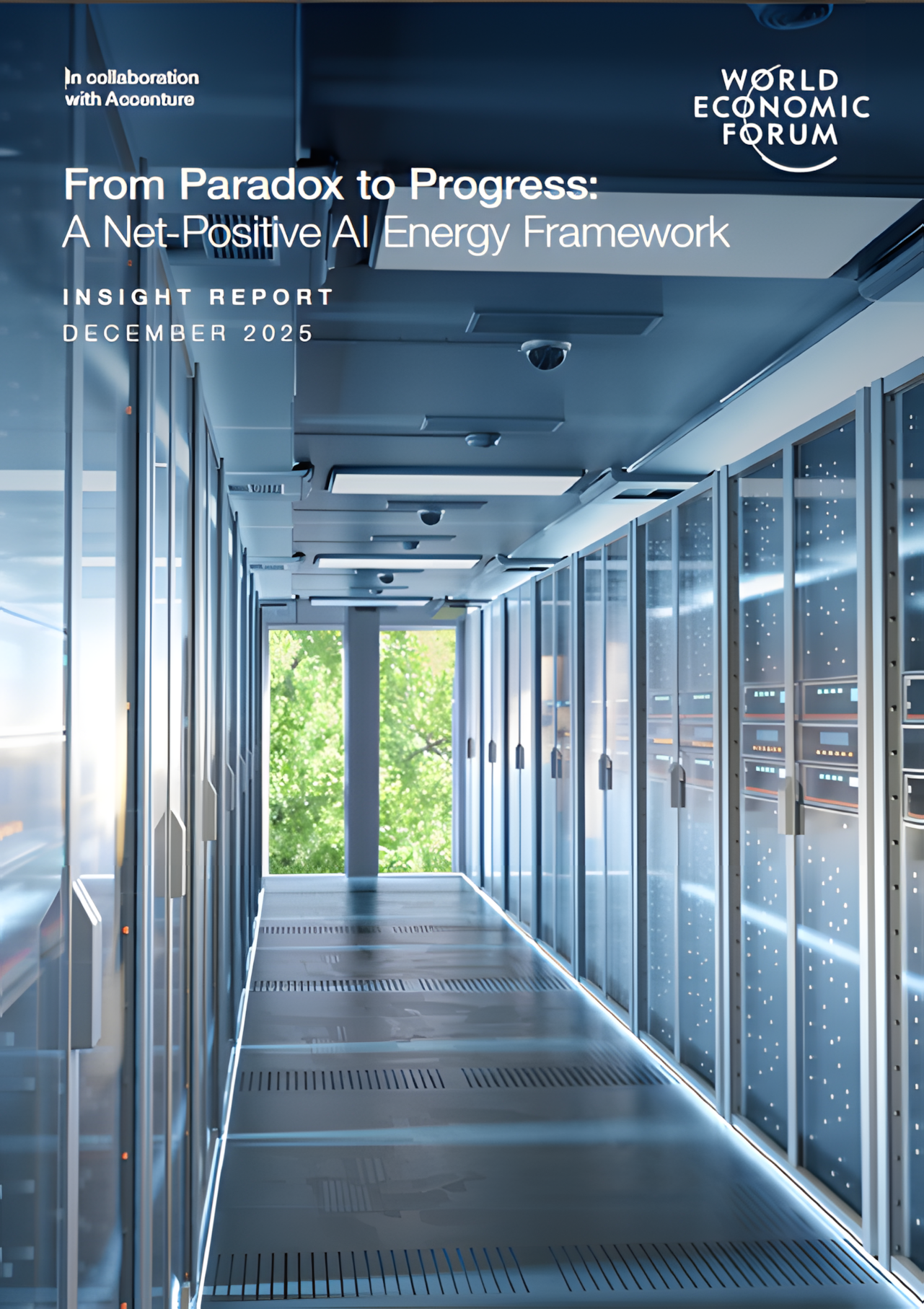
The WEF-Accenture report is correct in its opening premise: artificial intelligence has crossed a threshold at which its energy implications are no longer secondary effects. AI-driven compute growth, hyperscale data centers, and the upstream supply chains for advanced chips are now influencing electricity demand, infrastructure investment, and grid planning at national and regional scales.² The report’s projection that global data-center electricity demand could exceed 1,200 TWh by 2035—nearly triple 2024 levels—captures the scale of the challenge.³
What makes the report especially timely is its alignment with current events. In the United States, the Energy Information Administration projects record electricity consumption in 2026 and 2027, explicitly citing data centers and AI workloads as key drivers.⁴ At the same time, grid operators and regulators are grappling with transformer shortages, interconnection backlogs, and novel load configurations, including co-located generation and behind-the-meter arrangements.⁵ These pressures are now shaping tariff design, planning assumptions, and political debates over affordability.
Internationally, similar dynamics are unfolding. Ireland’s experience—where data centers have become a material share of national electricity demand—has pushed regulators to tighten connection rules and require stronger system contributions from large loads.⁶ These cases underscore a central insight of the WEF framework: AI growth is inevitable, but unmanaged AI growth can undermine energy security, public acceptance, and climate goals.
Strengths of the WEF–Accenture Approach
The report’s definition of “net-positive AI energy”—a condition in which the energy and resource savings enabled by AI exceed its full lifecycle consumption—is a major contribution.⁷ It moves the debate from abstract claims about AI’s potential to a measurable standard that can, in principle, be audited and compared across sectors and jurisdictions.
This framing aligns well with the academic literature calling for lifecycle-based disclosure of AI energy and emissions impacts. Research in machine learning and natural language processing has demonstrated that model choice, training regime, inference patterns, and data-center characteristics can dramatically alter energy use and carbon intensity.⁸ By anchoring the discussion in lifecycle accounting, WEF situates AI within the same analytical tradition long used in energy policy and environmental assessment.
The three action drivers—Design for efficiency, Deploy for impact, and Shape demand wisely—are thoughtfully chosen and mutually reinforcing. Each corresponds to a well-documented failure mode in current AI deployment trajectories.
Design for efficiency recognizes that AI’s energy footprint is not fixed. Advances in hardware efficiency, cooling systems, model architectures, and data-center design can yield large gains.⁹ WEF’s emphasis on embedding efficiency at the design stage is consistent with evidence showing that early technical choices dominate long-run energy outcomes.
Deploy for impact shifts attention from raw capability to contextual value. AI applications that reduce losses, improve forecasting, or optimize industrial and grid operations can deliver genuine system benefits, especially under constrained conditions. This focus aligns with energy-economics research showing that the value of efficiency depends on where and when it occurs.
Shape demand wisely is particularly important. By explicitly addressing rebound effects, unconscious consumption, and “dark data,” the report avoids a common pitfall of efficiency narratives.¹⁰ The historical literature—from Jevons onward—demonstrates that efficiency gains alone do not guarantee reduced resource use.¹¹ WEF’s inclusion of demand shaping signals a mature understanding of energy-system dynamics.
The report’s strategic enablers—consumer education and workforce upskilling, ecosystem collaboration, and transparent measurement and accountability—are pragmatic and well grounded. Energy transitions are not achieved through technology alone; they depend on human capacity, institutional trust, and shared standards.
Accenture’s influence is evident here in a positive sense. The report is oriented toward decision-makers who must act under real constraints, balancing cost, reliability, and sustainability. The use of over 130 real-world examples reinforces the framework’s credibility and applicability.
Underdeveloped Areas
One underdeveloped tension in the framework concerns timing. AI-driven load growth is arriving faster than generation, transmission, and distribution investments can be planned and built. Even with aggressive clean-energy deployment, infrastructure lead times create periods in which marginal demand may rely on existing fossil assets or exacerbate congestion.¹²
The report acknowledges this constraint, but future work could go further by examining how net-positive criteria should be applied during transitional periods. An AI deployment that is net-positive over its lifecycle may still impose short-term system costs that require explicit mitigation or compensation.
WEF is right to emphasize transparent measurement, but the complexity of system boundaries deserves additional attention. Net-positive claims depend on assumptions about geographic scope, temporal resolution, and upstream impacts. Does the accounting include embodied energy in semiconductors? How are regional grid emissions factors treated? How are water and land impacts incorporated alongside electricity use?
The academic literature has repeatedly highlighted these challenges. Patterson et al. show that location and processor choice can swing emissions outcomes dramatically, while Masanet et al. demonstrate how global data-center energy estimates can vary based on methodological choices.¹³ Strengthening standardized disclosure requirements would enhance the framework’s robustness.
Another area for expansion is distributional impact. The report correctly notes the risk that AI growth could raise electricity prices or concentrate benefits in energy-rich regions.¹⁴ These are not merely side effects; they shape political feasibility. Recent reporting on large technology firms’ commitments to fund grid upgrades reflects an emerging recognition that social license matters.¹⁵
Future iterations of the framework could more explicitly address how costs and benefits are allocated among customer classes, regions, and communities, and how net-positive outcomes are reconciled with affordability objectives.
Governance, as discussed in The Cognitive Grid, is best understood not as an abstract principle but as the practical question of how decisions are authorized, executed, and reviewed in public-interest systems. AI systems that inform prioritization, planning, or real-time operations can influence outcomes even when they remain “advisory.”
 Brandon Owens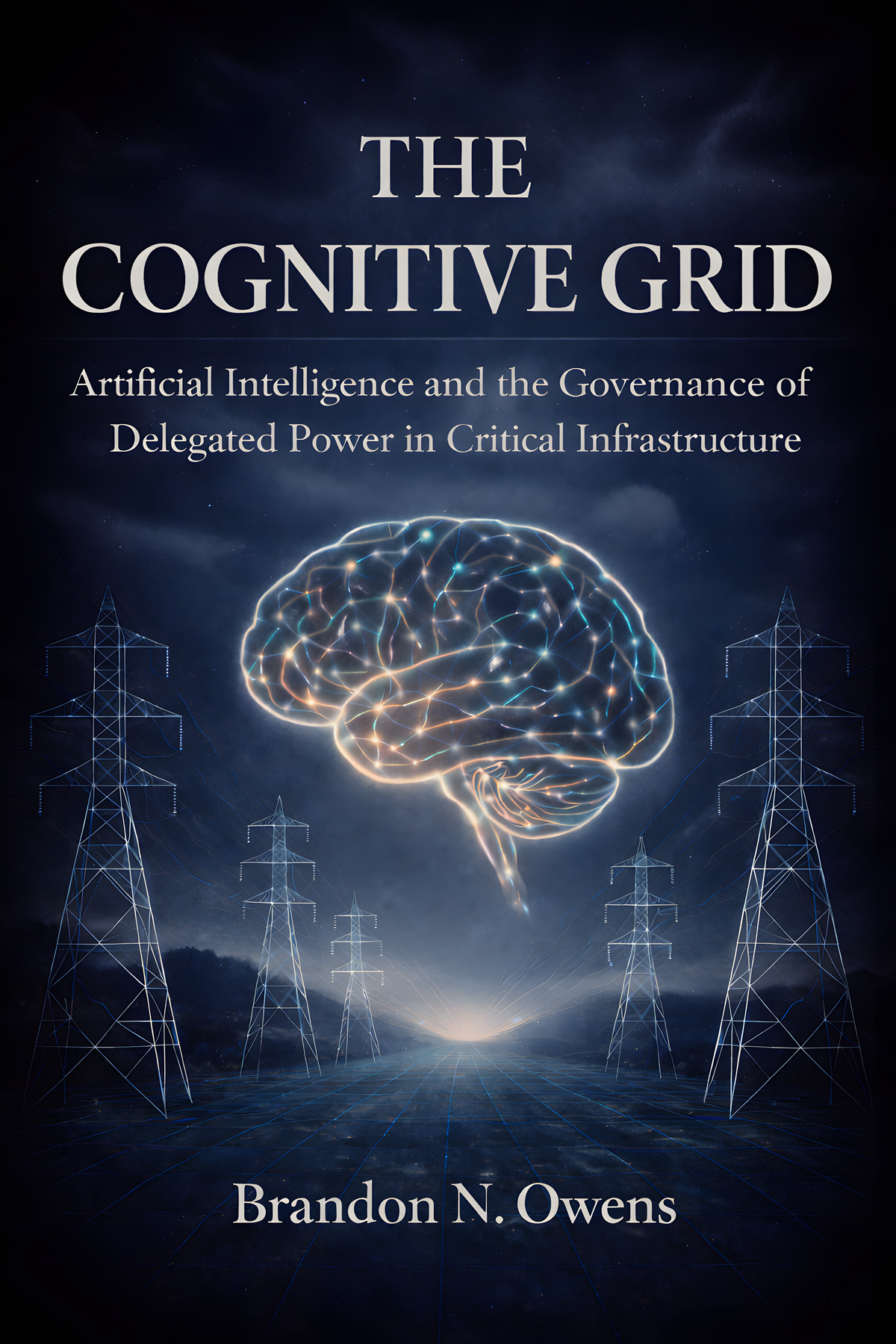
The WEF framework gestures toward accountability, but additional specificity—around decision rights, escalation pathways, and traceability—would strengthen its applicability in highly regulated environments such as electric grids. This is less a critique than an invitation: WEF is well-positioned to convene the actors needed to translate high-level principles into operational governance templates.
The framework reflects a clear understanding of how enterprises actually make decisions: through capital-allocation processes, performance metrics, and operational incentives. Without this grounding, calls for net-positive AI energy would risk remaining aspirational.
At the same time, enterprise pragmatism must be complemented by public-sector authority. Utilities and regulators operate under statutory obligations to ensure reliability and fairness, not merely efficiency. The report would benefit from drawing this distinction more explicitly—not to diminish enterprise action, but to clarify where voluntary leadership ends and binding rules begin.
A Foward-Looking Research Agenda
Building on the strong foundation laid by WEF and Accenture, several areas merit deeper exploration:
1. Operationalizing net-positive metrics at the grid and jurisdictional level, not only within enterprises.
2. Integrating infrastructure timing into net-positive assessments, distinguishing short-term system stress from long-term benefits.
3. Developing standardized disclosure templates for AI energy use, emissions, and resource impacts.
4. Addressing distributional effects explicitly, including affordability and regional equity.
5. Clarifying governance pathways for AI systems that influence consequential infrastructure decisions.
These steps represent natural extensions of its logic.
Conclusion
From Paradox to Progress is a constructive and timely contribution. It reframes the AI–energy relationship in terms that energy institutions understand: systems, constraints, trade-offs, and accountability. It avoids simplistic optimism, acknowledges real risks, and proposes a coherent structure for action.
The framework’s greatest value may be that it creates a shared language through which enterprises, utilities, regulators, and civil society can engage. Strengthening its treatment of infrastructure timing, measurement boundaries, economic distribution, and institutional governance would not weaken that language—it would make it more precise.
Progress, in energy systems, is rarely linear. But frameworks like this one matter because they shape how problems are named and which solutions are considered legitimate. In that respect, WEF and Accenture have provided a foundation that deserves both recognition and continued refinement.
Notes
- Brandon N. Owens, The Cognitive Grid: Artificial Intelligence and the Governance of Delegated Power in Critical Infrastructure (New York: Independently published, 2025).
- World Economic Forum, From Paradox to Progress: A Net-Positive AI Energy Framework (Geneva: World Economic Forum, December 2025), executive summary.
- Ibid., 6.
- Reuters, “US power use to beat record highs in 2026 and 2027, EIA says,” January 13, 2026.
- World Economic Forum, From Paradox to Progress, 6.
- European Commission and Irish regulatory reporting on data-center electricity demand and connection policy.
- World Economic Forum, From Paradox to Progress, 3–4.
- Emma Strubell, Ananya Ganesh, and Andrew McCallum, “Energy and Policy Considerations for Deep Learning in NLP,” Proceedings of the 57th Annual Meeting of the Association for Computational Linguistics (2019).
- World Economic Forum, From Paradox to Progress, 13–14.
- Ibid., executive summary.
- William Stanley Jevons, The Coal Question (London: Macmillan, 1865); Harry D. Saunders, “A View from the Macro Side: Rebound, Backfire, and Khazzoom–Brookes,” Energy Policy 28, no. 6–7 (2000): 439–449.
- International Energy Agency, Energy and AI (Paris: IEA, 2025).
- David Patterson et al., “Carbon Emissions and Large Neural Network Training,” arXiv:2104.10350 (2021); Eric Masanet et al., “Recalibrating global data center energy-use estimates,” Science 367, no. 6481 (2020): 984–986.
- World Economic Forum, From Paradox to Progress, 6.
- Financial Times, “Microsoft vows to ‘pay its way’ as it seeks to defuse data centre backlash,” January 2026.
Bibliography
European Commission. “In focus: Data centres – an energy-hungry challenge.” November 17, 2025.
Financial Times. “Microsoft vows to ‘pay its way’ as it seeks to defuse data centre backlash.” January 2026.
International Energy Agency. Energy and AI. Paris: IEA, 2025.
Jevons, William Stanley. The Coal Question. London: Macmillan, 1865.
Masanet, Eric, et al. “Recalibrating global data center energy-use estimates.” Science 367, no. 6481 (2020): 984–986.
Owens, Brandon N. The Cognitive Grid: Artificial Intelligence and the Governance of Delegated Power in Critical Infrastructure. New York: Independently published, 2025.
Patterson, David, et al. “Carbon Emissions and Large Neural Network Training.” arXiv:2104.10350 (2021).
Reuters. “US power use to beat record highs in 2026 and 2027, EIA says.” January 13, 2026.
Saunders, Harry D. “A View from the Macro Side: Rebound, Backfire, and Khazzoom–Brookes.” Energy Policy 28, no. 6–7 (2000): 439–449.
Strubell, Emma, Ananya Ganesh, and Andrew McCallum. “Energy and Policy Considerations for Deep Learning in NLP.” In Proceedings of the 57th Annual Meeting of the Association for Computational Linguistics. 2019.
World Economic Forum. From Paradox to Progress: A Net-Positive AI Energy Framework. Geneva: World Economic Forum, December 2025.