The Cognitive Grid Part I: Why the Grid Is Now an Intelligence Problem
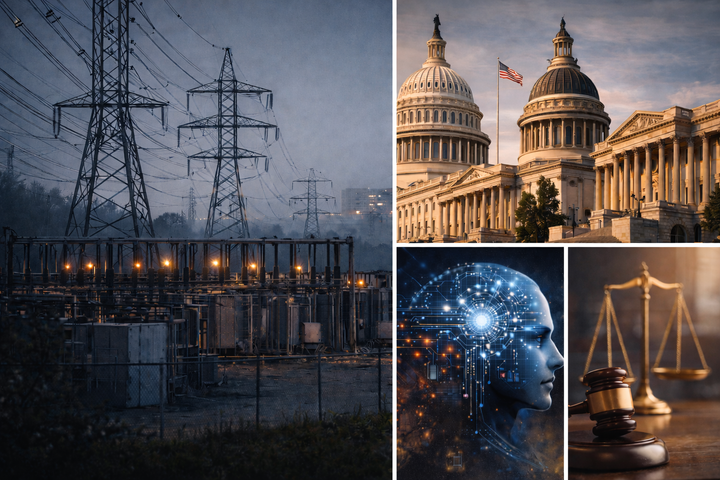
AI is turning electricity from a passive utility into active intelligence. As algorithms shape forecasting and dispatch, power becomes adaptive and moral. Cognitive Infrastructure Theory (CIT) argues that the grid’s greatest challenge isn’t capacity—but governance.
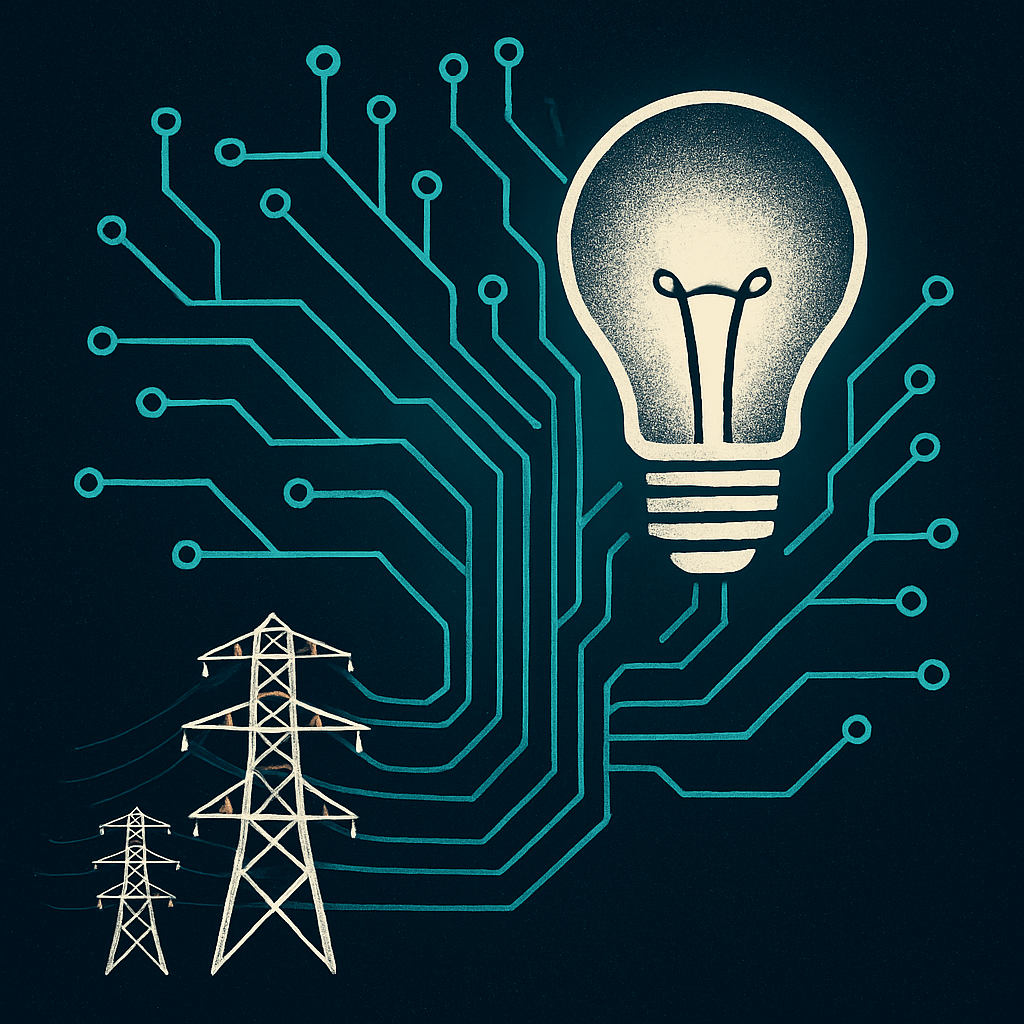
This article is Part I of The Cognitive Grid — a five-part article series from AIxEnergy exploring how artificial intelligence is beginning to merge with the electric grid. As utilities take their first steps toward integrating AI into forecasting, dispatch, and system operations, a deeper transformation is taking shape beneath the surface: electricity itself is becoming intelligent.
Artificial intelligence is transforming electricity from a passive commodity into an active intelligence. As algorithms permeate the grid’s forecasting, dispatch, and market systems, the nature of power itself is shifting from mechanical obedience to cognitive adaptation. This article introduces Cognitive Infrastructure Theory (CIT) — a framework that explains and governs this transition. It argues that the central challenge of the twenty-first-century grid is not capacity but governance: ensuring that the intelligence we embed into our energy systems reflects social values, transparency, and moral accountability.
The Grid’s Quiet Transformation
In September 2025, the International Energy Agency issued a striking projection: global data-center electricity demand could double by 2030, driven largely by artificial intelligence and cloud computing.[1] Meanwhile, PJM Interconnection—the largest regional transmission organization in the United States—reported that AI-related interconnection requests could add tens of gigawatts of new demand within the next five years.[2] Across the Atlantic, the Netherlands halted data-center approvals after its power network reached capacity limits, revealing how digital growth now dictates grid expansion.[3]
The story dominating business headlines is that AI is hungry for electricity. Yet behind the megawatts lies a subtler truth: electricity itself is learning to think.
For more than a century, the grid was engineered to obey. Power plants responded to dispatch signals, transmission networks delivered current, and regulators supervised reliability. Its logic was linear, hierarchical, and deterministic—a monument to the industrial age. Today, the grid is becoming recursive, probabilistic, and adaptive. Algorithms forecast demand, optimize voltage, and trade power across digital markets in milliseconds. What was once a mechanical infrastructure is mutating into a cognitive infrastructure.
From Optimization to Cognition
The first hint of this transition emerged with the rise of the so-called smart grid in the early 2000s. Smart meters and digital sensors introduced feedback loops into a previously one-way system. As Norbert Wiener observed in Cybernetics (1948), feedback transforms mechanism into behavior—machines that react, adapt, and anticipate.[4] Yet early smart grids remained bounded by instrumental goals: efficiency, reliability, and cost reduction.
The twenty-twenties ushered in a deeper evolution. Artificial intelligence began to colonize grid operations. Predictive maintenance, anomaly detection, and reinforcement learning entered control rooms once governed by deterministic rules. AI-assisted generation forecasting improved renewable integration, while machine-learning models began optimizing real-time energy trading. The grid, in effect, started to perceive and remember.
This is what I define as the Cognitive Grid: the fusion of the electric grid and artificial intelligence into a distributed neural network of substations, inverters, and algorithms capable of perceiving, predicting, and self-correcting. It does not merely transmit electricity; it metabolizes information. Every watt carries data about its origin, intent, and carbon cost. Every node—from household battery to data center—participates in a shared learning process. The boundary between computation and generation is dissolving. Electricity, once a mechanical current, is becoming an epistemic one.
Cognitive Infrastructure Theory (CIT)
To understand this shift, consider Cognitive Infrastructure Theory (CIT), a framework that examines how distributed intelligence alters the meaning, control, and ethics of essential systems. CIT rests on three original premises:
- Ontological Shift — Electricity evolves from controlled matter into self-regulating cognition.
- Constitutional Necessity — Governance must be embedded within infrastructure, not applied externally after the fact.
- Ethical Risk Hierarchy — The gravest danger is not technical malfunction but governance insufficiency — the inability of oversight to match the speed and opacity of machine learning.
These principles distinguish CIT from three major intellectual precedents. Smart grid literature focused on optimization, not agency. Cyber-physical systems theory examined technical interdependence but ignored moral consequence. AI ethics explored algorithmic bias in digital platforms but rarely extended to physical infrastructure. The Cognitive Grid unites them. It treats the grid as a cognitive organism whose decisions must be governed with constitutional precision. CIT positions governance as a design discipline, not a regulatory afterthought. If intelligence is infrastructural, so too must ethics be infrastructural.
The Governance Imperative
Modern grids already operate at speeds that escape human deliberation. Automated trading systems in electricity markets execute thousands of transactions per second. Machine-learning models forecast supply and demand using opaque neural networks. Even before full autonomy arrives, decision-making authority has begun to migrate from regulators to algorithms. This produces what I call a governance latency gap — the distance between technological action and institutional comprehension.
The risk is subtle but systemic. A perfectly optimized grid can still produce inequitable outcomes if its objectives are misaligned with public values. Without embedded accountability, data monopolies may capture grid intelligence, privatizing decision-making in a public domain. A cognitive grid run solely for profit could minimize cost while maximizing carbon or social harm. The result: a flawless machine that undermines democracy.
The remedy is constitutional automation — embedding transparency, auditability, and ethical constraints directly into code. Governance must evolve from external supervision to internal design. As Lawrence Lessig once wrote, "Code is law"; in the cognitive era, code is also policy.[5]
Constitutional automation would hardwire moral clauses into machine logic: explainable AI for dispatch algorithms, open ledgers for grid transactions, and algorithmic impact assessments akin to environmental reviews. These measures ensure that as the grid becomes intelligent, its conscience scales with its cognition.
The New Energy Social Contract
Electricity has always been political. The New Deal’s rural electrification programs were acts of nation-building as much as engineering. The liberalization of energy markets in the 1990s was a political ideology rendered in kilowatt-hours. Now, as the grid becomes cognitive, governance must once again adapt.
A Cognitive Grid Constitution would define rights and obligations in this new order: data transparency for consumers, algorithmic accountability for operators, and equitable access to clean power. It would require regulators to oversee not just assets and tariffs but models and learning objectives. The principle is simple: governance should be as intelligent as the system it governs.
This is not utopian speculation. Elements of this constitutional turn are already visible. The European Union’s AI Act introduces risk-based oversight for algorithmic systems.[6] The U.S. Department of Energy has launched programs such as Speed to Power to study AI’s role in grid modernization.[7] Yet these initiatives remain fragmented. What’s missing is a coherent philosophy—a theory linking cognition to legitimacy. That is the role of Cognitive Infrastructure Theory.
While prior literature has examined automation, cyber-physical feedback, and ethical AI, no published body of work has unified these fields into a single theory positioning governance as the ontological core of intelligent infrastructure. CIT originates this synthesis, defining the Cognitive Grid as the first system where intelligence, energy, and ethics converge.
Conclusion
The grid is not yet self-aware, but its trajectory is unmistakable. As AI and energy systems intertwine, the challenge will not be to control intelligence but to civilize it. Governance must evolve from regulation to relationship—from mechanical oversight to moral architecture. The Cognitive Grid is both warning and opportunity: the moment when civilization’s oldest network begins to think, and humanity must decide what values it will remember.
This concludes Part I of a five-part article series on the Cognitive Grid. In Part II — “The Cognitive Grid Part II: Building Constitutional Intelligence System for Energy Infrastructure,” we will discuss the current limitations and examine the type of intelligence systems that might be required to successfully manage and govern critical infrastructure like the power grid.
Notes
- International Energy Agency, AI Is Set to Drive Surging Electricity Demand from Data Centres (Paris: IEA, September 2025).
- PJM Interconnection, Long-Term Load Forecast Report (Audubon, PA: PJM, August 2025).
- Netherlands Ministry of Economic Affairs and Climate Policy, National Data Center Strategy (The Hague, 2025).
- Norbert Wiener, Cybernetics: Or Control and Communication in the Animal and the Machine (Cambridge, MA: MIT Press, 1948).
- Lawrence Lessig, Code and Other Laws of Cyberspace (New York: Basic Books, 1999).
- European Commission, Artificial Intelligence Act (Brussels, 2024).
- U.S. Department of Energy, Speed to Power Initiative (Washington, DC, 2025).
References
European Commission. Artificial Intelligence Act. Brussels, 2024.
International Energy Agency. AI Is Set to Drive Surging Electricity Demand from Data Centres. Paris, September 2025.
Lawrence Lessig. Code and Other Laws of Cyberspace. New York: Basic Books, 1999.
Netherlands Ministry of Economic Affairs and Climate Policy. National Data Center Strategy. The Hague, 2025.
PJM Interconnection. Long-Term Load Forecast Report. Audubon, PA, August 2025.
U.S. Department of Energy. Speed to Power Initiative. Washington, DC, 2025.
Wiener, Norbert. Cybernetics: Or Control and Communication in the Animal and the Machine. Cambridge, MA: MIT Press, 1948.