Artificial intelligence did not arrive in the energy sector with a single breakthrough moment. It arrived quietly, incrementally, and then all at once—embedded in data centers that now rival industrial loads, woven into control systems that increasingly guide grid operations, and infused into planning, forecasting, and design tools that shape infrastructure decisions long before steel meets ground.
What we are living through is not simply the digitalization of energy. It is a deeper structural shift: the convergence of artificial intelligence and energy infrastructure into what can best be described as a cognitive grid—an electricity system that senses, decides, learns, and adapts in real time. This transformation carries extraordinary promise, but also material risks. It demands new frameworks, new skills, and new forms of governance.
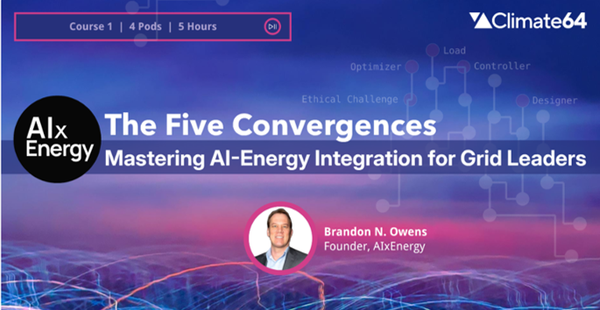
That is the context in which The Five Convergences of AI and Energy course was created—and why Climate64 is the right platform to deliver it.
From Software to Infrastructure: Why AI Changes Everything in Energy
For decades, energy professionals have grown accustomed to waves of technological change: digital meters, advanced SCADA systems, distributed generation, storage, and electrification. Artificial intelligence, however, is fundamentally different. Unlike prior digital tools, AI is not just a layer of monitoring or optimization—it is increasingly an active participant in the system.
AI consumes electricity at massive scale through hyperscale data centers. It controls assets through autonomous trading systems, predictive maintenance platforms, and distributed energy orchestration. It optimizes operations by uncovering patterns no human operator could see. And it now participates in the design of infrastructure itself, from siting generation to drafting regulatory documentation.
At the same time, AI introduces new ethical and governance challenges. Algorithms make decisions that can affect reliability, equity, safety, and cost. When those decisions are embedded in opaque systems, traditional oversight mechanisms strain to keep up.
In short, AI is no longer adjacent to the grid. It is inside the grid.
Understanding this shift requires more than technical literacy. It requires a systems-level framework that connects demand, control, optimization, design, and governance into a coherent whole. That framework is the Five Convergences.
The Five Convergences Framework: A Map of a New Energy Era
The Five Convergences framework was developed to bring structure and clarity to a rapidly fragmenting conversation. Rather than treating AI in energy as a collection of isolated use cases, the framework organizes the transformation into five interlocking dimensions:
- AI as Load – AI as a dominant new source of electricity demand, reshaping planning, rates, and reliability.
- AI as Controller – AI directly operating energy assets and markets, often faster and more complex than human control.
- AI as Optimizer – AI enhancing maintenance, forecasting, customer engagement, and system efficiency.
- AI as Designer – AI influencing how infrastructure, markets, and policies are conceived and built.
- AI as Ethical Challenge – AI raising new questions of governance, transparency, accountability, and equity in critical infrastructure.
Individually, each convergence is important. Taken together, they describe a structural transformation in how the energy system functions and how decisions are made within it.
The original Five Convergences report laid out this conceptual map. The course takes the next step: translating that map into practical understanding and applied strategy.
Why This Course Exists
Many professionals sense that something fundamental is changing at the intersection of AI and energy—but lack a structured way to engage with it. Technical experts may understand individual tools without seeing the systemic implications. Executives may grasp the strategic stakes without understanding the underlying mechanics. Policymakers may feel the urgency without a shared vocabulary to guide regulation.
This course exists to close that gap.
Rather than focusing on narrow tools or speculative futures, it grounds learners in the realities already reshaping the grid. It connects operational examples with strategic consequences. It emphasizes not just what AI can do in energy, but what it should do—and under what constraints.
The goal is not to turn participants into data scientists or AI engineers. The goal is to help them think clearly, rigorously, and responsibly about a system that is becoming more autonomous, more complex, and more consequential by the year.
What the Course Covers
The Cognitive Grid and AI as Load
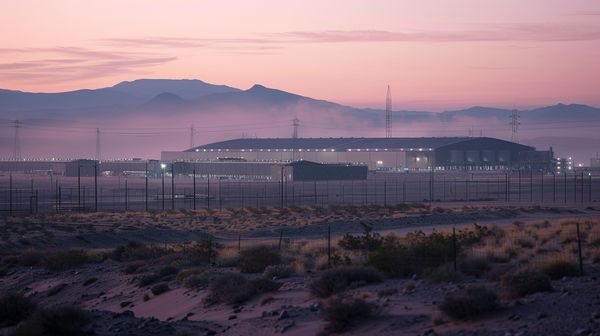
The course begins by reframing AI as physical infrastructure. Learners explore how data centers and AI workloads have become one of the fastest-growing electricity loads in modern history, often arriving in concentrated clusters that stress local grids.
This module examines planning challenges, tariff design, interconnection bottlenecks, and the geopolitical competition emerging around energy-intensive compute. It also explores early responses—from large-load tariffs to off-grid generation—and their implications for equity and decarbonization.
Autonomous Operations: AI as Controller and Optimizer
Next, the course turns inward, examining how AI operates within the grid. Participants explore autonomous battery trading, AI-assisted control rooms, predictive maintenance, and distributed energy orchestration.
Crucially, the course does not treat autonomy as an unqualified good. It examines reliability risks, cybersecurity vulnerabilities, model drift, and the tension between speed and oversight. Learners grapple with questions of human-in-the-loop design and the limits of automation in life-critical systems.
Infrastructure Design and Ethical Governance
As AI begins to shape planning and design decisions, governance can no longer remain an afterthought. This module explores AI-assisted siting, permitting, and infrastructure optimization—alongside the ethical risks of bias, opacity, and accountability gaps.
Participants engage with emerging governance concepts, including auditability, explainability, and embedded constraints. The emphasis is on designing systems that remain governable as they grow more intelligent.
Strategic Implementation and Future Scenarios
The final module focuses on action. Learners translate insight into organizational roadmaps, workforce strategies, and scenario planning. Rather than predicting a single future, the course equips participants to prepare for multiple plausible trajectories—and to make decisions that remain robust under uncertainty.
Who This Course Is For
This course is designed for professionals who operate at the intersection of strategy, technology, and infrastructure. That includes utility leaders, regulators, policymakers, investors, consultants, and technologists working in or alongside the energy sector.
It is particularly relevant for those responsible for long-lived decisions—investments, policies, market designs—that will shape the grid for decades. The course assumes intellectual curiosity and professional seriousness, but not prior expertise in AI.
Why Climate64 Is the Right Platform
Just as important as the content is the platform delivering it. Climate64 is not a generic online learning marketplace. It is a purpose-built environment for climate and energy professionals who value rigor, credibility, and real-world relevance.
Climate64’s focus on applied climate education aligns directly with the intent of this course. The platform brings together practitioners who are already engaged in the work of decarbonization, infrastructure development, and system transformation. It prioritizes depth over breadth and expertise over volume.
For an interdisciplinary topic like AI and energy, that context matters. This course is not about abstract theory or consumer-level explanation. It belongs in a professional setting where learners expect nuance, complexity, and intellectual honesty.
Climate64 also provides the structure needed to translate research into learning—organizing content into coherent modules, supporting certification pathways, and creating a durable home for material that will evolve as the field matures.
In that sense, Climate64 is not just a distribution channel. It is an extension of the course’s philosophy: serious thinking, applied to real problems, in service of a sustainable and governable future.
Why This Moment Matters
The convergence of AI and energy is accelerating faster than governance, policy, and institutional learning. Decisions made in the next few years—about infrastructure, market design, and oversight—will shape outcomes for decades.
This course is an invitation to engage with that moment deliberately. To move beyond hype and fear toward structured understanding. To recognize that intelligent infrastructure is not just a technical challenge, but a social one.
If the grid is learning to think, we must learn to govern what it becomes. That is the purpose of this course—and why it belongs on Climate64.