The Role of Artificial Intelligence in World Energy Employment 2025
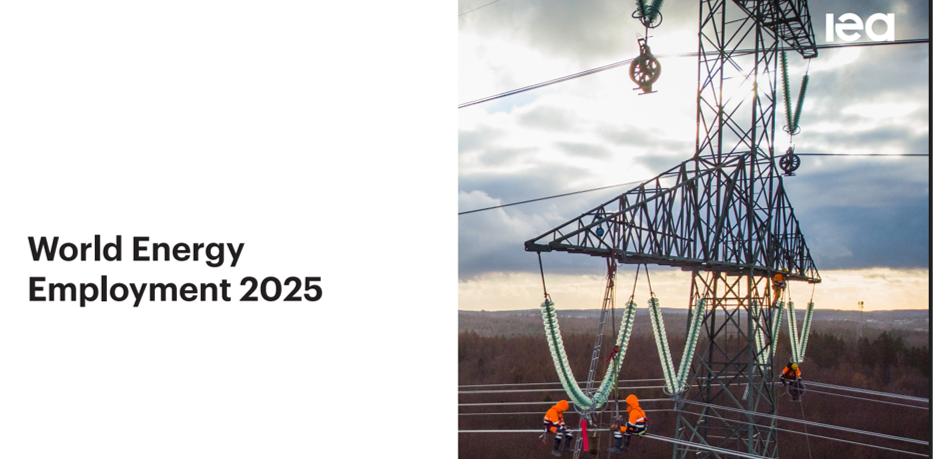
The International Energy Agency’s (IEA) World Energy Employment 2025 offers a comprehensive assessment of global labor trends across the energy sector. While the report’s core narrative focuses on job growth, skilled-worker shortages, and demographic pressures, it also provides a substantive—though understated—examination of how artificial intelligence (AI) is beginning to influence energy-sector employment. This review synthesizes and evaluates the IEA’s treatment of AI, highlighting its implications for workforce development, competitiveness, and the execution of the global clean energy transition.
AI as an Emerging Contributor to Energy-Sector Productivity
The report identifies artificial intelligence as “a powerful productivity tool in energy,” noting that early deployment is concentrated in administrative functions, permitting real-time monitoring, and safety applications (p. 7).¹ Virtual reality (VR)–based training is highlighted as a promising use case, particularly in offshore environments, where AI-enabled simulations reduce the need for costly and hazardous field training.²
These findings align with broader industry trends: AI adoption in energy currently serves to optimize workflows and augment decision-making rather than substitute for human labor. Automation is concentrated in documentation-heavy tasks, data analysis, and predictive maintenance—domains where AI’s comparative advantage is clearest.
However, the report is equally explicit in acknowledging AI’s limits. Current tools do not significantly reduce the need for field-based technical labor, which remains dominated by manual, situational, and safety-critical tasks that AI “is not currently well suited to replace” (p. 7).³ This distinction is significant. It suggests that AI is reshaping the structure of work without mitigating the acute labor shortages that characterize technical roles across the power, construction, and grid sectors.
In effect, AI elevates productivity at the administrative and cognitive layers of the workforce while increasing pressure on the physical and technical layers—an important systemic insight.
AI Talent Scarcity as a Strategic Vulnerability
The IEA highlights a marked gap in AI-relevant talent between the energy sector and other industries. Between 2018 and 2024, the concentration of AI-skilled workers in utilities, oil and gas, and mining was on average 40% lower than in education, technology, finance, and media (p. 43).⁴ This talent deficit represents a critical strategic vulnerability for the sector.
Several factors contribute to this disparity:
Salary Competition—Entry-level wages in the technology sector are approximately 30% higher than in energy (p. 43).⁵
Undefined AI Strategy—Many energy firms lack clear roadmaps for AI deployment, making it difficult to justify specialized hiring (p. 44).⁶
Limited Reskilling Infrastructure—Workers report barriers such as training cost, lost wages, and limited program awareness (p. 8).⁷
These structural challenges constrain the sector’s ability to recruit and retain AI professionals at a time when digital capabilities are becoming essential for grid optimization, distributed energy resource (DER) management, asset forecasting, and advanced analytics.
The report’s comparative framing underscores an important trend: while the global energy transition is accelerating, energy-sector employers are not yet competitive destinations for AI practitioners. This misalignment risks slowing modernization efforts and increasing dependence on external vendors.
AI’s Impact on Job Roles and Occupational Structure
The report describes AI as a catalyst for the evolution of job roles rather than a destroyer of occupations. It notes that AI “shifts the nature of work… requiring individuals and organisations to rethink job roles” (p. 43).⁸ Administrative functions—procurement, permitting review, compliance, and documentation—are the most exposed to automation.
However, the IEA finds no evidence that AI is materially reducing employment demand in the most labor-constrained roles, including electricians, lineworkers, heavy-equipment specialists, turbine technicians, and grid engineers. These occupations, which form the backbone of the energy transition, rely on physical dexterity, in-field problem solving, and judgment under uncertainty—areas where current AI systems lack capability.
The report’s occupation-level analysis reinforces this conclusion. Although AI enhances training, safety, and operational quality, “current use cases do not significantly reduce demand for applied technical workers in construction, operations, and maintenance” (p. 7).⁹
This distinction is crucial for workforce planning: AI is reconfiguring roles but not relieving the underlying shortage of skilled labor.
Geographic and Institutional Disparities in AI Adoption
The report emphasizes the uneven distribution of AI competencies across regions. Emerging market and developing economies (EMDEs) face constraints due to limited digital infrastructure, lower digital literacy, and reduced access to advanced training programs (p. 43).¹⁰ As a result, these economies face a dual challenge: they must scale labor-intensive infrastructure buildouts while simultaneously adapting to a digitalizing global energy system.
Advanced economies, by contrast, typically possess greater access to digital tools, training infrastructure, and higher-skilled labor pools. However, they face demographic pressures—particularly aging workforces in nuclear and grid occupations—where AI may be leveraged for knowledge capture and augmented decision support but cannot fully compensate for retirement-driven attrition (p. 6).¹¹
The report’s cross-economy comparison reveals an important strategic implication: AI adoption may accelerate divergence between digitally mature and digitally constrained energy systems, with downstream effects on cost, deployment speed, and labor intensity.
Education, Training, and Reskilling: The Human Prerequisites for AI Integration
AI readiness requires complementary human capital investments. The report outlines several persistent obstacles:
Insufficient collaboration between firms and educational institutions—fewer than 25% of companies participate in curriculum development for AI-related or technical programs (p. 8).¹²
Inadequate vocational pipelines—applied technical graduates increased only 9% from 2015–2022 despite a 16% increase in demand across the economy (p. 7).¹³
High retirement rates—especially in nuclear and grid subsectors, threaten institutional knowledge continuity (p. 6).¹⁴
Limited training uptake—hindered by cost, lost wages, and low awareness (p. 8).¹⁵
Where AI is deployed as a training and knowledge-transfer tool, it shows promise—particularly through VR simulations, digital twins, and AI-assisted safety training. But the report concludes that workforce advancement depends on broad-based improvements in education partnerships, reskilling incentives, and institutional capacity-building. AI, in other words, is not a substitute for workforce development; it is dependent on it.
Overall Assessment of the IEA’s Treatment of AI
IEA’s discussion of AI is measured and empirically grounded. It avoids both overstatement and technological determinism. However, the report’s treatment remains conservative in two respects.
First, the analysis underestimates AI’s strategic significance. Although the report identifies AI as a contributor to productivity and training enhancements, it does not fully integrate AI into its longer-term scenario planning, nor does it quantify AI’s potential role in addressing workforce bottlenecks in planning, forecasting, and system coordination.
Second, the report understates the competitive disadvantage posed by the AI talent gap. A 40% deficit in AI-skilled workers is not merely a labor statistic; it is a threat to modernization, grid reliability, and the pace of energy system transformation.
Nonetheless, the document provides a rigorous foundation for understanding how AI intersects with energy labor markets. It makes clear that AI is already changing the shape of work—even if it is not yet changing the volume of it.
Conclusion
World Energy Employment 2025 presents a nuanced portrait of a global workforce navigating simultaneous pressures: rapid infrastructure expansion, demographic strain, and emerging digitalization. The report’s findings on AI, though subtle, carry major strategic implications:
- AI elevates productivity and administrative efficiency but does not solve skilled labor shortages.
- AI talent scarcity is a defining competitiveness challenge for energy companies and national labor markets.
- Job displacement effects are concentrated in administrative roles, while technical trades remain shielded.
- Without investment in training and education ecosystems, AI adoption may widen regional and occupational disparities.
For policymakers, energy firms, investors, and workforce planners, the message is clear: AI is an essential enabler of the energy transition, but it cannot—and will not—replace the need for a robust, well-trained human workforce. Its role is complementary, not substitutive. In this sense, the report underscores a central reality: the future of energy work will be defined not by the contest between humans and machines, but by the quality of integration between them.
Notes
- World Energy Employment 2025, 5.
- Ibid., 7.
- Ibid., 7.
- Ibid., 7.
- Ibid., 43.
- Ibid., 44.
- Ibid., 8.
- Ibid., 43.
- Ibid., 7.
- Ibid., 43.
- Ibid., 6.
- Ibid., 8.
- Ibid., 7.
- Ibid., 6.
- Ibid., 8.