The Shadow Grid Doctrine: The United States Is Building a Second Energy System for Artificial Intelligence
The White House AI framework accelerates infrastructure at unprecedented speed—but exposes 10 systemic risks, from rising grid fragmentation and cost shifting to reliability, market and governance gaps, as a “Shadow Grid” emerges outside traditional oversight.
On March 20th, 2026, the White House released its National Policy Framework for Artificial Intelligence. Most policy documents fade quickly into the background noise of Washington—summarized, debated, and then absorbed into the slow churn of implementation. This one will not.
Because this is not, in substance, an AI policy document. It is an infrastructure document.
Read carefully, its logic becomes unmistakable. It does not ask what artificial intelligence should be allowed to do. It asks how fast it can be built. It does not begin with risk, or rights, or system coordination. It begins with capacity—compute, energy, and physical deployment at scale. The organizing principle is acceleration.
That choice places the United States on a distinct trajectory. Not merely toward leadership in artificial intelligence, but toward the rapid construction of a new layer of physical and economic infrastructure—one that is only partially visible within the institutions designed to govern it.
Artificial intelligence is no longer just software running on distant servers. It is becoming one of the fastest-growing sources of electricity demand in modern history. It is reshaping capital allocation across energy and industrial systems. It is embedding decision-making into the operational fabric of infrastructure itself.
The framework recognizes the opportunity. It does not yet fully account for the consequences. And those consequences will not unfold gradually. They are already beginning.
What the Framework Accelerates—and What It Leaves Exposed
The White House framework will be described, in familiar terms, as pro-innovation and pro-growth. That description is accurate but incomplete. The more precise characterization is that it elevates infrastructure development above all competing priorities. Speed becomes the governing objective. Friction is treated as a liability. Coordination is assumed to follow.
That ordering matters. Because infrastructure, once built, does not wait for governance to catch up. What follows are not hypothetical risks. They are structural conditions already set in motion by the framework’s design.
1. Infrastructure First, Governance Later
The framework accelerates physical buildout—data centers, energy systems, and supporting assets—without establishing a corresponding system of control. This sequencing is not neutral. Infrastructure defines behavior. It locks in incentives, patterns of use, and pathways of dependency. By the time governance adapts, the system it seeks to govern is already operating at scale. The risk is not that governance fails to emerge, but that it arrives too late to shape outcomes in a meaningful way.
2. The Formal Emergence of the Shadow Grid
In endorsing behind-the-meter generation and private power procurement, the framework quietly authorizes a second energy system to take shape. Data centers will increasingly co-locate with dedicated generation, optimizing for uptime and cost rather than system-wide coordination. This is not an incremental evolution of the grid. It is a structural divergence.
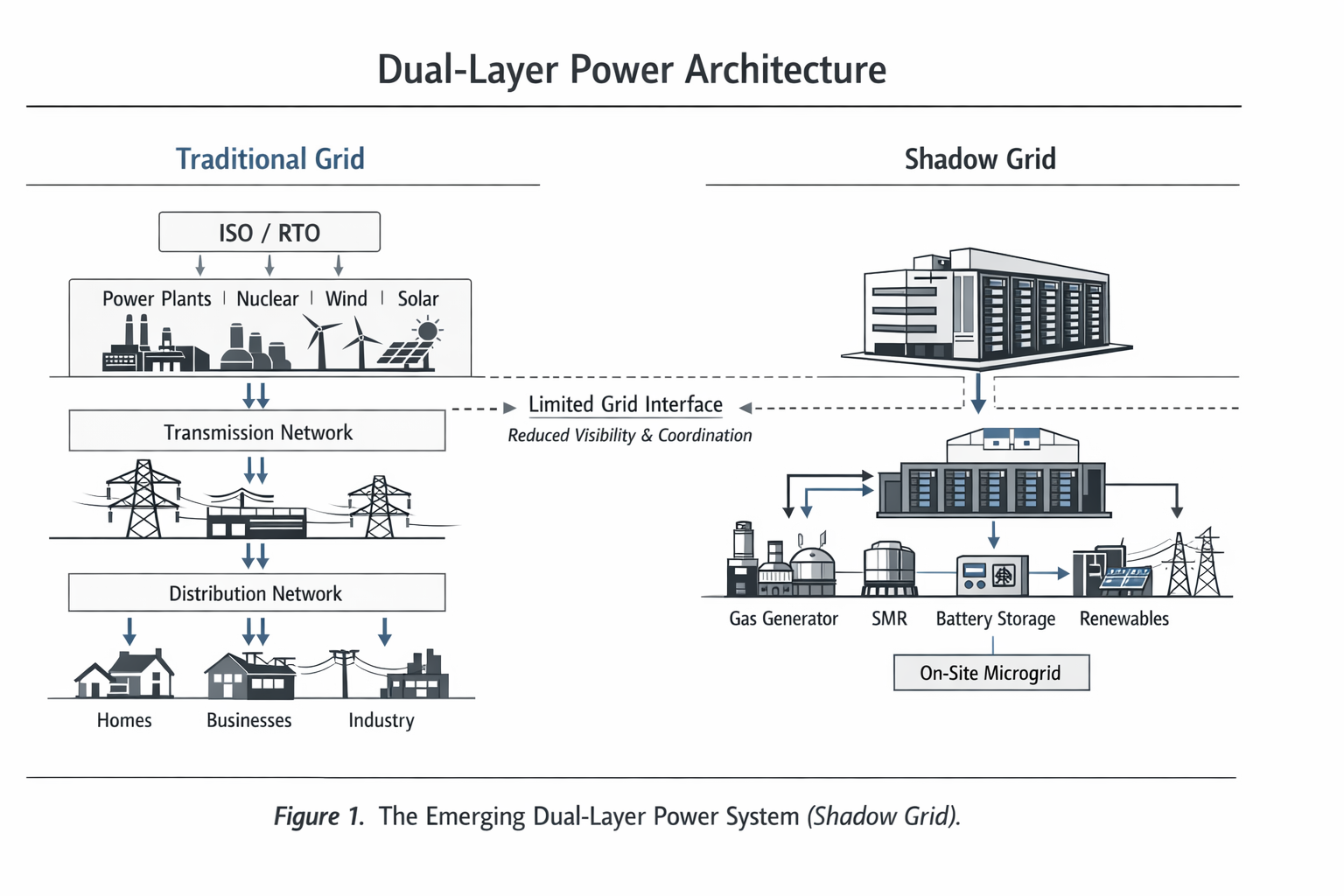
What emerges is a layered architecture: a privately controlled, rapidly expanding energy network operating alongside the traditional grid, but not fully governed by it. Visibility declines. Coordination weakens. The system becomes harder to manage precisely as it becomes more critical.
3. Ratepayer Protection Without System Mechanics
The commitment to shield residential ratepayers from rising costs reflects a political reality. But the framework does not resolve the underlying system dynamics required to achieve it. As large, high-value loads migrate toward private supply, the shared cost base erodes. Transmission, distribution, and legacy generation costs remain. They do not vanish when demand leaves.
Over time, the gap must close. Through rates, through reliability, or through policy intervention. The promise holds at the level of rhetoric. The system behaves according to physics and economics.
4. Sovereignty Shifts from Public Systems to Private Infrastructure
Energy infrastructure has historically existed within a framework of public oversight, even when privately owned. The expansion of AI-linked, privately controlled generation introduces a different model. Strategic assets begin to operate with reduced regulatory visibility, guided by internal optimization rather than system-wide objectives.
This is not simply deregulation. It is a redistribution of control over critical infrastructure. Decisions that shape energy supply, system stability, and regional development migrate toward actors whose incentives are not aligned with public coordination.
5. Environmental Exposure Without Integrated Accounting
The framework emphasizes speed and scale, but does not integrate environmental accounting into its infrastructure model. Behind-the-meter generation can expand rapidly, particularly where it offers cost or reliability advantages. Yet these systems may not be fully captured within existing planning or reporting frameworks.
The result is a widening gap between policy intent and system reality. Emissions, water use, and land impacts accumulate in ways that are difficult to measure and even harder to govern after the fact.
6. A New Class of Load Without a Model to Understand It
Artificial intelligence introduces a demand profile that does not resemble anything the grid has managed before. It is concentrated, dynamic, and driven by computational cycles rather than human behavior. Training runs, inference bursts, and rapid scaling events create patterns that are invisible to traditional planning models.
Yet the framework treats demand as a question of volume, not behavior. Capacity can be added. Behavior must be understood. Without that understanding, the system operates with a blind spot at its center.
7. Reliability as an Emergent Property, Not a Managed Outcome
Grid reliability depends on coordination. Generation, transmission, and load must operate in balance, continuously and precisely. As more infrastructure moves outside coordinated frameworks, optimizing locally rather than systemically, that balance becomes harder to maintain.
Reliability does not disappear. It becomes unpredictable. It emerges from the interaction of independently optimized systems rather than from centralized planning. That shift introduces a form of risk that is difficult to model and even harder to control.
8. Centralized Authority Without Operational Reach
The framework moves to preempt state-level regulation, consolidating authority at the federal level. This resolves one form of fragmentation. It creates another.
Authority is centralized. Capability is not.
No single institution is equipped to manage the real-time, cross-sector dynamics of AI embedded in infrastructure. Energy regulators oversee markets. Standards bodies define specifications. Security agencies monitor threats. None operate at the level of the integrated system now emerging.
The result is a gap between jurisdiction and execution. The system becomes national in scope, but remains fragmented in operation.
9. Markets Designed for a Different Era
Electricity markets were built on assumptions that are no longer fully valid: predictable demand, centralized generation, and clear price signals. AI disrupts each of these.
Demand becomes flexible, strategic, and in some cases self-supplied. Price signals lose influence when large actors can operate outside them. Investment decisions become harder to align with system needs.
Markets do not fail immediately. They drift. And in that drift, inefficiencies accumulate, resilience declines, and the system becomes more difficult to stabilize.
10. National Security Framed at the Wrong Layer
The framework acknowledges risks associated with advanced AI models—misuse, strategic competition, and technological leadership. These are real concerns. But they are incomplete.
The more immediate vulnerability lies in the infrastructure that supports those models. Concentrated clusters of compute and energy represent high-value targets. Their disruption carries consequences that extend beyond any single application.
Security, in this context, is not just about controlling information. It is about ensuring the continuity of systems that have become essential to economic and national function.
The Deeper Pattern
Taken together, these risks point to a single underlying condition. The framework treats artificial intelligence as something to be accelerated within existing system logic. In reality, AI is altering that logic.
It is changing how electricity is consumed, how infrastructure is financed, how decisions are made within systems, and how control is distributed across institutions. It is not simply another sector to be enabled. It is a force that reorganizes the system itself. And systems do not reorganize without consequence.
What Comes Next
None of these risks are inevitable. They are the product of sequencing—of building before governing, of scaling before coordinating. The solution is not to slow development or constrain innovation. It is to match the pace of infrastructure expansion with a corresponding evolution in governance.
That governance cannot exist solely at the level of policy or regulation. It must operate within the system itself—capable of observing, constraining, and coordinating behavior in real time. It must integrate energy, computation, and decision-making into a coherent framework.
What is emerging is not simply a larger grid, nor a more digital economy. It is a new form of infrastructure—one in which electricity and intelligence are no longer separate domains, but components of a single, interdependent system. The frameworks that governed the industrial energy era were designed for physical flows and human-driven demand. They are not sufficient for systems in which computation drives load, algorithms shape behavior, and infrastructure responds dynamically to machine-generated signals.
A new layer is required—one that sits above markets and below policy, translating intent into operational constraint. A governance architecture designed not just to regulate outcomes, but to shape system behavior itself.
This is the work ahead. In the twentieth century, energy defined the boundaries of economic power. Oil fields, pipelines, and geopolitics determined the structure of the global system. In the twenty-first, that foundation is shifting. Energy is no longer only a fuel. It is the substrate of intelligence. And intelligence, in turn, is beginning to reorganize how energy is produced, consumed, and controlled.
The White House framework marks the moment the United States chose to accelerate into that future. But acceleration alone is not strategy.
The systems we are building will determine not just economic outcomes, but the distribution of control, the resilience of infrastructure, and the integrity of the social contract that underpins it.
The question is no longer whether artificial intelligence will reshape the energy system. It already is. The question is who will define the architecture of that system—and whether it will be governed by design, or left to emerge by consequence. Because the risk is not that artificial intelligence fails.
The risk is that it succeeds—faster than the systems designed to guide it.
Brandon N. Owens is the founder of AIxEnergy, a research platform focused on artificial intelligence and energy systems. He has worked across energy markets, infrastructure and policy, including roles at NREL, GE Energy, S&P Global and NYSERDA.