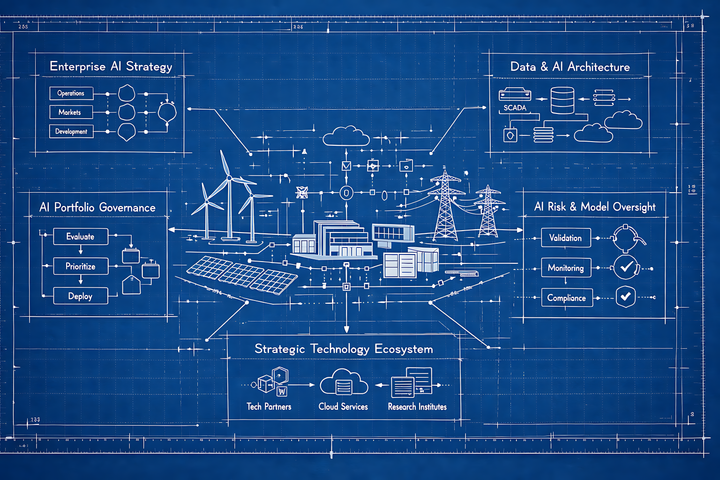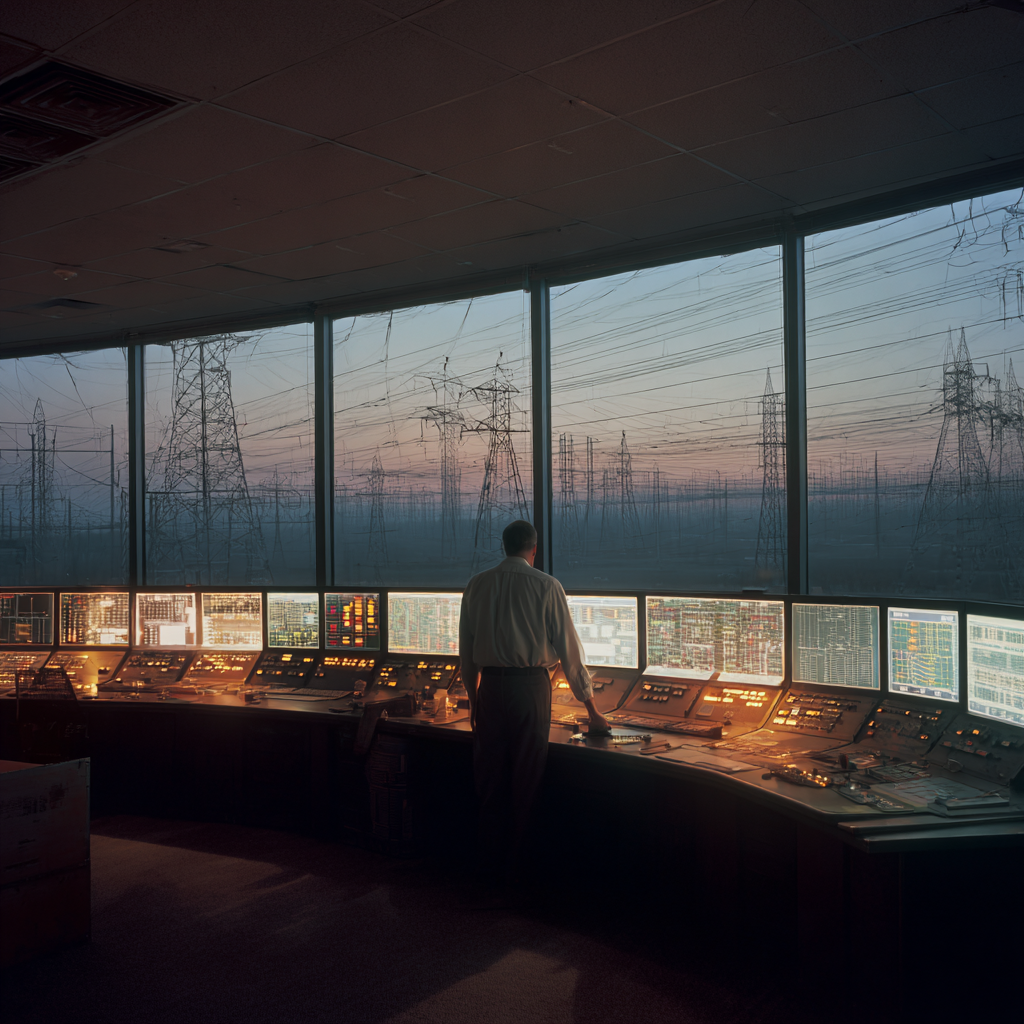
U.S. utilities are adopting AI cautiously—piloting tools for forecasting, reliability, and large-load management while avoiding autonomous control. The constraint isn’t technology, but governance, data, regulation, and risk tolerance.
Artificial intelligence has entered the U.S. utility sector not as a single, decisive technological break, but as a layered response to accumulating operational stress. Electric and gas utilities are navigating simultaneous pressures: electrification of transport and buildings, climate‑driven reliability risks, aging transmission and distribution assets, workforce attrition, and the sudden emergence of AI‑driven data centers as a new class of large, volatile load. In this environment, AI is being explored less as a visionary upgrade and more as a coping mechanism—an attempt to manage complexity that exceeds the limits of traditional planning, forecasting, and operations tools.
Public narratives often frame AI as inevitable or transformative. Inside utilities, the reality is more restrained. Adoption is uneven, highly cautious, and shaped by institutional constraints rather than technical imagination. Most utilities are experimenting with narrow, well‑bounded applications. Fully autonomous systems remain rare. Human oversight, regulatory visibility, and conservative deployment dominate the current landscape. This article establishes a clear baseline of AI adoption as it exists today, documenting what utilities are actually doing, where AI has gained traction, and why progress remains incremental.
Adoption Patterns and Sectoral Distribution
Recent surveys and industry reporting show rising interest in AI across the utility sector, but interest does not equate to institutional readiness. Large investor‑owned utilities and major public power systems lead adoption. They benefit from scale, capital access, internal analytics teams, and regulatory flexibility. Smaller municipal utilities and cooperatives lag behind, constrained by limited budgets, thinner staffing, and lower tolerance for operational risk.
Most AI activity remains in pilot or proof‑of‑concept form. Utilities report dozens of experiments, but relatively few systems embedded into core operations. Where production deployments exist, they are typically confined to advisory or planning functions. Closed‑loop control—where algorithms directly dispatch assets or make real‑time operational decisions without human intervention—remains the exception rather than the rule.
This uneven distribution reflects structural realities. AI adoption requires more than software. It depends on data quality, system integration, cybersecurity posture, workforce skills, and regulatory acceptance. Utilities that already struggle with legacy IT environments or fragmented data architectures face steep barriers before AI can add value.
Core Use Cases Gaining Traction
Despite these constraints, several AI use cases have moved beyond conceptual discussion into limited operational use.
Forecasting and Planning
Load, weather, and market forecasting represent the most common entry point for AI. Machine learning models are used to refine short‑term demand forecasts, update renewable generation expectations, and improve congestion or price prediction. These applications align well with existing utility workflows. They augment planning processes rather than replace them, making them easier to justify to regulators and internal risk committees.
Utilities report improved forecast accuracy and faster scenario analysis, particularly as weather volatility and distributed energy resources complicate traditional statistical methods. Even so, these tools generally inform human decision‑making rather than automate it.
Outage Prediction and Reliability Support
AI‑driven outage prediction has become a prominent area of experimentation. Utilities are combining weather data, vegetation records, asset condition data, and historical outage information to anticipate failure risks. These systems flag high‑risk circuits or geographic areas, allowing utilities to pre‑stage crews or prioritize maintenance.
Early results suggest meaningful reductions in outage duration and avoided customer interruptions, particularly during storms. However, deployment remains cautious. Predictions inform preparation; they do not override operational judgment.
Wildfire Mitigation and Vegetation Management
Wildfire risk has accelerated AI adoption in western states. Utilities are using computer vision, LiDAR, and machine learning to identify hazardous vegetation and assess ignition risk. Some systems integrate high‑resolution imagery with growth models to prioritize trimming before faults occur.
More advanced applications include AI‑enhanced protective relays that detect faults and de‑energize lines far faster than conventional equipment. These systems represent one of the few cases where AI directly affects real‑time grid behavior, but even here deployment is tightly controlled and limited to specific high‑risk corridors.
Asset Monitoring and Predictive Maintenance
Predictive maintenance has long been a promise of advanced analytics. AI has improved the ability to detect early signs of equipment failure across generation, transmission, and distribution assets. Utilities use sensor data, vibration analysis, thermal imagery, and historical maintenance records to predict failures before they escalate.
These tools support cost control and reliability, particularly for high‑value assets such as transformers, turbines, and substations. Adoption is strongest where sensors already exist and data streams are reliable. Where instrumentation is sparse, benefits remain theoretical.
Grid Optimization and Distributed Resource Coordination
Some utilities are piloting AI‑enabled distribution management systems that optimize voltage, reactive power, and distributed energy resource coordination. Virtual power plants, combining batteries, solar, and demand response, increasingly rely on algorithmic coordination to scale.
Yet these systems typically operate within predefined constraints. AI recommends actions or executes within narrow bounds approved in advance. Utilities remain reluctant to allow unconstrained algorithmic control over grid operations.
Data Center and Large Load Integration
The rapid growth of AI data centers has introduced a new and urgent application: managing large, dynamic loads that strain interconnection processes and local grid capacity. Utilities are using AI‑based modeling tools to identify flexibility options—on‑site generation, storage, or demand response—that allow faster connections without compromising reliability.
Industry consortia have emerged to coordinate utilities, grid operators, and technology companies around data center flexibility. These efforts signal a shift in how large loads are integrated, but they remain experimental and highly context‑specific.
Regulatory and Policy Environment
Regulatory institutions are beginning to grapple with AI indirectly, primarily through the lens of reliability, interconnection, and large load management. There is no comprehensive regulatory framework for AI in utility operations. Instead, oversight emerges piecemeal through existing authority.
Federal regulators have focused on transparency and fairness in interconnection processes as data center demand accelerates. State commissions are adjusting procedures to accommodate high‑energy users while studying long‑term rate and reliability impacts. In parallel, federal agencies have solicited input on how AI might support grid planning, resilience, and climate adaptation.
Importantly, regulators remain wary of autonomous systems. Cost recovery, accountability, and cybersecurity concerns shape their stance. Utilities must demonstrate not only technical merit but also governance discipline before AI systems are allowed to influence operations at scale.
Structural Constraints on Adoption
Utilities consistently cite several barriers slowing AI deployment.
Data and Integration Challenges
Utility data environments are fragmented. Legacy systems store information in incompatible formats, and operational data often lacks the consistency required for machine learning. Significant effort is spent cleaning, reconciling, and validating data before AI models can be deployed.
Integration poses another hurdle. AI outputs must connect to outage management systems, work order platforms, or planning tools. Without seamless integration, insights remain unused.
Cybersecurity and Risk Exposure
Centralizing data and analytics increases cyber risk. Utilities operate under strict security standards, and regulators expect conservative approaches. Cloud‑based AI platforms raise additional concerns about data sovereignty and system resilience.
Workforce and Organizational Capacity
AI expertise is scarce within utilities. While hiring and training efforts are underway, many organizations rely on vendors or consultants. This dependence limits internal learning and slows institutionalization.
Regulatory Incentives and Cost Recovery
Cost‑of‑service regulation rewards proven investments, not experimentation. Utilities struggle to justify pilots that lack clear pathways to recovery. Regulatory sandboxes exist, but approval processes remain slow relative to technology development cycles.
Partnerships and Emerging Ecosystems
The current phase of AI adoption is characterized by partnerships. Utilities collaborate with national laboratories, technology vendors, cloud providers, and research consortia. These arrangements lower risk and distribute expertise, but they also reinforce vendor dependence.
Major equipment manufacturers now bundle AI capabilities with traditional hardware. Cloud providers position themselves as essential infrastructure partners. Startups offer niche solutions for specific use cases. Utilities act as integrators rather than primary developers.
Capital Investment and Workforce Trends
AI investment largely flows through enabling infrastructure: advanced meters, sensors, communications networks, and data platforms. Direct spending on AI software remains modest relative to overall grid modernization budgets.
Workforce development lags technology ambition. Utilities are building analytics teams, but cultural adaptation is slow. Many employees view AI as a support tool rather than a transformative force.
Conclusion
The current state of AI adoption across U.S. utilities is defined by cautious experimentation rather than transformation. AI has moved from speculation to practice, but its role remains bounded. Utilities deploy AI where it augments existing processes without challenging governance norms or reliability obligations.
This caution reflects rational risk management in a sector responsible for critical infrastructure. At the same time, external pressures—load growth, climate risk, workforce constraints—are intensifying. Traditional tools are straining under new demands. AI increasingly appears not as a luxury, but as a capacity multiplier.
Whether AI becomes foundational to grid operations will depend less on algorithmic breakthroughs than on institutional readiness. Governance frameworks, regulatory incentives, workforce capacity, and data infrastructure will determine the pace and shape of adoption. For now, AI in utilities is best understood as an emerging operational layer: promising, constrained, and still in the process of earning trust.
Bibliography
California Public Utilities Commission (CPUC). “CPUC Streamlines Electric Grid Connections for High-Energy Users Like Data Centers and EV Chargers.” CPUC News and Updates, July 25, 2025. https://www.cpuc.ca.gov/news-and-updates/all-news/cpuc-streamlines-electric-grid-connections-for-high-energy-users-like-data-centers-and-ev-chargers.
Electric Power Research Institute (EPRI). “AI Is Already Impacting the Energy Industry.” EPRI Journal, February 9, 2024. https://eprijournal.com/ai-is-already-impacting-the-energy-industry/.
Federal Energy Regulatory Commission (FERC). “FERC Directs Nation’s Largest Grid Operator to Create New Rules to Embrace Innovation and Protect Consumers.” December 19, 2025. https://www.ferc.gov/news-events/news/ferc-directs-nations-largest-grid-operator-create-new-rules-embrace-innovation-and.
Juchno, Michael, and Zaki Arifulla. “Outsmarting Outages: AI Predicts Disruptions Before They Happen.” Utility Dive, March 27, 2025. https://www.utilitydive.com/news/outsmarting-outages-ai-predicts-disruptions-before-they-happen/743367/.
Lazo, Alejandro. “California AI Data Center Rules Blocked by Big Tech.” CalMatters, December 29, 2025. https://calmatters.org/environment/2025/12/data-center-energy-study-california/.
Martucci, Brian. “Portland General Electric Invests in AI-Powered Flexibility to Speed Data Center Connection.” Utility Dive, October 20, 2025. https://www.utilitydive.com/news/gridcare-portland-general-pge-data-centers/803097/.
Martucci, Brian. “Utilities See AI as Tool for Grid Modernization but Lack Expertise, Survey Finds.” Utility Dive, October 28, 2025. https://www.utilitydive.com/news/utilities-see-ai-as-tool-for-grid-modernization-but-lack-expertise-survey/803980/.
Milner, Katy, et al. “U.S. Department of Energy Seeks Comment on Using AI to Improve Electric Grid and Mitigate Climate Risks.” Hogan Lovells, March 11, 2024. https://www.hoganlovells.com/en/publications/us-dept-of-energy-seeks-comment-on-using-ai-to-improve-electric-grid-and-mitigate-climate-risks.
North American Electric Reliability Corporation (NERC). Characteristics and Risks of Emerging Large Loads. White paper. Atlanta: NERC, July 2025. https://www.nerc.com/globalassets/who-we-are/standing-committees/rstc/whitepaper-characteristics-and-risks-of-emerging-large-loads.pdf.
S&P Global Market Intelligence. “DistribuTECH 2025: More Intelligent Energy Grid Looms as Utilities Adopt AI.” March 5, 2025. https://www.spglobal.com/market-intelligence/en/news-insights/research/distributech-2025-more-intelligent-energy-grid-looms-as-utilities-adopt-ai.
Trabish, Herman K. “Avista, PG&E, Ameren AI Demonstrations Show Great Potential—but Are Other Utilities Ready?” Utility Dive, March 7, 2025.
Trabish, Herman K. “Utilities, Regulators Look to Accelerate Pilots to Achieve Speed-to-Innovation.” Utility Dive, December 1, 2025. https://www.utilitydive.com/news/regulatory-sandbox-dcflex-vpp-pura-pilot-project/806454/.
U.S. Department of Energy (DOE), Office of Cybersecurity, Energy Security, and Emergency Response (CESER). “Fortifying America’s Electric Grid Against Wildfires With AI.” August 26, 2025. https://www.energy.gov/ceser/articles/fortifying-americas-electric-grid-against-wildfires-ai.
Vasudevan, Hari. “Wildfires and Outages: How AI Can Fix Utility Vegetation Management.” POWER Magazine, September 14, 2025. https://www.powermag.com/wildfires-and-outages-how-ai-can-fix-utility-vegetation-management/.
Walton, Robert. “EPRI Launches Data Center Flexibility Initiative With Utilities, Google, Meta, NVIDIA.” Utility Dive, May 21, 2024. https://www.utilitydive.com/news/epri-launches-data-center-flexibility-initiative-with-NVIDIA-google-meta/731490/.