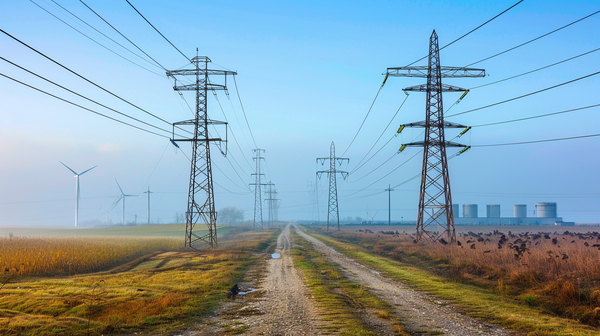
The Shadow Grid: AI’s Hidden Energy Network and the Crisis of Infrastructure Visibility

The Shadow Grid: AI’s Hidden Energy Network and the Crisis of Infrastructure Visibility

AI data centers are driving a surge in electricity demand and spawning a “shadow grid” of private power plants. Built outside traditional planning, this hidden infrastructure erodes visibility over the energy system and creates new challenges for governance and reliability.

Share this post

For twenty years, U.S. electricity demand was flat – a mature, modest-growth system. Today that serenity is shattered. A surge in data center construction for artificial intelligence (AI) is sending demand up to new heights. The Energy Information Administration reports U.S. consumption reached a record 4,195 TWh in 2025 and is forecast to climb to 4,268 TWh in 2026 and 4,372 TWh in 2027 (Reuters 2026). Much of this jump is driven by AI. Researchers at Lawrence Berkeley Lab estimate data centers used ~176 TWh in 2023 (about 4.4 percent of U.S. power) and could consume 6.7–12 percent of U.S. electricity by 2028 (Mural et al. 2026). Analysts from the Electric Power Research Institute (EPRI) find data centers already use roughly 4.5 percent of U.S. power and could consume 9–17 percent by 2030 (Marshall 2026). In absolute terms, U.S. centers today use on the order of 200 TWh, but projections suggest 400–600 TWh by 2030 – roughly triple today’s usage and nearly 10 percent of U.S. electricity (Battery Council International 2025). (One industry group colorfully describes data center demand as “about to triple” to 8–12 percent of total load by 2030.)

audio-thumbnail
Article Summary
0:00
/84.280159

These loads are enormous and grew faster than planned expansion. For years transmission investments were modest, but today grid operators warn of multi-gigawatt shortfalls. PJM ( warns that data centers could force supply shortfalls of up to 60 GW by the end of the decade. ERCOT (Texas) reports 226 GW of large new loads – mostly data centers – seeking interconnection (roughly three times today’s U.S. data-center capacity). Capacity market prices in PJM have spiked by 10x, and day-ahead prices have risen ~7 percent in the last year. Clearly, AI-driven demand is back in a big way – and faster than institutional planning can keep up (Bousso 2026).

The Rise of the Shadow Grid

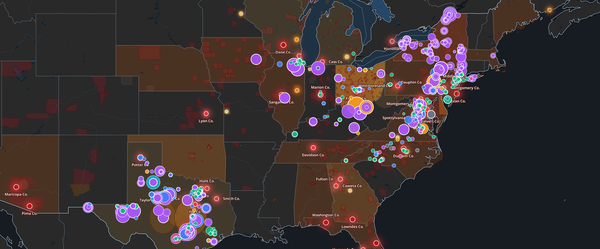
In response to the rush of AI loads, many companies are bypassing the traditional grid entirely. Unable to wait years for a new 500 kV substation, hyperscalers are building their own power plants and “microgrids” on-site. Clean energy firm Cleanview has identified dozens of planned data centers that include on-site generation. In fact, 46 U.S. data centers (nearly one-third of all planned capacity) are reported to be developing their own behind-the-meter power plants, primarily natural-gas turbines (Bousso 2026). A February 2026 news report calls this emerging infrastructure a “shadow network” of private power plants (The Experiment 2026). In Texas, for example, Oracle and OpenAI’s new “Stargate” campus will be powered by a 700 MW natural-gas microgrid (Thomas 2025). The original Stargate site in Abilene already partly relies on its own fleet of gas generators. Similarly, Elon Musk’s xAI is reportedly deploying dozens of truck-sized gas turbines at its “Colossus” AI centers in Memphis – at one point 35 generators ran Colossus 1 (Kerr 2026) – and even plans a dedicated gas plant in Mississippi. Indeed, one analysis found at least 47 data centers nationwide either building or planning their own power systems (The Experiment 2026).

Why are companies going off-grid? The answer is simple: time and certainty. Interconnection queues and transmission upgrades often take 7–12 years; tech giants racing to train superpowerful AI models cannot wait that long. A Business Insider report explains that Oracle and OpenAI will rely on an on-site gas plant so they can come online “as early as 2026” (Thomas 2025). In practice this means linking hundreds of gas generators or even developing multi-gigawatt plants sited in gas-rich areas. Texas alone now has dozens of planned gas-fired plants (e.g. a 7.65 GW “GW Ranch” in the Permian) explicitly intended to fuel AI centers (Baddour 2026). As one Cleanview executive warns, this build-out of mini power plants is so rapid that the environmental outlook is “catastrophic” (The Experiment 2026).

These self-supply systems come in various forms. Some are simple microgrids: data centers co-locate diesel or gas turbine generators plus solar or batteries to make a private power station. Others are huge merchant plants co-owned or contracted by cloud providers (e.g. Pacifico’s 7.65 GW data-center plant (Baddour 2026), Chevron’s 5 GW Texas plant, or Fermi America’s 6 GW gas plan for Amarillo). All share one feature: they operate behind the meter, outside the usual utility planning process. A recent court ruling even put these turbines in the news: regulators found xAI’s dozens of portable gas turbines were no mere backup generators but de facto power plants, subject to air-permit rules (Kerr 2026).

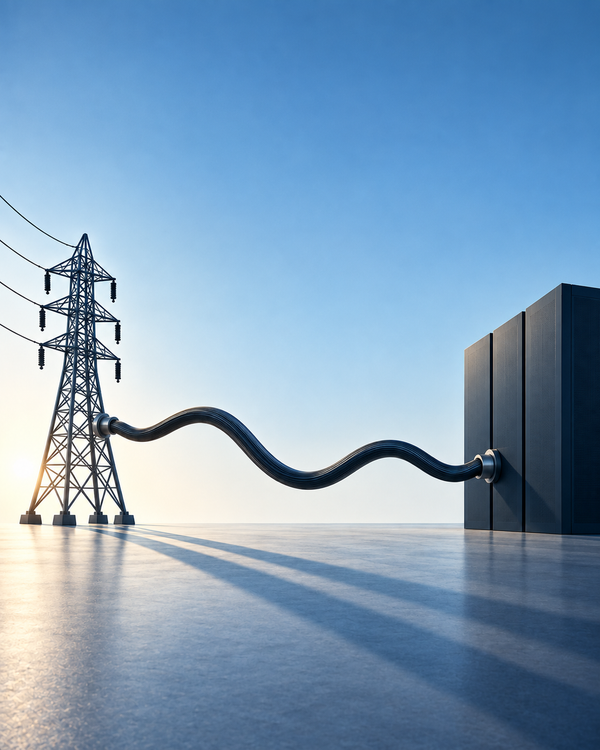
In short, a shadow grid is forming: a parallel system of generators, transformers, and microgrids financed by AI firms rather than utilities. This growth is not driven by altruism; it’s about securing reliable, low-cost power fast. As Cleanview’s Michael Thomas puts it, tech companies “have no choice” but to power themselves given the grid’s delays. Even President Trump quipped that AI data centers can “build their own power plants…so that no one’s prices will go up” (Bousso 2026). In effect, the AI boom is creating a de facto new electricity network, one only faintly visible to existing regulators and planners.

Why This Matters Beyond Energy Markets

At first glance, one might see the shadow grid as just another market dynamic – big consumers co-invest in supply. But the implications run deeper. For a century, our power system was a single coordinated network: utilities forecast demand, plan generation, and regulators ensured reliability. Big loads went through the lights: every new plant had to file for interconnection, resource plans included major industrial users, grid operators simulated their impact. This made the system legible – transparent – to planners and policymakers.

The shadow grid breaks that paradigm. Now very large generators are being built outside the normal processes. In many cases, developers even obscure their plans: residents in Texas say companies avoided putting their names on project filings (The Experiment 2026). Because these private plants are behind customer meters, they don’t show up in utility planning studies or state capacity forecasts. As a result, there is a growing gap between what exists and what institutions think exists on the system.

This matters because governance depends on shared situational awareness. Grid regulators and operators rely on (for example) load forecasts, resource adequacy plans, interconnection queues and reliability studies. If those inputs omit or under-count the shadow-build, the plans will be wrong. One local utility CEO notes that private data-center power shifts all maintenance costs onto the public grid, since “money poured into private power projects… leaves local grids to shoulder higher maintenance and expansion bills” (The Experiment 2021). In other words, ratepayers end up footing the cost of new line upgrades for generators they never knew existed.

Moreover, hidden generation strains fundamental policy goals. If a corporate power plant never enters the public docket, its emissions and fuel use may go uncaptured in state clean-energy accounting. Grid operators could find themselves short on reserves or transmission capacity because they didn’t see the need coming. Public oversight suffers too: communities have already raised alarms (e.g. in Texas and Virginia) at “surprise” new gas plants in their backyards (Baddour). Yet if regulators don’t even have formal project applications to scrutinize, the traditional check-and-balance model breaks down.

In short, the shadow grid is not just an energy-market story. It signifies a structural shift: infrastructure is being deployed outside the visibility of the institutions designed to govern it. The state-of-play we inherited – a single power grid whose every part is mapped and regulated – is changing into something messier.

Legibility and Infrastructure

To understand the stakes, it helps to frame this in light of classic ideas about planning and technology. James C. Scott, in Seeing Like a State, showed how governments historically make complex realities “legible” by imposing simplified maps and metrics (Rao 2010). In Scott’s terms, early states had almost no idea of the resources in their realm without creating records and grids. This need for legibility drove standardization of agriculture, cities and even electrical networks. Today’s grid itself was once an engineered simplification – planners built interchanges and poles according to grand visions. But the shadow grid undoes that simplification. It makes the electricity system illegible again, in the very opposite sense of what Scott analyzed: we literally do not have the data or “map” of these new plants to see the whole.

Friedrich Hayek’s knowledge problem also resonates. Hayek argued that no central planner can ever know all the dispersed information in an economy. He claimed, “No single individual or institution… could ever possess all the information needed to make fully informed decisions for a whole society” (Butler 2024). In some ways, the shadow grid is a Hayekian outcome: companies are acting on their local knowledge of AI demand and power markets, rather than waiting for a planner to solve the puzzle. In Hayek’s language, they are tapping into dispersed knowledge at the expense of collective coordination. Of course, unlike ideal free markets, here the investment costs and externalities are socialized, so the Hayekian “solution” comes with a heavy side effect: reduced public control.

Thomas P. Hughes’s work on the history of electricity is also instructive. Hughes described power networks as socio-technical systems, shaped by both technology and social institutions (Little 2020). He noted that building out grids required massive coordination of engineers, financiers and regulators – “massive, extensive, vertically integrated” arrangements (Little 2020). In Hughes’s view, the power system’s form is the outcome of that political-economy. The rise of private data-center power decouples parts of this system: new generation is technically part of the grid, but institutionally it’s managed by corporations, not utilities. What Hughes would see is that the seamless coupling of technology and regulation is fraying. We are witnessing a partial undoing of the centralized network he described: a hybrid where large-scale plants exist but are effectively invisible to the network-of-power framework of a century ago.

Langdon Winner’s famous question, “Do artifacts have politics?”, reminds us that infrastructure embeds power. Winner argued that the design of a technology can privilege certain actors – think of Robert Moses’s low bridges that kept buses (and minority communities) out of Long Island parkways. Similarly, the architectural choice to put gas generators on-site effectively “hard-codes” a political choice: who controls the power supply. The shadow grid artifacts (portable gas turbines, behind-the-meter microgrids, hardened fiber links, etc.) are not neutral. They shift authority from public utilities to tech firms and their financiers. In Winner’s terms, these behind-the-meter plants embed a political structure – a privatized regime of generation – into the landscape.

Taken together, these thinkers suggest the paradox we face: we once required legibility (Scott) and central coordination (Hughes) to manage grids; Hayek would warn that we can’t fully centralize knowledge of such complex needs; and Winner reminds us that whatever infrastructure emerges will reshape who holds power. The shadow grid sits at the intersection of these ideas – it is a huge new technical system that our existing institutions did not build, and which carries with it new power relations.

The New Governance Problem

What all this points to is a new epistemic problem for infrastructure governance. The shared infrastructure of electricity once meant shared visibility: everyone (utility engineers, regulators, system operators) had a picture of the grid. Now that picture has blind spots. Regulators rely on certain information flows – the interconnection queue, integrated resource plans, emissions inventories – to see how capacity is evolving. If gigawatts of generation quietly appear outside those channels, regulators effectively lose situational awareness.

This fragmentation has concrete risks. Planning reliability becomes guesswork. For example, if ten 100 MW plants go up behind data centers without notice, a regional operator might be two thousand homes short on reserve margin without knowing why. Planners might build or retire the wrong resources and grid upgrades could be mislocated. In the worst case, it could even threaten stability if supply-additions and demand-additions aren’t tracked together. Texas has already seen local resistance: citizens in San Antonio and rural counties banded together when 500+ MW of gas generators were permitted for cryptomining and AI load (Baddour 2026). These fights show how accountability breaks down when projects aren’t subject to the usual public processes.

Carbon accounting and decarbonization goals suffer similarly. If a big user buys its own gas plant, is that consumption counted in the state’s inventory? Often not, especially if the electricity never crosses retail meters. One utility executive warns that costs of generation (and carbon!) are being externalized: “data centers will… saddle local utilities with indirect costs,” requiring ratepayers to pay for expansion they didn’t approve (The Experiment 2026) In effect, the shadow grid can game both markets and policy – enough energy can be supplied privately that public forecasts fall short, while emissions can hide under the radar.

Finally, democracy and oversight are at stake. Who gets to decide where infrastructure goes? When the grid was public, citizens had some avenue to shape it (through state regulators, public utility commissions, etc.). But a private microgrid is like a castle: built with corporate capital, it is not subject to the same permitting scrutiny or public comment. Locals in one Texas county lost a hearing on an ammonia-spewing gas plant for a blockchain farm after just 45 seconds of discussion (Baddour 2026).

AI and the Cognitive Layer of Infrastructure

As if new invisible wires weren’t enough, today’s grid is also acquiring a new thinking layer: artificial intelligence. The same AI that drives data centers is being woven into grid operation. In dozens of control rooms, AI models already help forecast demand, detect faults, and suggest dispatch decisions. The modern system is cognitive infrastructure that anticipates, learns and optimizes itself.

These AI systems become the new lenses through which the grid is “seen.” Operators do not perceive reality directly; they see dashboards and alerts shaped by algorithms. For instance, an AI might highlight a transmission line overload while downplaying a local microgrid deficiency, simply because that was how it was trained. In effect, the grid now has an algorithmic interpreter. This adds a layer to the visibility problem: even for existing, visible plants and loads, the question arises whose model is interpreting the data, and what values are embedded in it. If an AI is tuned only for efficiency, as one utility observer warns, it might restore power to factories before hospitals in an outage – not out of malice, but because its objective function rewards industrial output.

The emerging governance task is therefore double: not only must regulators see what plants and lines exist, they must also understand the algorithms that manage them. In our narrative terms, the shadow grid is already on the ground; now cognitive grid-management is in the cloud. When generators or demand are controlled by unseen code, society needs ways to audit and influence that code. As one recent analysis urges, grid-facing AI “should not be black boxes” – we need model certification, explainability protocols, and clear rules of the road (Owens 2025). In short, who governs the grid’s brains becomes as important as who governs its pipes.

Conclusion

The shadow grid — the web of private power plants and algorithms now emerging — is the first large-scale example of a new kind of infrastructure challenge. We are seeing infrastructure evolve faster than the institutions meant to track and regulate it. In the 20th century, debates focused on how much power to build and where to site transmission. In the 21st century, the harder question may be: how do we maintain shared visibility into critical infrastructure when so much of it is private and automated?

In practice, addressing this will require rethinking governance models. Possibilities include enhanced reporting requirements for behind-the-meter generation, expanded roles for regional planning councils, or new market and permitting rules that treat large data center sites more like independent utilities. At the same time, it will mean designing oversight of the grid’s digital layer: mandates for AI transparency, ethics checks on dispatch algorithms, and public participation in grid-modernization decisions.

If we fail to do so, we risk living under multiple, uncoordinated grids. That outcome may leave consumers unaware of the true system they depend on, undercounted in policy decisions, and possibly exposed to higher costs and reliability risks.

References

Baddour, Dylan. “Huge Texas Data Centers Will Get Their Own Gas Power Plants.” The Texas Tribune, February 2, 2026. https://www.texastribune.org/2026/02/02/texas-permian-basin-power-plant-project-data-centers/.

Battery Council International. “The Batteries Behind AI and U.S. Data Centers.” November 7, 2025. https://batterycouncil.org/news/the-batteries-behind-ai-and-u-s-data-centers/.

Bousso, Ron. “U.S. AI Boom Faces Electric Shock.” Reuters, February 25, 2026. https://www.reuters.com/markets/commodities/us-ai-boom-faces-electric-shock-2026-02-25/.

Butler, Eamonn. “Hayek: 50 Years after the Nobel Prize.” Adam Smith Institute Blog, December 11, 2024. https://www.adamsmith.org/blog/hayek-50-years-nobel-prize.

Hayek, Friedrich A. The Constitution of Liberty. Chicago: University of Chicago Press, 1960.

Hayek, Friedrich A. “The Use of Knowledge in Society.” American Economic Review 35, no. 4 (1945): 519–30.

Hughes, Thomas P. Networks of Power: Electrification in Western Society, 1880–1930. Baltimore: Johns Hopkins University Press, 1983.

Kerr, Dara. “Elon Musk’s xAI Datacenter Generating Extra Electricity Illegally, Regulator Rules.” The Guardian, January 15, 2026. https://www.theguardian.com/technology/2026/jan/15/elon-musk-xai-datacenter-memphis.

Little, Daniel. “Thomas Hughes on Electric Power as a Sociotechnical System.” Understanding Society (blog), April 10, 2020. https://undsoc.org/2020/04/10/thomas-hughes-on-electric-power-as-a-sociotechnical-system/.

Marshall, Christa. “Data Centers’ Share of U.S. Electricity Seen Doubling by 2030.” E&E News by POLITICO, February 26, 2026. https://www.eenews.net/articles/data-centers-share-of-us-electricity-seen-doubling-by-2030/.

Mural, Rachel, Dipesh Pherwani, Chaitanya Gupta, Yiqi Yu, Ai Takahashi, Dongjoo Kim, Subir Majumder, Henry Lee, Minlan Yu, and Le Xie. “AI, Data Centers, and the U.S. Electric Grid: A Watershed Moment.” Belfer Center for Science and International Affairs, February 10, 2026. https://www.belfercenter.org/research-analysis/ai-data-centers-us-electric-grid.

Owens, Brandon N. “AI Is Coming for Grid-Decision Making. Here’s Why Governance Can’t Be an Afterthought.” Utility Dive, June 18, 2025. https://www.utilitydive.com/news/ai-power-grid-governance/750725/.

Rao, Venkatesh. “A Big Little Idea Called Legibility.” Ribbonfarm, July 26, 2010. https://www.ribbonfarm.com/2010/07/26/a-big-little-idea-called-legibility/.

Reuters. “U.S. Power Use to Beat Record Highs in 2026 and 2027, EIA Says.” February 10, 2026. https://www.reuters.com/business/energy/us-power-use-beat-record-highs-2026-2027-eia-says-2026-02-10/.

Scott, James C. Seeing Like a State: How Certain Schemes to Improve the Human Condition Have Failed. New Haven, CT: Yale University Press, 1998.

The Experiment. “AI Data-Center Owners Are Building a Shadow Network of Private Gas Power Plants in the U.S.” February 25, 2026. https://md-eksperiment.org/en/post/20260225-ai-data-center-owners-are-building-a-shadow-network-of-private-gas-power-plants-in-the-us.

Thomas, Ellen. “Oracle and OpenAI’s Second Stargate Data Center in Texas Will Be Powered Off the Grid.” Business Insider, October 23, 2025. https://www.businessinsider.com/openai-building-natural-gas-microgrid-at-new-texas-data-center-2025-10.

Winner, Langdon. “Do Artifacts Have Politics?” Daedalus 109, no. 1 (1980): 121–36.


Share this post

Be the first to know

Join our community and get notified about upcoming stories

Subscribing...
You've been subscribed!
Something went wrong