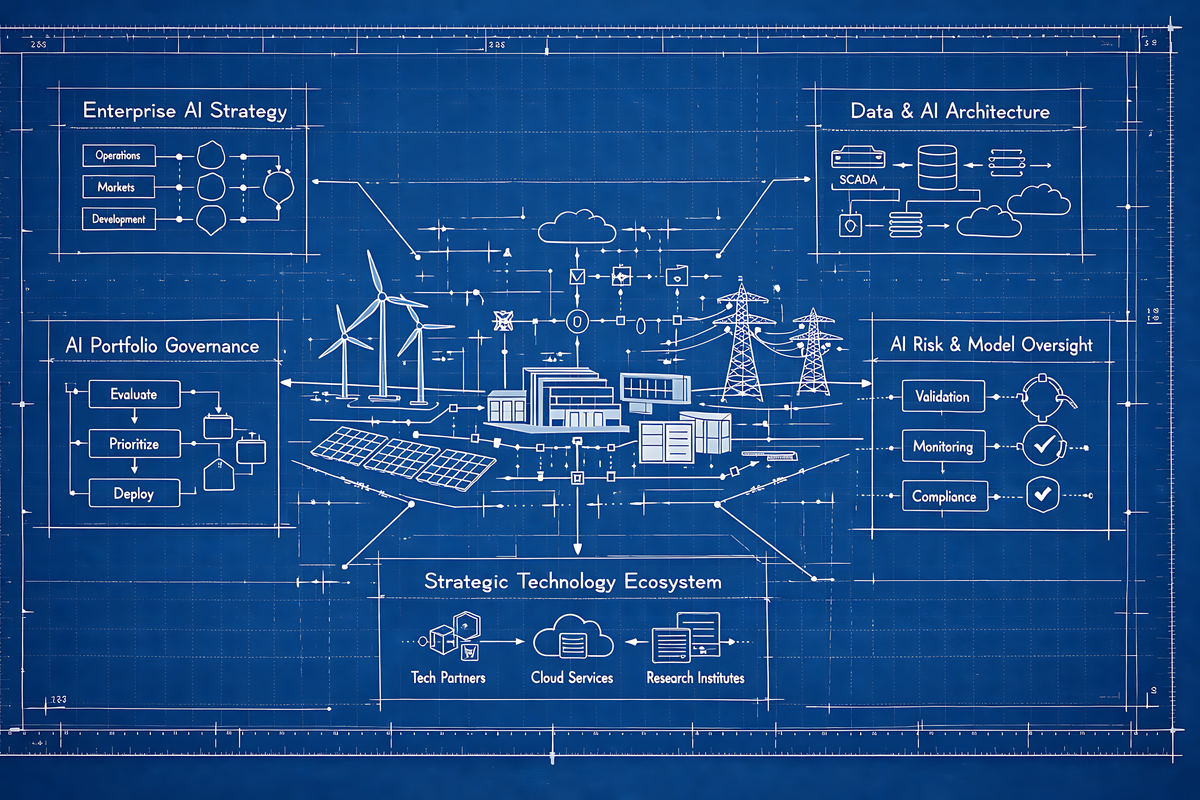
AI is reshaping energy companies by embedding prediction into infrastructure operations. A five-part blueprint guides transformation: identify where AI creates value, build unified data architecture, manage AI as a portfolio, govern model risk, and develop strategic technology ecosystems.
On a recent winter morning, a senior leadership team at a large energy company gathered around a wall of screens displaying operational data from across its asset portfolio. Wind speeds across multiple states, turbine vibration signatures, battery dispatch patterns, electricity price forecasts, and development pipeline metrics were all streaming into a single analytical interface. Somewhere inside the system, a machine‑learning model had just produced an updated forecast of next day power prices, while another model detected a subtle anomaly in turbine vibration data that could indicate an emerging gearbox failure.
The organization had invested heavily in artificial intelligence. There were forecasting models, predictive maintenance tools, and internal generative AI pilots. Data scientists were embedded in several departments. Cloud infrastructure had been modernized. Yet as the discussion progressed, an uncomfortable realization began to surface.
Despite all of these tools, the company did not yet have a clear answer to a simple question: What exactly was the enterprise AI strategy?
This moment is becoming familiar across the energy industry. Artificial intelligence has entered the sector with remarkable speed. Machine‑learning models now forecast renewable generation, analyze satellite imagery for project development, detect turbine anomalies, and help traders anticipate electricity price volatility. Technology firms promise that AI will reshape grid operations, accelerate the energy transition, and unlock new operational efficiencies.
Yet inside many companies, the reality looks different. AI pilots proliferate while enterprise transformation remains incomplete. The difference between these two states is profound. AI adoption introduces analytical tools into existing workflows. AI transformation reorganizes the enterprise itself. It changes how infrastructure systems are managed, how capital is allocated, and how decisions are made across operations, trading, development, and corporate strategy.
For companies that operate multi‑gigawatt generation fleets, manage complex electricity trading operations, and deploy billions of dollars of capital into infrastructure development, that distinction matters enormously. Artificial intelligence introduces something that the energy sector has never possessed at industrial scale: machine prediction embedded directly into the operational architecture of the enterprise.
Once prediction becomes a strategic capability, executives must answer a series of structural questions about how the organization itself should evolve. Across the industry, these questions increasingly fall into five categories that mirror the responsibilities of an enterprise AI transformation function. Together they form a blueprint for how energy companies can move from experimentation to true enterprise transformation.
1. Establishing the Enterprise AI Strategy
Every AI transformation begins with a strategic question that appears deceptively simple: where should artificial intelligence be applied inside the business?
The temptation in many organizations is to allow AI experimentation to emerge organically. Engineering teams experiment with predictive maintenance models. Traders explore machine‑learning price forecasts. Corporate innovation teams test generative AI tools. Each initiative produces useful insights. But without strategic alignment, these efforts rarely produce enterprise impact.
Electric power systems possess several characteristics that make them unusually sensitive to predictive capability. Electricity supply and demand must balance continuously in real time. Renewable generation introduces weather‑driven variability into supply. Electricity prices can change rapidly as system conditions shift. These dynamics mean that improved prediction directly influences economic performance.
The economics of a generation fleet can be simplified as:
R = P × Q
where P represents electricity price and Q represents generation output.
In renewable systems both variables contain uncertainty. Wind speeds fluctuate across landscapes. Solar output depends on cloud formation and atmospheric conditions. Electricity prices respond to fuel costs, grid congestion, and shifts in demand. Artificial intelligence improves forecasting of both variables simultaneously.
Machine‑learning models trained on meteorological and operational datasets can significantly improve predictions of renewable generation and electricity prices. Improved forecasts allow operators to schedule maintenance more effectively, optimize dispatch decisions, and improve hedging strategies in electricity markets.
At fleet scale, even modest improvements compound rapidly. A one‑percent improvement in renewable asset performance across a multi‑gigawatt portfolio can translate into millions of dollars in additional annual revenue. The strategic implication is clear: AI must be deployed where improved prediction alters the economic performance of infrastructure systems.
For most energy companies, these domains cluster around a small number of high‑impact functions: renewable fleet optimization, electricity market forecasting, predictive maintenance, project development analytics, and grid operations modeling. Defining the enterprise AI strategy therefore means identifying where predictive intelligence creates structural economic leverage and aligning AI initiatives directly with the company’s long‑term competitive positioning.
2. Building the Enterprise Data and AI Architecture
Once the strategic priorities are clear, a second challenge emerges. Many energy companies discover that their existing data architecture cannot support machine‑learning systems at scale.
Operational data across the enterprise is typically fragmented. Supervisory control and data acquisition systems monitor turbines and solar arrays. Asset management software tracks maintenance activity. Weather models generate forecasts. Electricity market platforms record price signals. Financial systems manage hedging positions and contracts. Each of these systems evolved independently over decades.
Artificial intelligence requires these systems to function as a unified analytical environment. Machine‑learning models depend on datasets that cross operational boundaries. Renewable forecasting models must combine weather simulations with turbine performance signals and grid conditions. Predictive maintenance algorithms require years of equipment performance and failure data linked across asset lifetimes.
Wind turbines illustrate the opportunity. Modern turbines generate enormous volumes of operational data through sensors measuring vibration, temperature, rotational speed, and power output. Machine‑learning models trained on these datasets can identify subtle anomalies in turbine behavior that precede mechanical failure.
Predictive maintenance systems built on SCADA data have demonstrated the ability to detect anomalies weeks or even months before component failures occur, allowing operators to intervene before catastrophic downtime interrupts electricity production.
However, these systems depend entirely on integrated data infrastructure. If operational signals remain trapped across multiple databases, machine‑learning models cannot learn effectively.
The result is that the first stage of enterprise AI transformation is rarely algorithm development. It is the construction of the enterprise data architecture that allows machine intelligence to operate across the organization.
Temporal integration aligns signals across time scales ranging from seconds to hours. Spatial integration links local asset data with regional weather patterns and grid conditions. Lifecycle integration connects operational signals with maintenance and failure records. This architecture becomes the foundation upon which every subsequent AI initiative depends.
3. Managing the Enterprise AI Portfolio
Once organizations begin building this infrastructure, they encounter a third challenge: how should AI initiatives across the enterprise be prioritized and managed?
Without governance, companies accumulate scattered pilots. A predictive maintenance model operates in one region. A trading desk develops its own price forecasting algorithm. A corporate analytics team builds generative AI tools.
Each initiative produces insight, but few scale across the enterprise. Enterprise AI transformation therefore requires portfolio management. Artificial intelligence initiatives must be evaluated, prioritized, and funded through structured investment frameworks similar to those used for infrastructure projects.
Most organizations eventually organize their AI portfolios across three domains. Operational AI focuses on improving the performance of physical infrastructure through predictive maintenance, renewable forecasting, and grid analytics.
Market AI focuses on improving financial performance in electricity markets through price forecasting and trading optimization. Enterprise AI focuses on internal productivity and decision support through engineering design tools, document analysis systems, and knowledge platforms.
Each initiative progresses through defined stage gates before scaling across the enterprise. Early pilots demonstrate feasibility and economic impact. Successful models then expand into broader operational deployment. This disciplined portfolio management ensures that AI investments remain aligned with enterprise value creation rather than becoming isolated technology experiments.
4. Establishing AI Governance and Risk Management
As artificial intelligence becomes embedded in operational decisions, governance becomes critical. Electric power systems are critical infrastructure. Dispatch decisions affect grid stability. Maintenance schedules influence equipment reliability. Trading strategies shape financial exposure.
Machine‑learning models introduce probabilistic outputs into these decisions. Unlike traditional engineering models, they identify statistical relationships in data rather than deterministic physical laws.
Executives therefore face a governance challenge. Artificial intelligence must operate within frameworks that ensure transparency, accountability, and regulatory compliance.
These frameworks typically include model validation procedures, continuous performance monitoring, and retraining protocols as system conditions evolve. Model drift—when algorithm performance degrades as real‑world conditions diverge from training data—is particularly important in energy systems influenced by changing weather patterns and market conditions.
In practice, AI governance increasingly resembles financial risk management. Models become instruments whose assumptions, performance metrics, and operational limits must be documented and reviewed. Strong governance frameworks allow organizations to scale AI adoption confidently while maintaining operational discipline and regulatory alignment.
5. Building the External AI Ecosystem
No enterprise AI transformation occurs in isolation. Artificial intelligence innovation is advancing rapidly across cloud providers, technology firms, startups, and academic research institutions.
Successful companies therefore build strategic partnerships across this ecosystem. Cloud platforms provide scalable computing infrastructure and machine‑learning frameworks. Specialized technology firms develop forecasting models and optimization algorithms. Universities contribute research in energy systems modeling and artificial intelligence.
These collaborations accelerate innovation while allowing companies to maintain control over operational data and infrastructure systems. For enterprise leaders, managing this ecosystem becomes an essential strategic function.
Partnerships allow organizations to access new technologies while focusing internal resources on the operational domains where AI creates the greatest value.
The Emergence of Intelligent Energy Enterprises
Artificial intelligence represents the next stage in the evolution of infrastructure systems. The twentieth century built physical networks capable of generating and transmitting electricity across continents. The digital revolution introduced sensors and automated control systems that allowed operators to monitor those networks.
Artificial intelligence introduces something new: infrastructure systems capable of learning from operational data and adapting to complex environments. For energy companies, the challenge is not simply adopting machine‑learning tools. It is redesigning the enterprise so that predictive intelligence becomes a core capability embedded across operations, markets, and development.
Companies that answer the five strategic questions clearly—defining enterprise AI strategy, building data architecture, managing the AI portfolio, establishing governance frameworks, and cultivating strategic partnerships—will define the next generation of energy infrastructure. They will not simply operate infrastructure more efficiently.
They will operate infrastructure differently. And in an industry where capital investment is measured in billions of dollars and margins are often thin, that difference will determine who leads the next phase of the global energy system.
Strategic Insights for Energy Executives
The practical experience of early enterprise AI deployments across the energy sector reveals several deeper lessons that are not immediately obvious when organizations begin experimenting with machine learning. These insights have begun to emerge as companies move beyond isolated pilots and attempt to scale AI across entire portfolios of infrastructure assets.
Prediction is the first derivative of value.
Most executives initially view artificial intelligence as an automation technology. In practice, the dominant economic impact arises from prediction. Improvements in prediction change operational decisions, and operational decisions change financial outcomes. In electricity markets, where margins are often narrow and volatility can be extreme, even small improvements in forecast accuracy can compound rapidly across large asset fleets. The organizations that internalize this principle begin treating predictive capability as a strategic asset in the same way they treat generation capacity or transmission access.
Data architecture is more important than algorithms.
Energy companies frequently begin their AI journey by hiring data scientists or purchasing machine‑learning software. Yet the performance of AI systems is constrained far more by data architecture than by model sophistication. If operational data remains fragmented across asset management systems, SCADA platforms, weather feeds, and market data providers, machine‑learning models cannot capture the full structure of the system they are attempting to predict. In practice, successful AI transformations devote the majority of early investment to building integrated data environments rather than building models.
Operational trust determines adoption.
Even highly accurate models will fail to influence decision‑making if operational teams do not trust them. In infrastructure industries this trust develops slowly. Engineers and operators must understand how models behave, what assumptions they embed, and where their limits lie. Organizations that succeed in scaling AI therefore invest heavily in model transparency, validation, and operational integration. AI systems are introduced not as replacements for domain expertise but as analytical partners that augment it.
Portfolio discipline prevents AI fragmentation.
Without governance, AI initiatives proliferate across departments without coordination. Each team develops its own models and data pipelines. Over time this fragmentation creates technical debt and organizational confusion. Treating AI initiatives as a managed portfolio—subject to prioritization, stage gates, and measurable value realization—allows organizations to scale the most impactful applications while avoiding unnecessary duplication.
Strategic partnerships accelerate learning curves.
Artificial intelligence innovation is advancing far more rapidly than any single energy company can track internally. Strategic partnerships with cloud providers, research institutions, and specialized technology firms allow companies to access emerging capabilities without attempting to develop every component themselves. The most successful enterprises focus internal resources on the domains where their operational data and infrastructure expertise create unique advantage.
These insights are beginning to define a new model of energy company—one in which predictive intelligence becomes embedded throughout the enterprise architecture. Over time this shift will reshape how infrastructure systems are designed, operated, and financed.
For executives leading this transformation, the task is not simply to deploy artificial intelligence tools. It is to guide the organization through a structural transition in which data, prediction, and machine intelligence become foundational components of infrastructure management.
The companies that recognize this transition early will not merely improve operational efficiency. They will redefine the competitive architecture of the energy industry.
Foundational Books for the AI Energy Executive
Owens, Brandon N. The Cognitive Grid: Artificial Intelligence and the Governance of Delegated Power in Critical Infrastructure. New York: AIxEnergy Press, 2025.
https://www.aixenergy.io/books/
Roy, Debashish. AI for Utilities: Reimagining the Future Energy System. New York: Apress, 2024.
https://books.google.com/books/about/AI_for_Utilities.html?id=6Xc2EQAAQBAJ
Sayed-Mouchaweh, Moamar, ed. Artificial Intelligence Techniques for a Scalable Energy Transition. Cham: Springer, 2020.
https://link.springer.com/book/10.1007/978-3-030-42726-9
Vijayalakshmi, S., Savita, and Balamurugan Balusamy, eds. AI-Powered IoT in the Energy Industry: Digital Technology and Sustainable Energy Systems. Cham: Springer, 2023.
https://rainydaybooks.com/book/9783031150432
Temizel, Tugrul T., et al. Artificial Intelligence in the Energy Industry: Theory, Case Studies, and Applications. London: Routledge, 2024.
https://www.routledge.com/Artificial-Intelligence-in-the-Energy-Industry-Theory-Case-Studies-and-Applications/Temizel-Tutun-Canbaz-Alagoz-Dundar-Sari-Saputelli-Oskay/p/book/9781041020073
Christian, Brian. The Alignment Problem: Machine Learning and Human Values. New York: W. W. Norton & Company, 2020.
https://brianchristian.org/the-alignment-problem/