This week in Washington, a quiet but consequential moment occurred in the evolution of the artificial intelligence economy. Executives from Microsoft, Google, Meta Platforms and several other leading AI developers gathered at the White House to endorse what officials are calling a “ratepayer protection pledge.” The concept behind the pledge is straightforward: companies building the massive data centers required for artificial intelligence should supply—or finance—the power needed to run them so that household electricity bills do not rise.
The politics surrounding the event are obvious. Electricity prices have increased in recent years, and communities across the country have begun linking those increases to the rapid construction of energy-hungry data centers. At the same time, artificial intelligence has become central to American economic strategy and technological competition with China. The White House is attempting to prevent a political backlash before it takes hold.
But the pledge addresses only the visible edge of the issue. The deeper reality is that artificial intelligence is beginning to reshape the physical architecture of the electric grid—and the economic model that supports it.
When Computation Becomes Industrial Load
Electric systems evolved around predictable patterns of demand. Residential loads rise in the evening. Commercial demand peaks during the day. Industrial consumption follows economic cycles.
Artificial intelligence introduces something different. Training clusters for frontier AI models require enormous concentrations of electricity delivered with extremely high reliability. Hyperscale campuses now routinely request 300 to 1,000 megawatts of continuous power, roughly the demand of a mid-sized city. Thousands of GPUs operate simultaneously while high-capacity cooling systems remove the heat produced by the processors.¹
Even highly efficient facilities operate with power-usage effectiveness (PUE) values between 1.1 and 1.3, meaning that for every megawatt consumed by computing hardware, an additional 10–30 percent is required for cooling, power conditioning, and auxiliary systems.²
From the perspective of the electric system, artificial intelligence has created a new category of industrial load characterized by three unusual features:
- Extreme scale. A single campus can approach gigawatt-level demand.
- High load factor. AI training clusters operate continuously for weeks or months.
- Geographic concentration. Facilities cluster where land, fiber infrastructure, and regulatory conditions align.
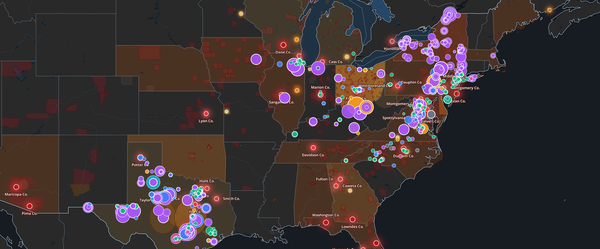
Data centers already account for roughly 5 percent of U.S. electricity consumption, according to estimates from the Electric Power Research Institute. Projections suggest that share could reach 15 to 17 percent by 2030 as artificial intelligence deployment accelerates.³ Meeting that demand requires enormous investment in the physical electric system.
The Electrical Architecture of AI Infrastructure
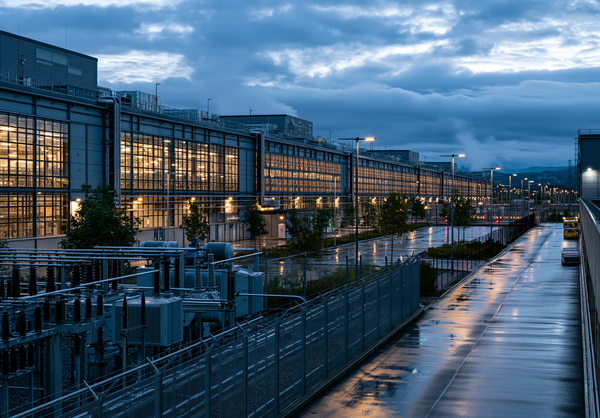
Modern hyperscale data centers already resemble miniature power systems. Electricity typically enters an AI campus through dedicated 230-kV or 345-kV transmission interconnections connected to regional grid infrastructure. From there, power flows through a hierarchy of electrical transformation stages:
- High-voltage interconnection substation
- On-site switchyard and step-down transformers
- Medium-voltage distribution feeders (often 13–35 kV)
- Uninterruptible power supply systems
- Battery energy storage banks
- Low-voltage rectification and rack-level distribution
Each layer exists to guarantee reliability. Because AI training clusters cannot tolerate interruptions in power supply, hyperscale facilities are typically designed with redundancy levels approaching N+1, N+2, or 2N electrical configurations. These architectures allow facilities to sustain multiple simultaneous equipment failures without interrupting computation.
Inside the data halls, the electrical system converges with the digital architecture itself. GPUs are connected through high-speed fabric networks that synchronize distributed training workloads across tens of thousands of processors.
From the perspective of the grid, these campuses behave less like buildings and more like industrial energy nodes embedded within the transmission system. And when one appears, the consequences ripple outward across the network.
The Infrastructure Cascade
A gigawatt-scale data center triggers what grid planners sometimes describe as an infrastructure cascade.
First comes generation adequacy. The grid must maintain sufficient capacity to serve the new load during peak conditions. That often requires new power plants or long-term capacity contracts.
Second comes transmission reinforcement. Delivering hundreds of megawatts to a single location frequently requires new high-voltage lines, transformer upgrades, and expanded substations.
Third comes system stability infrastructure. Large concentrated loads alter voltage profiles, reactive power flows, and contingency planning across the network.
In many regions the infrastructure required to support a single hyperscale campus can exceed $1 billion in generation and transmission investment.⁴ Those investments eventually appear in electricity prices. The central question confronting regulators is where.
The Cost Allocation Dilemma
Electric utilities traditionally recover infrastructure investments through regulated electricity rates. When utilities build generation or transmission assets, regulators allow those costs to be placed in the rate base, where they are shared across millions of customers.
Artificial intelligence challenges that model. When infrastructure is built primarily to serve hyperscale computing facilities, regulators must decide whether those costs should remain in the shared rate base or be assigned directly to the companies driving the demand. The distinction is subtle but economically significant.
If costs are socialized, households and small businesses may subsidize part of the AI economy. If costs are assigned entirely to data centers, developers may shift toward building private energy systems instead of relying on the grid.
This tension is already visible in electricity markets. Within the territory managed by PJM Interconnection—which serves roughly sixty-five million people across the Mid-Atlantic—capacity prices surged in recent auctions as forecasts of data center demand increased while replacement generation lagged behind plant retirements.⁵
Capacity costs tied to new load ultimately flow through electricity bills. Which is why electricity infrastructure has suddenly become a national political issue.
The Timing Problem
Electric infrastructure moves slowly. Large power plants typically require five to ten years to plan and build. High-voltage transmission projects can take even longer because of permitting and siting processes.
Data centers can be constructed in two to three years. This mismatch between digital speed and infrastructure speed creates pressure across electricity markets. Artificial intelligence demand can appear faster than the grid can expand to accommodate it.
When that occurs, prices rise. The political anxiety surrounding electricity and artificial intelligence stems largely from this structural reality.
The Emergence of the Shadow Grid
While policymakers debate tariffs and pledges, the technology industry has begun constructing an alternative solution.
Across the United States, clusters of hyperscale data centers are assembling localized energy systems designed specifically to power AI infrastructure. These systems include:
- Dedicated natural-gas generation
- Large-scale battery storage
- On-site substations and switching infrastructure
- Microgrid architectures capable of islanded operation
Taken together, they form what can be described as the "Shadow Grid". The shadow grid does not replace the traditional electric grid. Instead, it operates alongside it as a parallel energy system designed to guarantee reliability for artificial intelligence workloads.
For companies investing billions of dollars in AI infrastructure, reliability is not optional. Training cycles for advanced models can run for weeks, and interruptions in power supply can disrupt expensive computational processes.
Building private energy systems is one way to ensure those interruptions never occur. But the shadow grid introduces a new economic tension.
The Structural Tension
For more than a century the electric grid functioned as shared public infrastructure. Millions of customers collectively supported the cost of maintaining generation capacity, transmission networks, and reliability services.
Artificial intelligence may be changing that arrangement. If the largest electricity consumers begin constructing semi-independent energy systems, the financial structure of the traditional grid begins to shift. The remaining customers—households, small businesses, and conventional industries—may end up supporting a larger share of the cost of maintaining the public network.
This possibility lies at the heart of the political debate now unfolding in Washington. The White House pledge attempts to reassure voters that the cost of powering artificial intelligence will not fall on ordinary households.
Yet the real issue is not a pledge. It is the architecture of the energy system itself.
The Energy System of the AI Era
Artificial intelligence promises extraordinary economic benefits. Policymakers across the political spectrum view leadership in AI as essential to national competitiveness and security.
But the infrastructure required to power that technology is unprecedented. The electric grid was designed for a different era—an era of gradual demand growth and distributed consumption. Artificial intelligence introduces concentrated gigawatt-scale loads capable of appearing within a few years.
Integrating those loads will require not only new power plants and transmission lines, but also new regulatory frameworks governing how infrastructure costs are allocated. The pledge announced this week signals that policymakers are beginning to understand the stakes. Artificial intelligence is no longer just software running on silicon. It is a new industrial system built on electricity. And the grid that must sustain it is only beginning to take shape.
Brandon N. Owens is an energy systems expert and founder of AIxEnergy, a research platform focused on the intersection of artificial intelligence and electric infrastructure. He has spent more than two decades analyzing global energy markets, power systems, and technology-driven shifts in electricity demand.
Notes
- Lawrence Berkeley National Laboratory, United States Data Center Energy Usage Report (Berkeley: LBNL, 2024).
- Uptime Institute, Global Data Center Survey 2024 (New York: Uptime Institute, 2024).
- Electric Power Research Institute, Powering Intelligence: Analyzing Artificial Intelligence and Data Center Energy Consumption (Palo Alto: EPRI, 2024).
- International Energy Agency, Electricity 2025: Analysis and Forecasts to 2027 (Paris: IEA, 2025).
- PJM Interconnection, Reliability Pricing Model Auction Results (Valley Forge, PA: PJM, 2025).