The United States is building more electric generating capacity than at any point in modern history. Solar and battery storage are scaling at record levels. Wind development is rebounding. Grid investment is accelerating after decades of stagnation. On the surface, the trajectory appears clear: the shared electric system is expanding and decarbonizing at speed.
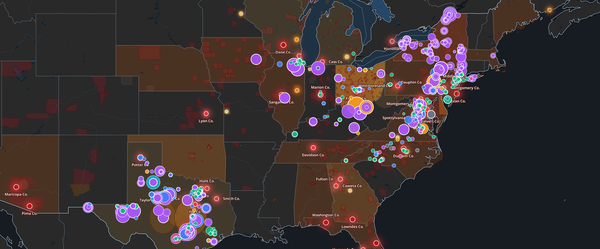
But alongside this visible expansion, another system is taking shape. Across Texas, Pennsylvania, Ohio, West Virginia, Wyoming, Utah, and other states, large industrial facilities—most prominently hyperscale artificial intelligence data centers—are constructing their own power plants. These facilities are often fueled by natural gas. They are frequently located behind the meter. They sometimes avoid formal grid interconnection entirely. In many cases, they fall outside the regulatory structures that govern traditional utilities.
This emerging parallel infrastructure is not a rumor, nor a conspiracy, nor a statistical error. It is the product of regulatory seams—legal definitions, jurisdictional boundaries, interconnection rules, and economic development incentives that were designed for another era.
The result is what can best be described as a shadow grid: a privately structured layer of generation developing alongside the decarbonizing shared system. Understanding how it emerged requires examining the regulatory architecture that made it possible.
The Architecture of Traditional Regulation
For more than a century, American electricity has been organized around a shared network model. Utilities build generation and transmission infrastructure. Public utility commissions regulate retail service and approve integrated resource plans. The Federal Energy Regulatory Commission governs wholesale markets and interstate transmission. Environmental agencies regulate emissions. Costs are recovered across broad customer bases.
This framework assumes that electricity is delivered through a public network to diverse end users. It assumes that large generation resources either sell power at wholesale or serve retail customers under tariff. It assumes that most major infrastructure is interconnected.
What it does not assume is that a private company will construct a gigawatt-scale power plant solely for internal consumption. That is the seam. If a facility does not sell electricity at wholesale, does not provide retail service, and does not interconnect with the bulk power system, it may fall outside the jurisdiction of public utility commissions and federal wholesale regulation. It may still be subject to environmental permitting, but it does not participate in integrated resource planning or clean energy mandates designed for utilities.
This boundary condition—historically minor—has become macro-relevant in the age of artificial intelligence.
The Demand Shock of Artificial Intelligence
For two decades, U.S. electricity demand grew slowly. Efficiency improvements offset economic expansion. Utilities planned incrementally.
Artificial intelligence has altered that equation. Modern AI training facilities can require several hundred megawatts per campus. Some approach or exceed one gigawatt—roughly the demand of a mid-sized city. These facilities operate continuously. They monetize uptime. They cannot tolerate multi-year interconnection delays.
In many regions, grid interconnection queues stretch for years. Transmission expansion is capital intensive and politically complex. Permitting timelines are uncertain. For AI developers competing in a global race, waiting is not neutral. It is strategic risk.
When grid delivery becomes uncertain, self-generation becomes rational. Multiply that decision across dozens of campuses, and you do not get isolated self-supply. You get a parallel infrastructure layer.
State-Level Pathways Enabling Self-Supply
Several states have enacted or proposed legislation that lowers barriers for large loads to self-generate.
Some laws create microgrid districts that allow industrial campuses to operate autonomous power systems. Others establish deadlines that, if unmet in grid interconnection negotiations, allow developers to procure electricity independently. Still others remove prior restrictions that required large users to contract through regulated utilities.
These measures are typically framed as economic development tools. Governors and legislatures compete to attract data centers. They see construction jobs, tax revenue, and technology branding.
When grid timelines slow projects, lawmakers respond by smoothing the path for private generation. The intent is not to create a shadow system. The effect is to normalize one.
Clean Energy Mandate Asymmetry
A second seam lies in decarbonization policy. Many states have binding clean energy standards that apply to regulated utilities. Utilities must procure renewable energy, meet emissions targets, and file integrated resource plans that consider least-cost and least-emissions pathways. Behind-the-meter generation owned by private entities may not be subject to the same mandates. This creates asymmetry.
The shared grid decarbonizes under formal policy constraints. Autonomous industrial generation may operate under different—or weaker—requirements.
The divergence is not necessarily ideological. It is structural. Clean energy standards were written to govern utilities. When generation moves outside that category, mandate coverage can weaken. Over time, that asymmetry can shape emissions trajectories in ways not visible in traditional grid statistics.
Federal Proposals and Jurisdictional Gaps
At the federal level, proposed legislation has highlighted the same boundary conditions. Some proposals aim to protect ratepayers from bearing the costs of data center load growth by requiring large facilities to secure separate energy supply. Others would explicitly exempt fully isolated power systems from federal oversight under existing energy statutes.
The motivations vary—consumer protection, economic competitiveness, regulatory clarity—but the cumulative effect would be to formalize off-grid autonomy. What began as a gray zone could become codified independence.
That shift would not eliminate emissions regulation or environmental permitting, but it would further detach large-scale generation from traditional grid planning frameworks.
The Economics of Speed
At the heart of the shadow grid is not ideology but speed. AI deployment cycles operate in quarters. Venture funding moves rapidly. Competitive advantage is tied to computing capacity and time to market.
Grid planning operates in decades. Transmission projects can require eight to ten years from conception to operation. Even new gas generation interconnected to the grid may face lengthy studies and cost allocation disputes. When those timelines collide, autonomy becomes a hedge.
From the perspective of a hyperscale developer, a dedicated gas plant secured through a long-term contract offers certainty. No merchant exposure. No wholesale market volatility. No queue risk. The economic logic is powerful. When repeated across states and companies, it becomes structural.
Implications for Cost Allocation
The shared grid is built on cost socialization. Transmission infrastructure, reliability investments, and legacy assets are financed through rates paid by broad customer bases. Large industrial loads historically contributed significantly to fixed cost recovery.
If substantial incremental load growth bypasses regulated utilities, the burden of fixed infrastructure costs may shift to remaining customers. Utilities may still need to maintain transmission and distribution networks even if new gigawatt-scale campuses self-supply.
This raises questions about fairness, rate stability, and long-term infrastructure utilization. The challenge is not simply emissions. It is economic architecture.
Planning Fragmentation
Integrated resource planning depends on accurate load forecasts. When large facilities self-generate without full interconnection, forecasting becomes more complex. Grid operators may see reduced net load but face reliability challenges if autonomous systems reconnect during outages or rely on backup grid support.
Autonomous generation can improve resilience at a campus level while complicating system-level planning. The grid was designed as a coordinated network. Fragmentation introduces coordination challenges that existing regulatory frameworks did not anticipate at this scale.
The Emergent Nature of the Shadow Grid
It is tempting to search for a central architect behind the shadow grid. There is none. Hyperscale operators seek reliability and speed. Independent developers seek long-term contracted revenue. States seek economic investment. Existing law permits autonomy if interconnection is avoided. Aligned incentives produce emergent infrastructure. No single actor designs the parallel system. It arises from rational decisions made within inherited legal structures.
The United States now faces a structural choice. Policymakers can extend clean energy mandates, emissions reporting, and cost allocation principles to all large-scale generation regardless of interconnection status. That approach would attempt to harmonize oversight across shared and private systems.
Alternatively, lawmakers can continue to allow autonomous generation to evolve under distinct regulatory regimes, effectively institutionalizing a dual-system model. Neither path is simple.
Expanding regulatory reach raises questions about jurisdiction and competitiveness. Restricting autonomy may slow AI development and economic growth. Leaving seams unaddressed risks emissions divergence and cost shifting. The debate is not about whether the energy transition is happening. It is about how governance evolves when infrastructure architecture changes.
Two Systems, One Geography
The shared grid is expanding rapidly, dominated by solar and storage additions. That progress is real. At the same time, a privately structured generation layer—often gas-anchored—is emerging to power artificial intelligence. Both systems operate in the same geography. Both influence emissions trajectories. Both shape ratepayer economics. The shadow grid does not replace the shared grid. It coexists with it. The question is whether that coexistence becomes coordinated—or permanently bifurcated.
Conclusion
The emergence of the shadow grid is not a failure of statistics or a hidden conspiracy. It is a predictable outcome of regulatory architecture meeting technological acceleration.
Definitions of "utility," jurisdictional limits, interconnection rules, and clean energy mandates were written for a different era. Artificial intelligence has exposed their seams. The United States is building a record clean energy expansion. It is also building a parallel layer of private generation designed to power AI. Understanding both is now essential to understanding the future of American power. The grid is growing. So is the shadow. What policymakers decide to do about the seams between them will shape infrastructure, emissions, and rate stability for decades to come.
Table 1 — The Regulatory Landscape Enabling the Shadow Grid
| Jurisdiction | Law / Policy | Status | Core Mechanism | Effect on Shadow Grid | Shadow Enablement | Clean Energy Alignment | Cost Allocation Treatment | Estimated Shadow Gas Exposure (GW) |
|---|---|---|---|---|---|---|---|---|
| Ohio | HB 15 (Energy Reform) | Enacted | Removes barriers for large-load self-generation and competitive contracting | Expands autonomy for industrial self-supply; reduces reliance on regulated utilities | Moderate | No automatic renewable mandate for private generation | Limited explicit obligation to participate in long-term utility cost recovery | TBD (policy enables; project-by-project) |
| Utah | SB 132 | Enacted | Allows data centers to secure independent power if interconnection agreements stall | Creates statutory bypass trigger for off-grid supply | High | No direct renewable requirement for autonomous systems | Avoids standard utility rate recovery participation | TBD |
| West Virginia | HB 2014 (Microgrid Districts) | Enacted | Authorizes certified microgrid districts for autonomous campus power | Institutionalizes legally recognized self-contained generation zones | High | Environmental permitting applies; no utility clean energy mandate | Grid cost recovery obligations remain ambiguous for autonomous districts | ~3.7 GW (announced exposure) |
| Maryland | SB 937 | Enacted | Establishes framework for large-load direct supply arrangements | Lowers regulatory friction for private generation | Moderate | Not inherently tied to renewable procurement standards | Large loads may negotiate outside standard tariff structures | TBD |
| Colorado | HB 26-1030 (Data Center Development Authority) | Enacted | Provides tax incentives and certification pathways for data centers | Encourages rapid development; may indirectly support self-generation | Moderate | Utility consultation encouraged; renewable matching not mandatory | Infrastructure cost internalization partially addressed | TBD |
| Colorado | SB 26-102 (Renewable Matching Proposal) | Proposed | Requires large data centers to procure renewables matching annual load | Would constrain shadow gas expansion if enacted | Constraining | Strong renewable alignment requirement | Requires cost responsibility for grid impacts | N/A (constraint proposal) |
| Federal | GRID Act (Proposed) | Proposed | Requires data centers to secure separate energy sources to protect ratepayers | Could institutionalize off-grid generation as policy objective | High | Does not mandate renewable sourcing | Explicitly insulates grid ratepayers from data center costs | TBD (nationwide if enacted) |
| Federal | DATA Act (Proposed) | Proposed | Exempts fully isolated power systems from Federal Power Act oversight | Formalizes federal jurisdictional exemption for off-grid systems | High | No federal clean energy mandate attached | Removes FERC oversight; cost allocation left to private arrangements | TBD (nationwide if enacted) |
| Multi-State | Interconnection Queue Delays | Ongoing Structural Condition | Multi-year transmission and generation study backlogs | Incentivizes autonomous self-generation for speed and certainty | High | Clean energy projects also delayed under same constraints | Costs borne privately rather than socialized across grid | N/A (driver) |
| Multi-State | Renewable Portfolio Standards (RPS) | Enacted in many states | Mandates clean energy procurement for regulated utilities | Does not automatically bind behind-the-meter generation | Moderate (via asymmetry) | Strong for utilities; weak for autonomous systems | Cost recovery embedded in retail rates | N/A |
Shadow Enablement Key:
High = Explicit bypass path, autonomous district authorization, or jurisdictional exemption.
Moderate = Lowers friction or incentivizes development without requiring off-grid supply.
Constraining = Closes seams through renewable matching and grid cost responsibility.
Table 2 — Emissions and Ratepayer Risk Matrix
| Policy | Primary Seam | Emissions Exposure Risk | Ratepayer Cost-Shift Risk | Why It Matters |
|---|---|---|---|---|
| Utah SB 132 | Interconnection delay → statutory exit | High | High | Converts delay into a legal trigger for autonomy, often gas-backed, while grid fixed costs remain. |
| West Virginia HB 2014 | Autonomous microgrid districts | High | Moderate–High | Formalizes repeatable off-grid industrial power zones with ambiguous grid obligations. |
| Ohio HB 15 | Self-supply flexibility | Moderate | Moderate | Encourages private contracting; impact depends on technology mix and tariff design. |
| Maryland SB 937 | Direct supply structures | Moderate | Moderate | Negotiated structures can weaken traditional tariff-based infrastructure contributions. |
| Colorado HB 26-1030 | Incentives without firm guardrails | Moderate | Moderate | Accelerates load growth; fossil self-supply becomes rational if renewables are not required. |
| Colorado SB 26-102 (proposed) | Renewable matching + grid impact payment | Low | Low | Would close two core seams: emissions asymmetry and cost shifting. |
| GRID Act (proposed) | Separate supply mandate | High (unless conditioned) | Low for grid | Shields ratepayers but could expand private fossil generation without clean-energy conditions. |
| DATA Act (proposed) | Federal oversight exemption | High | Moderate | Codifies fragmentation; narrows federal coordination levers. |
| Interconnection delays | Time + uncertainty | High | Moderate | The longer queues persist, the more autonomy becomes default. |
| Utility RPS frameworks | Mandate asymmetry | Moderate | Low–Moderate | Shared grid decarbonizes while private emissions may rise outside mandate boundaries. |
These tables and layout elements provide a consolidated, publication-grade view of how regulatory seams collectively enable the shadow grid while revealing where policy interventions could close them.