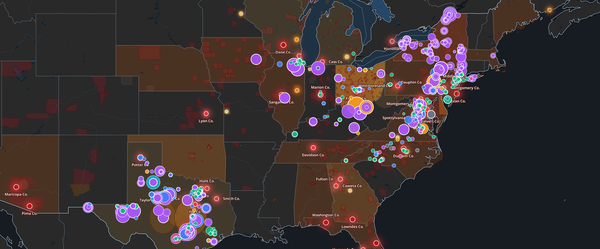
Global electricity demand is expected to grow by an average of 3.6 percent annually between 2026 and 2030, adding about 1,100 terawatt-hours each year—roughly 50 percent more annual demand growth than over the previous decade, according to the International Energy Agency (IEA). Through 2030, electricity consumption is projected to grow at least 2.5 times as fast as overall energy demand, underscoring how much this moment is being driven by electrification and not simply broader economic growth¹.
This growth is driven by rising industrial use of electricity, accelerating uptake of electric vehicles², expanded air conditioning use, and the AI-fueled increase in data center power demand³. In the United States, which is leading the global data center surge, EPRI scenarios estimate that data centers could account for roughly 9 to 17 percent of US electricity consumption by 2030, up from about 4 to 5 percent in 20244. We are moving at speed into the age of electricity. The question that is top of mind for many is, “How will we meet this moment?”
Under what conditions can flexibility create more headroom?
As demand from AI and data centers grows at unprecedented speed, flexibility is becoming the third leg of the speed-to-power stool, alongside generation and transmission.⁵ Flexibility allows large loads to reduce or shift consumption during periods of grid stress through various methods, including on-site generation, on-site battery storage, on-site thermal storage, standby generation, uninterruptible power supply, and/or shifting of chiller and compute workloads. These mechanisms are not interchangeable: they differ in speed, duration, notice, location, emissions profile, and contractual form.
The question is whether flexibility can create additional system headroom and, in some cases, reduce or defer infrastructure needs when the response is available at the right location, time, duration, and level of reliability. Under what conditions can flexibility also shorten interconnection timelines and accelerate time-to-power, subject to the utility study and the contractual arrangement that governs the commitment?
The industry has moved beyond asking whether selected data center loads can flex toward understanding what makes a specific flexibility commitment dependable enough to count in a planning study that carries a compliance obligation. We propose five criteria for evaluating whether a flexibility commitment is dependable enough to receive planning credit:
Firm. The obligation to reduce must be contractual, not discretionary, with defined depth, duration, notification time, and frequency—and with consequences for non-performance.
Deliverable. The reduction must demonstrably relieve the relevant electrical constraint. System-level flexibility does not automatically translate into relief of a specific post-contingency overload.
Coincident. The commitment must be available in the hours and under the conditions in which the constraint binds, which are not necessarily the hours of highest system load.
Verifiable. Performance must be measured against a defined baseline, reported, and auditable, on the same footing as any other resource on which reliability depends.
Modeled. The load must be represented in planning and operational models with validated dynamic behavior, including response to voltage and frequency disturbances and recovery or rebound demand following a flexibility event.
These criteria are a practical test for evaluating planning credit. They also align with the direction of recent reliability work. In May 2026, NERC issued a Level 3 Alert addressing computational-load modeling, studies, instrumentation, commissioning, operations, protection, and control. In July, FERC directed NERC to develop and submit new or modified reliability standards and registry revisions for computational loads by December 31, 2026.⁶ That record reinforces why demonstration success and planning credit are related, but not the same.
When is flexibility real?
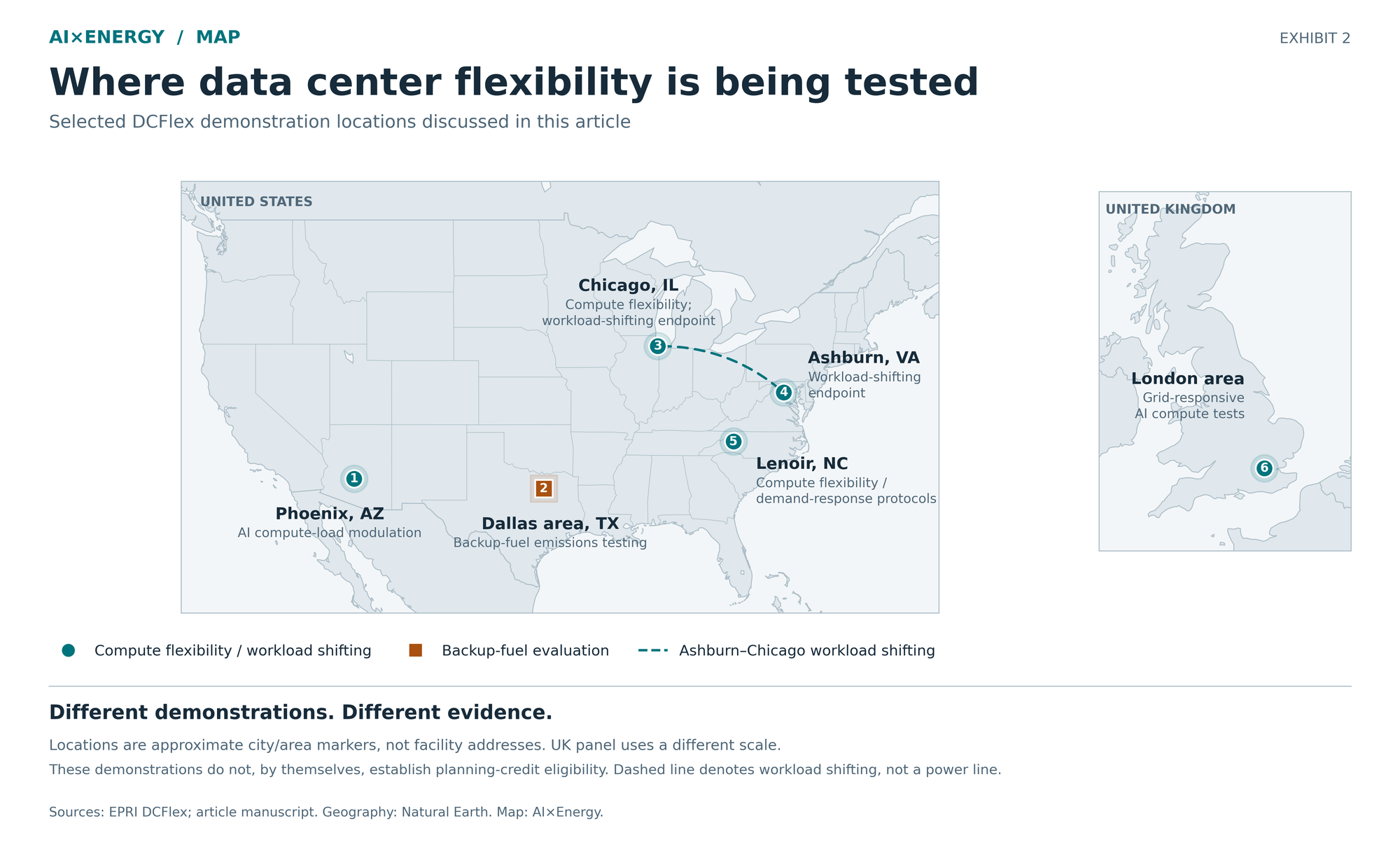
When EPRI’s Data Center Flexible Load Initiative (DCFlex) was founded in November 2024, a central question was how data center flexibility could be demonstrated, repeated, and incorporated into utility planning. Since then, DCFlex has advanced a portfolio of demonstrations at data center facilities around the world⁷.
The evidence is beginning to move beyond modeling and controlled laboratory work into operating data centers and commercial utility programs.
These demonstrations illustrate a range of flexibility pathways across compute, facility systems, and backup power and show that flexibility strategies can be tailored to the availability, scale, and duration of grid events. Public project materials document meaningful load response under tested conditions while maintaining service-level commitments for the evaluated workloads. Detailed metrics should be read from the underlying EPRI and partner project reports, including EPRI’s DCFlex technical publications.
Moving from pilots to scale
While DCFlex’s demonstrations have highlighted the benefits of flexibility, they are only the first step. The utility and data center developer industries still need a common language to define flexibility. That’s why, in March 2026, DCFlex launched Flex MOSAIC™, collaborating with more than 70 utilities, system operators, technology providers, and hyperscalers12.
The Flex MOSAIC framework defines five classes of flexibility based on the magnitude, timing, duration, and frequency of a load’s response. The purpose of establishing these defined classes is to replace bespoke, project-by-project interconnection negotiations with shared, performance-based descriptions. Without a common vocabulary, every interconnection is a custom negotiation, which can slow down speed-to-power.
Leveraging insights from the Flex MOSAIC™ framework, the DCFlex team is developing tools for base features and reference-design support elements. By year-end 2026, the team expects to roll out the final reference design, as well as structural incentive-program designs and tools for adoption of the framework. By establishing a shared language, transparent facility performance expectations, and repeatable grid responses, the framework can help utilities, system operators, regulators, and data center developers make faster, more consistent, and more confident decisions when evaluating flexibility.
The DCFlex team recently released an interactive simulation on its website where users can test the usefulness of Flex MOSAIC™ from the standpoint of a data center developer, interconnection-study engineer, tariff/program designer, or long-term planner. I invite you to try the simulation and to move from simulations to reality by applying the lessons learned across the energy ecosystem.
Flexibility and speed to power
Flexibility can reduce the need for premature investment in additional power plants and transmission lines if the industry has tools to evaluate when that potential is real. As part of the DCFlex effort, the EPRI team developed a practical industry Headroom Framework [LJ2] to help power-system planners evaluate how much additional load, particularly from rapidly growing data centers, can be integrated without expanding generation, storage, or transmission infrastructure13. The framework provides a uniform, stepwise approach to evaluate how increasing data center flexibility, via Flex MOSAIC™ flexibility classes, may contribute usable headroom under specific system conditions: resource adequacy, transmission topology, operating constraints, contingencies, timing, and location.
At EPRI, we believe these tools can improve information exchange between system planners and data center developer communities about where system flexibility is most valuable and what type of flexibility is prioritized. With the right signaling, connection requests become more aligned with system needs, which can streamline the interconnection process.
Collaboration and the path to scale
Thanks to DCFlex and its more than 70 collaborators, including hyperscalers, utilities, independent system operators, power producers, technology providers, consultants, and finance stakeholders, what exists today is a shared language integrated with demonstrations leading to flexibility strategies and dynamic planning tools. Even with these advances, a trust gap remains.
Because DCFlex demonstration projects have validated the physics of flexibility under defined conditions, stakeholders can use a common language from the earliest stages of negotiations and interconnection planning through rate design and long-term planning. The next step is turning individual results into a track record: aggregating dispatched-event outcomes across many facilities and evaluating them against consistent baselines, the same way generation resources have been assessed for decades. That is how flexibility earns trust and a place in planning, not just in pilots.
As DCFlex progresses, large-load flexibility is becoming more viable as a planning resource. The path to fuller utilization will require ongoing industry-wide collaboration and recognition that gains in efficiency can override one-off solutions created by individual utilities and hyperscalers, making outcomes more predictable, effective, and affordable.
We have shown that data centers can flex. The five-part test offers a practical way to determine if that flexibility is dependable. That is how we meet this moment: with flexibility that is not just possible, but dependable enough to plan on.
Arshad Mansoor is president and CEO of EPRI. The institute is an independent, nonprofit energy research and development organization. EPRI does not advocate for policy or commercial outcomes.
Notes
¹ International Energy Agency (IEA), “Demand,” in Electricity 2026 (IEA, February 2026), https://www.iea.org/reports/electricity-2026/demand.
² IEA, Global EV Outlook 2026 (IEA, May 2026), https://www.iea.org/reports/global-ev-outlook-2026; IEA, “Demand,” in Electricity 2026, https://www.iea.org/reports/electricity-2026/demand.
³ IEA, World Energy Outlook 2024 (IEA, 2024), “Executive Summary,” https://www.iea.org/reports/world-energy-outlook-2024/executive-summary; IEA, “The World Is Moving at Speed into the Age of Electricity,” accessed September 14, 2026, https://www.iea.org/spotlights/the-world-is-moving-at-speed-into-the-age-of-electricity.
4 Electric Power Research Institute (EPRI), Powering Intelligence 2026: Updated Scenarios of U.S. Data Center Electricity Use and Power Strategies (EPRI, February 2026), https://powering-intelligence.epri.com/.
⁵ Zachary Skidmore, “EPRI Launches Data Center Flexibility Framework to Speed Up Grid Connections,” Data Center Dynamics, April 23, 2026, https://www.datacenterdynamics.com/en/news/epri-launches-data-center-flexibility-framework-to-speed-up-grid-connections/.
⁶ North American Electric Reliability Corporation (NERC), “Computational Load Modeling, Studies, Instrumentation, Commissioning, Operations, Protection, and Control,” Level 3 Essential Action Alert, May 4, 2026, https://www.nerc.com/globalassets/programs/bpsa/alerts/level-3-computational-load-alert.pdf; Federal Energy Regulatory Commission, “Reliability Standard(s) Pertaining to Computational Load Integration,” Docket No. RD26-7-000, July 16, 2026, https://www.ferc.gov/media/e-1-rd26-7-000.
⁷ EPRI, “DCFlex Demonstrations,” accessed September 14, 2026, https://dcflex.epri.com/demonstrations
⁸ Philip Colangelo et al., “AI Data Centres as Grid-Interactive Assets,” Nature Energy 11, no. 2 (2026): 254–61, https://doi.org/10.1038/s41560-025-01927-1.
⁹ EPRI Journal, “Flexible Loads, Resilient Grids,” August 20, 2025, https://eprijournal.com/flexible-loads-resilient-grids/.
10 Michael Terrell, “A New Milestone for Smart, Affordable Electricity Growth,” Google, March 19, 2026, https://blog.google/innovation-and-ai/infrastructure-and-cloud/global-network/demand-response-data-center-milestone/.
11 EPRI, Data Center Flexible Load Initiative (DCFlex): Flex MOSAIC and Demonstration Summary, n.d., 3–4, accessed September 14, 2026, https://restservice.epri.com/publicattachment/98143.
12 EPRI, “An Open Letter to the Power and Digital Infrastructure Industries: Accelerating Time-to-Power for Data Centers and Large Loads Through a Flexibility Framework,” accessed September 14, 2026, https://dcflex.epri.com/flex-mosaic/open-letter.
13 EPRI, A Proposed Framework to Assess Headroom for Integrating Data Centers into Regional Power Systems, report no. 3002036339 (EPRI, 2026), https://headroom.epri.com/.