American utilities spent most of the past two decades managing a grid whose total electricity demand, adjusted for weather and GDP, was essentially flat. Load forecasters grew accustomed to small positive numbers, and the system's institutions—interconnection queues, capacity markets, integrated resource plans—were calibrated accordingly. That era is over. The proximate cause is artificial intelligence.
The more important point is not simply that demand is growing again. It is that the character of demand is changing. AI data centers combine the electrical scale of heavy industry, the mobility of digital commerce, the capital structure of hyperscale technology firms, and the operational logic of software systems. They are not ordinary factories with server racks inside them. A steel mill, refinery, or LNG terminal is tied to a physical production process, a local supply chain, and a relatively stable industrial use case. Some AI workloads, by contrast, may be divisible across time, geography, or computing environments. Some training runs can be deferred. Some inference can be routed across regions. Some facilities can draw on backup or dedicated generation. Some projects can relocate before capital is fully committed. This hybrid character makes AI data centers difficult to govern through regulatory categories developed for passive retail loads and conventional industrial customers.
Lawrence Berkeley National Laboratory's 2024 report—the first congressionally mandated update to its widely cited 2016 study—documents the scale of the break. U.S. data centers consumed approximately 176 terawatt-hours (TWh) in 2023, or 4.4 percent of national electricity consumption, up from 58 TWh a decade earlier. The LBNL authors project that figure will reach between 325 and 580 TWh by 2028, representing 6.7 to 12 percent of total national supply—a range so wide that it admits the honest uncertainty embedded in the forecasts (Shehabi et al., 2024). Much of the recent acceleration is attributable to hyperscale and GPU-intensive AI workloads, although cloud growth, enterprise computing, cryptocurrency, and broader digital demand also contribute.
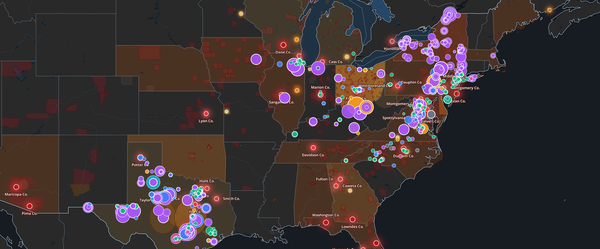
National aggregates understate geographic intensity. Northern Virginia hosts what is now the largest concentration of data center capacity in the world—by some estimates more than 4,900 megawatts of operational IT load as of early 2025, constituting roughly 13 percent of all reported global data center capacity and 25 percent of capacity in the Americas (JLARC, 2024; Northern Virginia Technology Council, 2026). PJM Interconnection, which operates the grid serving that region, projects that roughly 30 of the 32 gigawatts of peak load growth it anticipates between 2024 and 2030 will come from data centers—a proportion the grid operator's own board chair described as an "onrush of demand" (PJM, 2025a; PJM Inside Lines, 2025). MISO projects its peak load will climb from 121 GW in 2025 to 163 GW by 2035, with data centers potentially comprising a quarter of its total demand by 2040 (Data Center Dynamics, 2025). FERC's March 2026 State of the Markets report confirmed that more than 50 GW of data center capacity was operating nationwide at year-end 2025, representing 24 percent compound annual growth since 2020 (FERC, 2026).
What makes the current moment difficult for regulators is the combination of scale, speed, and category confusion. Data centers are retail customers, but they are also transmission-planning drivers, capacity-market drivers, potential demand-response resources, candidates for co-located generation, and sources of dynamic reliability behavior. Institutional frameworks built around slow, incremental load growth—the interconnection queue, the three-year-forward capacity market, the integrated resource plan with its five-year planning horizon—are being asked to absorb multi-gigawatt demand additions that can materialize, or evaporate, within months. The result is a proliferating set of regulatory responses that are, in many cases, working at cross-purposes. The article that follows maps those responses, identifies their common pressures and contradictions, and asks whether the current architecture is adequate to the task.
WHY AI DATA CENTERS ARE DIFFERENT
The regulatory challenge begins with the load itself. Large industrial customers are not new to the power sector. Utilities have long served steel mills, aluminum smelters, chemical plants, refineries, mines, and manufacturing complexes. These customers can be very large, and some have historically provided interruptible load or demand response. But AI data centers differ from conventional large loads in several important respects.
- First, their development cycle is unusually fast relative to the infrastructure required to serve them. A data center developer can identify a site, submit an inquiry, and begin commercial negotiation far more quickly than a utility can plan, permit, procure, and build the transmission, substation, transformer, and generation resources that may be needed to serve hundreds of megawatts of new load.
- Second, their load forecasts are unusually uncertain. A proposed data center campus may appear in utility or RTO forecasts before it has secured final permits, financing, equipment, power supply, or customer commitments. Conversely, once a hyperscaler commits to a region, load can ramp quickly and in large increments. This creates a forecasting problem that is qualitatively different from ordinary economic load growth.
- Third, the operational characteristics of AI data centers are not fully captured by conventional planning models. Their steady-state demand may appear as a high-load-factor block of consumption, but their response to voltage disturbances, protection-system operations, uninterruptible power supply transfers, backup-generation starts, and software-driven workload management may be more dynamic than that of a conventional commercial load.
- Fourth, data centers have more strategic options than many earlier industrial loads. They can sign long-term power purchase agreements, co-locate with generation, install backup generation and batteries, build private substations, participate in demand response pilots, or shift some workloads across time and geography. These options do not eliminate the need for reliable grid service, but they change the bargaining relationship between customer and utility.
The core regulatory question is therefore not whether data centers should be encouraged or discouraged. The question is how to classify, price, verify, and operate a new class of load that does not fit neatly into inherited categories.
FEDERAL REGULATION
FERC AND THE EMERGING FEDERAL FRAMEWORK FOR LARGE LOADS
The Federal Energy Regulatory Commission sits at the center of U.S. electricity regulation where interstate transmission and wholesale power markets are concerned. Its authority under the Federal Power Act is well established for transmission service, wholesale rates, regional market rules, and generator interconnection. What has historically been less clear is how that authority applies when the transmission system is being accessed not by a generator, but by a new class of infrastructure-scale load.
For most of the industry's history, that distinction created few institutional challenges. Large industrial customers connected through utility service territories, state-regulated tariffs, and local interconnection arrangements. Their effects on transmission systems, capacity markets, and reliability planning could generally be absorbed through existing utility forecasting and planning processes. The emergence of AI data centers, advanced manufacturing facilities, and other gigawatt-scale loads has exposed the limits of that framework.
A single AI campus may request hundreds or even thousands of megawatts. Regional clusters of such facilities can materially alter transmission plans, capacity-market outcomes, generation investment decisions, and long-term reliability assessments. Increasingly, these projects are arriving on timelines measured in months rather than years, reflecting the pace of the digital economy rather than the pace of traditional utility infrastructure development.
The clearest early manifestation of this challenge emerged in PJM, where developers proposed co-location arrangements that would place large data center loads at or near generating facilities. These arrangements promised faster access to power in regions facing transmission constraints, generation shortages, and interconnection backlogs. They also exposed significant gaps in existing tariffs regarding transmission rights, cost allocation, reliability obligations, and wholesale-market participation.
FERC initially addressed these issues through a series of PJM-specific proceedings, including the rejection of the proposed Susquehanna-Amazon co-location arrangement and subsequent orders directing PJM to develop new tariff provisions governing co-located loads. Those proceedings revealed a broader reality: large loads located near generation may reduce certain network requirements, but they do not necessarily eliminate dependence on the transmission system for backup service, balancing, ancillary services, reliability support, market settlement, or emergency operations.
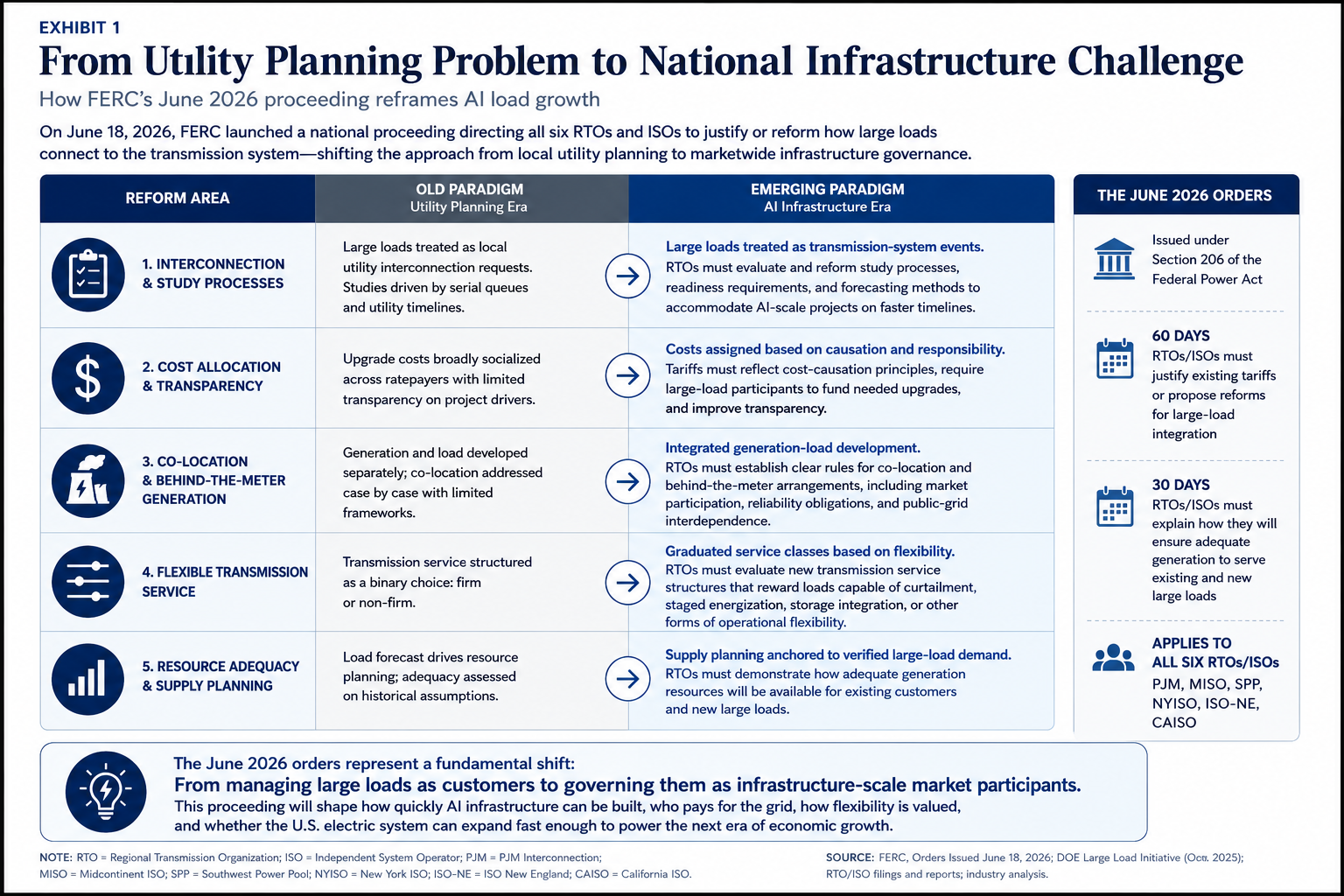
Physical proximity to generation does not eliminate public-grid obligations. Behind the meter is not always behind the grid. The significance of these disputes expanded dramatically on June 18, 2026, when FERC issued coordinated Section 206 show-cause orders directing all six RTOs and ISOs under its jurisdiction—PJM, MISO, SPP, NYISO, ISO New England, and CAISO—and their transmission-owning utilities to either justify or reform their tariff frameworks for large-load integration. At the same time, FERC directed each region to explain how it would ensure adequate generation resources exist to serve both existing customers and the next wave of large electrical loads.
The scope of the proceeding marks an important shift in federal policy. For decades, large-load growth was treated primarily as a local utility planning issue. FERC is now treating large-load integration as a national transmission, market-design, and reliability challenge. The Commission explicitly tied the proceeding to the Department of Energy's October 2025 large-load initiative and repeatedly framed the effort around improving "speed-to-power" for strategically important industries including artificial intelligence, advanced manufacturing, and digital infrastructure.
The Commission identified five broad areas where existing tariffs may no longer be adequate: (1) Transmission service applications and study processes; (2) Cost allocation and transparency; (3) Co-location and behind-the-meter generation; (4) Flexible transmission service; and (5) Planning for generation serving large electrical loads.
Taken together, these categories represent more than a collection of technical tariff issues. They reflect an attempt to redesign the interface between the electric grid and a new generation of infrastructure-intensive industries.
FERC's emerging large-load agenda should therefore be understood alongside Orders 2023 and 1920. Order 2023 addressed generator interconnection through cluster studies, readiness requirements, and queue reform. Order 1920 addressed long-term regional transmission planning and cost allocation. The June 2026 proceeding introduces what may become the third major pillar of AI-era grid governance: the rules governing how large loads connect to the transmission system, how quickly they can be studied, what obligations they must satisfy, how flexibility is valued, and who pays for the infrastructure required to serve them.
Particularly notable is FERC's emphasis on flexible transmission service. Historically, transmission service has largely been structured around a binary choice between firm and non-firm service. The Commission is now explicitly exploring whether large loads capable of curtailment, staged energization, demand flexibility, storage integration, or operational coordination should be offered alternative service structures. This reflects an emerging recognition that some AI infrastructure may function not only as load, but as a controllable grid resource.
The jurisdictional issue is therefore not simply whether FERC should regulate data centers. The issue is that a single AI-scale project can simultaneously become a retail customer, a transmission-planning driver, a capacity-market driver, a reliability concern, a cost-allocation issue, and a wholesale-market participant through co-located generation or flexible service arrangements.
State commissions retain authority over retail tariffs, utility cost recovery, and siting approvals. FERC retains authority over interstate transmission and wholesale markets. RTOs and ISOs administer regional tariffs, planning processes, and resource adequacy frameworks. NERC establishes reliability standards and assessments. Yet no single institution governs the entire transaction.
That fragmentation was manageable when load growth was gradual and predictable. It becomes increasingly fragile when hundreds or thousands of megawatts can enter planning forecasts before a project's commercial viability has been fully demonstrated. The large-load question is therefore as much a federalism challenge as it is an interconnection challenge.
The emerging federal objective is not to displace state authority. It is to establish a coherent framework governing transmission access, reliability obligations, cost responsibility, operational flexibility, and resource adequacy for a new class of infrastructure-scale load. In doing so, FERC has effectively acknowledged that artificial intelligence is no longer merely a technology-sector issue. It has become a power-system governance issue.
The June 2026 proceeding may ultimately be remembered not as a tariff case, but as the moment federal regulators formally recognized that the future of the AI economy depends as much on electricity market design as on software, semiconductors, and compute infrastructure.
NERC AND THE RELIABILITY PROGRAM
NERC's 2025 Long-Term Reliability Assessment, released in January 2026, is the starkest warning the organization has issued in at least two decades. Summer peak demand across the North American bulk power system is forecast to grow by 224 GW over the next ten years—69 percent higher than the 132 GW projected in the previous year's LTRA—while winter peak demand is projected to surge by 246 GW (NERC, 2025). To put those numbers in context: the entire current generating capacity of PJM is approximately 182 GW. Thirteen of NERC's twenty-three assessment areas now face elevated or high resource adequacy risk within the five-year planning horizon, including the MISO, PJM, ERCOT, and Northwest regions (NERC, 2025; Microgrid Knowledge, 2026). NERC's director of reliability assessments, John Moura, put it plainly: "The system is changing faster than the infrastructure needed to support it" (Utility Dive, January 30, 2026).
What distinguishes NERC's 2025 assessment from prior warnings is the precision of its attribution. Artificial intelligence data centers and the broader digital economy account for most of the projected load growth—though the report is careful to note that large industrial facilities, electrification, cryptocurrency mining, and demographic change all contribute (NERC, 2025). The assessment also identified a new reliability phenomenon: a series of events in 2024 and 2025 in which 1,000 MW or more of data center load dropped unexpectedly from the bulk power system simultaneously, triggering frequency and voltage disturbances that required emergency management. A July 2024 voltage fluctuation in Northern Virginia simultaneously disconnected sixty data centers, producing a 1,500 MW power surplus that operators had to absorb in real time (Belfer Center, 2026). NERC issued a Level 3 alert on this problem in May 2026. In April 2025, FERC directed NERC to investigate these load-loss events formally, and the resulting Large Load Task Force is the first systematic federal effort to characterize data center load dynamics for planning purposes (White & Case, 2025b).
Peer-reviewed engineering literature corroborates the concern. Kwon, Mukherjee, and Adetola (2025), writing from Pacific Northwest National Laboratory, classify AI data centers as "Large Dynamic Digital Loads" whose training and inference cycles generate sharp load ramps—on the order of minutes—that stress transfer capabilities and introduce transient stability risks not anticipated in conventional planning (Kwon et al., 2025). A 2026 study in Energies similarly documents that the combination of high power density, variable GPU utilization, and intensive cooling requirements reshapes system energy use in ways that standard load models were not designed to capture (Chen et al., 2026). The translation from engineering paper to regulatory standard is slow; NERC's standards development process operates on multi-year cycles even for priorities.
For reliability planners, the central question is not only how much electricity data centers consume, but how they behave during disturbances. A large computational load that trips, transfers to UPS, starts backup generation, or rapidly sheds noncritical workload during a voltage event is not equivalent to a static block of demand. If many facilities respond similarly to the same disturbance, the resulting load change can become material to frequency, voltage, and balancing operations. The relevant planning questions therefore include ride-through behavior, protection settings, telemetry, commissioning data, backup-generation logic, and whether operators have sufficient visibility into large-load response during contingencies. In that sense, the reliability challenge is shifting from serving large load to observing, modeling, and coordinating large load.
REGIONAL RESPONSES
PJM: The Pressure Cooker
PJM is not merely one regional example among many. It is the first large-scale stress test of how AI data center growth interacts with capacity markets, transmission planning, co-location, state retail regulation, and cost allocation. The region contains the country’s most concentrated data center load, relies on a forward capacity market, and spans multiple states with different regulatory priorities. If the United States is going to learn how data center load reshapes electricity governance, PJM therefore provides the clearest early case study.
No regional entity has absorbed the data center shock more visibly than PJM Interconnection. The mechanism through which that shock transmits to consumers is PJM's capacity market, which holds three-year-forward auctions to procure the reserves needed to meet peak demand. For decades these auctions were, from a public perspective, unremarkable. That ended abruptly. The 2025/2026 capacity auction—held in 2024 for the delivery year beginning June 2025—cleared at a price approximately 833 percent above the prior year's level, driven by the surge in forecast data center load in the PJM footprint (AAF, 2026; Introl, 2026). Subsequent auctions have cleared at or near the FERC-approved price cap: $329.17 per megawatt-day for 2026/2027 and $333.44 per megawatt-day for 2027/2028 (PJM, 2025b). The 2027/2028 auction—held in December 2025—totaled $16.4 billion and, critically, fell approximately 6,625 MW short of PJM's 20 percent installed reserve margin target, marking the first time in the grid operator's history that it failed to procure sufficient capacity for reliability (Utility Dive, December 2025).
Monitoring Analytics, PJM's independent market monitor, has been unsparing in its diagnosis. Data center load—both existing facilities and projected builds—accounted for $6.5 billion, or 40 percent, of the 2027/2028 auction's total cost; across PJM's last three base capacity auctions, data center-related charges totaled $21.3 billion, or 45 percent of the $47.2 billion in aggregate clearing costs (Monitoring Analytics, 2026). "Data center load growth is the primary reason for recent and expected capacity market conditions," the market monitor wrote in January 2026—a conclusion it has now repeated in multiple quarterly reports. By May 2026, wholesale power costs in PJM for the first quarter had risen 75.5 percent year-over-year, from $77.78 to $136.53 per megawatt-hour, with data center growth again identified as the primary driver (The Register, May 2026).
Load forecasting has become a contested issue in its own right. The problem is circular: PJM must include data center load in its forecast to set the capacity auction clearing price, but data center developers routinely file requests for load adjustments without firm commitments—meaning phantom facilities inflate the forecast, which drives up the auction price, which raises costs for all ratepayers whether or not those facilities are ever built. PJM's market monitor characterized data center forecasts as having "extreme uncertainty." In January 2026, PJM revised its near-term forecast downward by applying stricter vetting criteria—reducing the 2028 peak projection by 4.4 GW, or 2.6 percent—while simultaneously increasing its long-term annual growth rate projection to 3.6 percent per year through 2036 (Utility Dive, January 15, 2026; PJM Inside Lines, 2026).
The problem is that data center development is easier to announce than to verify. A proposed campus may have site control or a utility inquiry long before it has an executed electric service agreement, posted collateral, land-use approvals, major equipment orders, construction financing, or a realistic energization date. Yet once the load enters a regional forecast, it can affect capacity procurement, reserve margins, transmission planning, and ultimately customer bills. This creates a pathway through which speculative load can impose real system costs before it becomes real demand.
The logical response is milestone-based load verification. RTOs, utilities, and state commissions should not treat all proposed data center load as equally certain. Instead, load should enter planning and capacity-market assumptions according to verified project maturity: site control, zoning approval, executed service agreement, posted security, interconnection-study completion, major equipment procurement, construction start, and scheduled energization. The purpose is not to exclude uncertain growth. It is to weight uncertainty explicitly. A 300 MW inquiry should not have the same planning status as a 300 MW project with permits, financing, executed service contracts, and equipment on order. Forecasting, in this context, becomes less an exercise in predicting economic growth than a process for verifying infrastructure commitments.
PJM's own institutional response has been halting. In August 2025, the Board launched a Critical Issue Fast Path (CIFP) for Large Load Additions, proposing a Non-Capacity Backed Load service that would allow new data centers to receive grid connection in exchange for agreeing to curtail during declared emergencies—effectively a firm load-shedding obligation in return for expedited access (PJM Inside Lines, 2025). Stakeholders failed to reach consensus on these rules by November 2025, and FERC's December order superseded some of what PJM had been developing. The grid operator simultaneously began processing more than 170,000 MW of queued generation projects and introduced a multi-year collaboration with Google and Tapestry to deploy AI-enhanced tools for interconnection study processing (PJM, 2025b; PJM Inside Lines, 2026).
MISO and SPP: Fast-Track Experiments
MISO has experienced the sharpest regional acceleration: data center capacity in its fifteen-state Midwest and South footprint grew at a 43 percent compound annual rate between 2020 and 2025, and the grid operator expects 8 to 14 GW of new data center load in 2026 and 2027 alone (FERC, 2026; Data Center Dynamics, 2025). By 2030 it projects data centers will constitute a fifth of its electricity demand; by 2040, potentially a quarter. Its ten-year peak load forecast has risen from 121 GW in 2025 to a projected 163 GW in 2035.
MISO's primary institutional response has been its Expedited Resource Addition Study process, an accelerated interconnection pathway designed specifically to address resource adequacy deficits. The second ERAS cycle, announced in December 2025, targeted 6.1 GW of new capacity, with battery storage and natural gas projects constituting the bulk of the queue (DWGP, 2025). Importantly, MISO's ERAS is structured to serve resource adequacy gaps of individual load-serving entities, not simply to accelerate any and all project requests—a design choice that limits the risk of queue inflation while prioritizing the most pressing reliability needs.
SPP filed its own Expedited Resource Addition Study with FERC in May 2025, citing what it characterized as an emerging resource adequacy crisis in its fourteen-state central U.S. region—where annual load rose approximately 21 percent between 2020 and 2024 (S&P Global, 2025; K&L Gates, 2025). FERC approved a complementary Priority Process in November 2025, permitting existing generating facility owners to increase injection capability by up to 20 percent outside the normal interconnection queue. Both MISO and SPP are effectively using expedited interconnection as a supply-side substitute for the demand-side management tools they lack authority to impose directly on data center customers.
ERCOT: A Different Legal Terrain
The Electric Reliability Council of Texas operates outside FERC's jurisdiction—an artifact of Texas's decision to maintain an essentially intrastate grid—and has consequently had more freedom to act quickly, though its tools differ. ERCOT's peak demand could rise from 98 GW in 2026 to over 111 GW by 2032, predominantly on data center and cryptocurrency growth, and its T&D development pipeline has quintupled from under 500 miles in 2024 to over 2,400 miles in planned or under-construction transmission (ERCOT, 2025; S&P Global, 2025). Texas recorded the largest year-on-year increase in wholesale electricity sales of any regional system in 2025, at 5.2 percent (FERC, 2026).
At the legislative level, Texas enacted SB 6 in 2025, directing the Public Utility Commission of Texas to develop both mandatory and voluntary demand management programs for large loads. The mandatory component requires curtailment protocols for new large loads of 75 MW or more that interconnect after December 31, 2025, during firm load-shed events; the voluntary Large Load Demand Management Service allows ERCOT to competitively procure demand reductions from such loads ahead of anticipated emergency conditions (Yes Energy, 2026). ERCOT also established a fast-track large load interconnection process and launched its Real-Time Co-optimization plus Batteries initiative in December 2025. Texas's approach—imposing curtailability as a condition of rapid interconnection—represents the most developed attempt by any U.S. grid operator to directly restructure data center demand behavior rather than simply managing its consequences.
STATE-LEVEL RESPONSES: PUBLIC UTILITY COMMISSIONS AND LARGE LOAD TARIFFS
Virginia: The Epicenter
Virginia's regulatory response is the most fully developed in the country, partly because it has had the most time to absorb a problem that arrived first and hardest at its doorstep. Northern Virginia is widely regarded as the world’s dominant data center market—constituting some 13 percent of reported global data center capacity, a position built over two decades on cheap land, abundant fiber infrastructure, proximity to federal government clients, and generous state tax incentives (JLARC, 2024). Virginia's data center sales and use tax exemption, available through 2035, catalyzed an estimated $24 billion in qualified investment in fiscal 2023 alone. The consequence for ratepayers has been a 183 percent projected increase in electricity demand in Dominion Energy's service territory by 2040, and a $7.6 billion planned transmission expansion whose costs, by Dominion's own admission, will initially fall 55 percent on residential customers (JLARC, 2024; Virginia Mercury, April 2025).
JLARC's December 2024 report was blunt about the trajectory. Although data centers currently pay accurately for their load under existing tariff structures, future infrastructure costs—new transmission, new generation—will be socialized across all ratepayers unless allocation rules change. JLARC projected that data center growth could add $444 per year to a typical Dominion residential bill by 2040 if nothing changes (JLARC, 2024). That finding drove the Dominion rate case that dominated Virginia energy politics through 2025.
In November 2025, the Virginia State Corporation Commission approved Dominion's proposed GS-5 rate class—a new tariff applicable to customers demanding 25 MW or more at a monthly load factor exceeding 75 percent, effective January 1, 2027 (SCC, PUR-2025-00058, 2025). The class imposes minimum demand charges of 85 percent of contracted distribution and transmission demand and 60 percent of generation demand, with 14-year service contracts. It also rejected Dominion's full base-rate request: the company sought $822 million in new 2026 revenue; the Commission approved $565.7 million (SCC, 2025). Simultaneously, Virginia SB 253, introduced in February 2026, would authorize the SCC to shift distribution costs and PJM capacity auction costs more directly onto the GS-5 class through 2033—a proposal its sponsor described as the only energy bill in the session likely to reduce residential rates in the near term (Virginia Mercury, February 2026).
The SCC's November order was widely praised as a meaningful first step but criticized by environmental and consumer advocates as insufficient. The Piedmont Environmental Council's analysis suggested that the approved tariff would still leave 61 percent of data center-driven grid upgrade costs on residential ratepayers after the 14-year contract term—the period during which those costs are allocated to the GS-5 class (Inside Climate News, 2026). The SCC itself acknowledged the limits of what it was doing, noting that it expected to revisit the tariff design in 2027 "with two more years' experience."
Other State Responses
Virginia's approach has not emerged in isolation. American Electric Power subsidiaries have proposed large load tariffs across multiple state jurisdictions: Indiana, West Virginia, and Kentucky require 12-year contracts, collateral posting, and minimum demand charges. AEP Ohio's tariff requires demand charges equal to 85 percent of the 11-month rolling average bill and an 8-year minimum contract, with initial-year costs for a 100 MW facility running close to $10 million; the practical result has been a roughly 50 percent reduction in new connection requests in AEP Ohio's territory, which Enverus analysts characterized as "clearing the queue" of speculative projects (EUCI, 2025). Ohio's Public Utilities Commission is still adjudicating competing settlement proposals from data center operators who pushed back on those terms.
Georgia and Indiana show how quickly the tariff conversation is spreading beyond the earliest data center hubs. Georgia regulators have focused on ensuring that large new loads bear the generation and infrastructure costs required to serve them, while attempting to limit near-term impacts on ordinary retail customers. Indiana’s approach, reflected in the Indiana Michigan Power settlement, is more collaborative: it creates a framework for very large customers while requiring them to cover network upgrades and report material reductions in committed load. These examples suggest that state commissions are converging around a common toolkit: minimum bills, long-term service commitments, collateral, exit fees, direct upgrade funding, reporting obligations, and periodic review of actual load realization.
A 2025 EUCI survey of eleven large load tariffs across the country found consistent patterns: average minimum bills of 80 percent of contracted demand, average contract lengths of fourteen years, security deposits averaging seven years of minimum bills, and exit fees averaging five years of minimum bills (EUCI, 2025). Trigger thresholds ranged widely—from 5 MW to 500 MW—with an average of 114 MW. NARUC has convened state commissioners through its Center for Partnerships and Innovation to share methodology and track developments, reflecting a growing recognition that what happens in Virginia and Ohio will influence regulatory design far beyond those states.
The important point is not that all states should adopt the same tariff. They should not. Grid conditions, market structures, economic development priorities, and utility cost-recovery mechanisms differ. The common principle is that large-load tariffs are becoming instruments of forecast discipline. They do not merely recover costs; they test whether a proposed load is real enough to justify public infrastructure commitments.
COST ALLOCATION: THE PUBLIC LEGITIMACY PROBLEM
The cost-allocation problem is where the technical debate becomes a political one. Data centers can bring jobs, tax base, digital infrastructure, and strategic economic value. But the public legitimacy of the AI infrastructure buildout will depend on whether ordinary customers believe they are being asked to finance the grid requirements of some of the world’s largest technology companies.
The costs at issue are not limited to the energy consumed by the data center. Energy charges are often the easiest part of the problem. The harder questions involve transmission upgrades, distribution substations, transformers, generation procurement, capacity-market obligations, backup service, and stranded assets if a project is delayed, downsized, or canceled. A tariff that recovers volumetric energy costs may still fail to recover the fixed system costs created by reserved capacity.
This is why minimum demand charges, take-or-pay contracts, collateral requirements, and exit fees have become central to large-load tariff design. They are not simply punitive devices. Properly designed, they align commercial commitment with infrastructure commitment. If a customer wants the grid to reserve hundreds of megawatts of capacity, the customer should carry a corresponding obligation if the project fails to materialize.
The policy balance is delicate. Excessive charges could drive data centers toward self-supply, neighboring jurisdictions, or behind-the-meter arrangements that reduce regulatory visibility. Insufficient charges could socialize costs across residential and small commercial customers. The central design question is therefore not whether data centers should pay more, but how to make their payment obligation match the cost, timing, uncertainty, and reliability implications of the service they require.
UTILITY-LEVEL RESPONSES AND THE RISE OF CUSTOMER-DRIVEN INFRASTRUCTURE
At the most granular level, investor-owned utilities are navigating the data center surge through a combination of tariff design, long-range resource planning, and—increasingly—experimentation with demand flexibility. At least thirty-six utilities had adopted large load tariffs of varying design by late 2025, including Dominion Energy, Wisconsin Electric Power, and Arizona Public Service (EUCI, 2025). The proliferation reflects a common set of concerns: the risk of building infrastructure for facilities that never materialize, the specter of stranded assets, and the equity question of who pays for grid upgrades that primarily serve a narrow commercial class.
The stranded-asset risk is not theoretical. AEP subsidiaries in Indiana, West Virginia, and Kentucky collectively acquired approximately 750 MW of generating capacity to serve data centers that were ultimately not built; those utilities are now seeking to sell that capacity into PJM wholesale markets (EUCI, 2025). The episode illustrates the danger in the current model, where utilities are asked to make irreversible capital commitments against highly uncertain load forecasts—sometimes within compressed timelines set by data center developers eager to begin construction.
Dominion Energy, the utility most directly exposed to the Northern Virginia boom, has used its integrated resource planning process as well as the GS-5 tariff to manage the transition. Its 2024 IRP projects approximately 27 GW of new generation by 2039, including 21 GW of renewable energy and small modular reactors and roughly 6 GW of natural gas (Belfer Center, 2026). The IRP's scale—and the pace of transmission expansion it implies—gives some sense of what the data center era means in practical planning terms.
One important frontier, still underdeveloped in formal regulation, is data center demand flexibility. The Electric Power Research Institute's DCFlex initiative—a partnership involving Google, Meta, Microsoft, Duke Energy, PJM, and more than forty other organizations—is testing demand response, GPU workload shifting, and the use of uninterruptible power supplies as dispatchable grid resources (ITIF, 2025). Lawrence Berkeley National Laboratory's recent synthesis of the large load flexibility literature suggests that incorporating even modest data center flexibility into integrated resource planning—rather than treating data centers as fixed, inflexible loads—could generate net present value savings of $300 to $400 million over the 2025 to 2050 period (LBL, cited in Knowledge Problem, 2026). The 2025 Nicholas Institute report "Rethinking Load Growth," produced at Duke University, estimated that the U.S. grid could reliably absorb 76 to 126 GW of new flexible demand with no additional capacity expansion, provided those loads accepted curtailment for as little as 0.25 to 1 percent of annual hours (ITIF, 2025). These estimates are large enough to warrant regulatory attention, even if their precise magnitude remains uncertain.
On the generation side, the nuclear co-location pipeline has grown with unusual speed. IEA data from April 2026 placed conditional offtake agreements between data center operators and small modular reactor projects at 45 GW, up from 25 GW at the end of 2024 (IEA, 2026). Whether that pipeline matures into operating capacity is an open question—SMR technology remains commercially unproven at scale, and permitting timelines are long—but the trend suggests that AI demand may accelerate nuclear development in ways that energy policy alone could not have achieved. In the interim, many developers have turned to onsite natural gas generation to circumvent interconnection delays, a workaround that the IEA flags as raising its own reliability concerns given the rapid and large demand swings that AI training workloads impose (IEA, 2026).
A parallel development is the emergence of what might be called a shadow grid: a layer of customer-driven energy infrastructure built around the needs of hyperscale computing. It includes co-located generation, dedicated power purchase agreements, private substations, battery-backed campuses, backup generation fleets, microgrid concepts, and proposals for nuclear or gas-fired supply tied to specific data center loads. The term should not be read to mean that data centers are separating from the public grid. In most cases, they remain dependent on the grid for backup, balancing, transmission access, and market settlement. But the shadow grid concept captures an important change in bargaining structure. The data center is no longer merely a passive customer waiting at the end of a utility line. It increasingly arrives with its own generation strategy, flexibility options, carbon commitments, and infrastructure demands.
REGULATORY RESPONSE
The regulatory pattern that emerges from FERC, NERC, PJM, ERCOT, Virginia, Ohio, and the utility tariff cases is not yet a coherent architecture. It is a set of improvisations. But those improvisations point toward a more durable framework for governing AI-era load.
Executive Exhibit 2
Regulatory and Operational Response Matrix for AI-Scale Load Growth
AI data centers are no longer treated simply as large retail customers. They now affect transmission access, resource adequacy, capacity markets, reliability standards, state tariff design, utility capital planning, and customer-risk allocation.
Strategic implication: the emerging governance model is shifting from passive service obligation to verified deliverability. Large loads must demonstrate project maturity, carry the costs they cause, provide measurable flexibility where claimed, and give system operators enough visibility to protect reliability.
| Actor / Tier | Primary Authority | Key Actions & Proposals (2024–2026) | Cost Allocation | Load Forecasting | Reliability Measures |
|---|---|---|---|---|---|
| FERC Federal | FPA §§ 201, 205, 206; interstate transmission and wholesale markets. | Order 2023 generator interconnection reform; Order 1920 long-term regional transmission planning; October 2025 DOE-directed large-load initiative; June 2026 Section 206 show-cause orders directing all six RTOs/ISOs and transmission owners to justify or reform large-load tariffs within 60 days. Reform categories include study processes, cost allocation, co-location and behind-the-meter generation, flexible transmission service, and planning for generation serving large loads. | Moves the federal debate toward cost causation, transparency, participant responsibility for network upgrades, and tariff structures that reduce cross-subsidization between large new loads and existing customers. | Requires organized markets to confront whether current load forecasts, study queues, readiness requirements, and project-verification methods are adequate for multi-hundred-megawatt and gigawatt-scale loads. | Requires 30-day resource adequacy reports from each RTO/ISO explaining how adequate generation will be available to serve existing customers and new large loads; elevates flexible service, co-location rules, operational visibility, and generation adequacy into national market-design issues. |
| NERC Electric Reliability Organization | ERO jurisdiction; mandatory reliability standards for the bulk power system. | 2024 and 2025 Long-Term Reliability Assessments; Large Load Task Force; Level 3 alert on unexpected data center load-loss events in May 2026; expanding attention to large dynamic digital loads, ride-through behavior, protection settings, and disturbance response. | No direct retail or transmission-cost allocation authority, but reserve-margin requirements, reliability standards, and operational requirements can influence capacity needs, infrastructure investment, and customer-service obligations. | Data Center Load Information Survey deployed with PJM; advanced analytics and data collection on load volatility, tripping risk, and data center operating profiles. | Focuses on unexpected large-load loss, frequency and voltage stability, transient response, telemetry, ride-through performance, and the operational risks created when multiple large digital loads respond similarly to grid disturbances. |
| PJM Regional transmission organization | FERC-regulated wholesale market and transmission tariff authority across a thirteen-state region and the District of Columbia. | PJM co-location proceedings became the central early test case for large-load governance; Critical Issue Fast Path for Large Load Additions; Non-Capacity Backed Load service concept; expedited process for shovel-ready generation; stricter data center vetting in January 2026 load forecast; Google/Tapestry collaboration on AI-assisted interconnection studies. | Independent market monitor identified $21.3 billion in data center-related capacity costs across three auctions; ongoing debate over cost causation, capacity-market treatment, price caps, co-location charges, and whether speculative load should impose costs on existing customers. | Revised 2028 peak forecast downward by 4.4 GW using stricter data center vetting while increasing the long-term annual growth rate to 3.6 percent; roughly 30 GW of projected 2024–2030 load growth attributed to data centers. | December 2025 capacity auction fell 6,625 MW below the 20 percent reserve-margin target; reliability backstop mechanism under reform; NCBL concept would require curtailability during declared emergencies; PJM must now respond to FERC's national large-load orders. |
| MISO Independent system operator | FERC-regulated wholesale market and transmission operator across a fifteen-state Midwest and South footprint. | Expedited Resource Addition Study process with two fast-track interconnection cycles in 2025; 6.1 GW second cycle in December 2025; expects 8–14 GW of new data center load in 2026–2027; now subject to FERC's June 2026 show-cause requirement for large-load tariff adequacy. | Load-responsible entities bear upgrade costs under tariff; ERAS caps additions at LRE resource adequacy deficits, reducing speculative queue risk and linking expedited additions to demonstrated reliability need. | Peak forecast rises from 121 GW in 2025 to 163 GW in 2035; data centers projected to reach as much as 25 percent of demand by 2040; large-load forecasting increasingly tied to resource adequacy and transmission deliverability. | ERAS targets resource adequacy gaps; second cycle led by battery storage and gas; FERC-approved complement to the normal queue; June 2026 FERC orders require MISO to explain how supply will meet both existing and new large-load demand. |
| SPP Regional transmission organization | FERC-regulated wholesale market and transmission operator across a fourteen-state central U.S. region. | Expedited Resource Addition Study filed in May 2025; FERC-approved Priority Process in November 2025 for capacity uprates at existing facilities of up to 20 percent of output; early model for pairing large-load growth with accelerated supply additions. | Load-responsible-entity-based cost allocation; Priority Process limits cost exposure by focusing on incremental capability at existing resources and resource adequacy needs. | Annual load rose roughly 21 percent from 2020 to 2024; large-load and industrial demand growth increasingly shape SPP's transmission planning, interconnection priorities, and resource adequacy outlook. | Resource adequacy concerns prompted expedited processes; coordination with load-responsible entities; June 2026 FERC orders require SPP to address generation adequacy, study processes, and large-load tariff treatment as part of the national proceeding. |
| ERCOT Texas ISO | Intrastate market structure outside most FERC jurisdiction; overseen by the Public Utility Commission of Texas. | Fast-track large-load interconnection; SB 6 demand-management programs; mandatory curtailment protocols for new large loads of 75 MW or more; voluntary Large Load Demand Management Service; Real-Time Co-optimization plus Batteries launched in December 2025; transmission and distribution pipeline expanded to more than 2,400 miles. | Market-based structure combined with mandatory curtailment obligations and competitive procurement of demand reductions; large-load customers increasingly expected to contribute flexibility or carry service obligations in exchange for faster access. | Peak demand forecast rises from 98 GW in 2026 to more than 111 GW by 2032; data centers and cryptocurrency loads heavily influence forecasts; PUCT data collection underway. | Mandatory large-load curtailment during firm load-shed events; voluntary demand-management procurement; RTC+B improves operational dispatch; Texas provides a parallel model for large-load governance outside FERC's organized-market jurisdiction. |
| Virginia SCC State public utility commission | State retail regulation; Dominion Energy rate-setting; investor-owned utility oversight. | GS-5 rate class approved in November 2025, effective January 2027, for customers of 25 MW or more with at least 75 percent load factor; 14-year contracts; minimum demand charges; SB 253 proposes further assignment of energy costs to data centers. | 85 percent minimum demand charge for transmission and distribution; 60 percent minimum for generation; 14-year contracts; collateral; exit fees; JLARC found data centers could add $444 per year to a typical Dominion residential bill by 2040 without reform. | JLARC December 2024 demand analysis; SCC directed biennial GS-5 review beginning in 2027; tariff design increasingly used to separate verified projects from speculative inquiries. | Collateral, exit fees, and long-term commitments reduce stranded-asset risk; $7.6 billion Dominion transmission expansion under review; Virginia remains the leading state-level test case for aligning data center growth, ratepayer protection, and grid reliability. |
| Ohio PUC / AEP Ohio State-utility tariff model | State PUC regulation of AEP Ohio tariff; FERC authority for wholesale and transmission matters. | Large-load tariff with demand charges equal to 85 percent of the 11-month rolling average demand; 8-year minimum contract; up to $100,000 load study fee; competing settlement proposals pending before the PUC. | First-year costs of roughly $10 million for a 100 MW facility; connection requests reduced by about 50 percent; AEP subsidiaries in Indiana, West Virginia, and Kentucky absorbed 750 MW for data centers that did not materialize and are now seeking to sell that capacity into PJM. | Tariff functions as a forecasting filter by requiring financial commitment before speculative projects enter utility and regional planning assumptions. | De-risking mechanism deters phantom projects, reduces stranded-asset exposure, and helps utilities align infrastructure commitments with credible customer demand. |
| IOUs Industry-wide | State PUC-regulated retail service; FERC authority for wholesale markets and interstate transmission. | At least 36 utilities adopted large-load tariffs by late 2025; DCFlex initiative with EPRI, Google, Meta, Microsoft, Duke, PJM, and others; growing use of staged energization, dedicated substations, customer-funded upgrades, co-location agreements, and behind-the-meter generation strategies. | Average large-load tariff terms include approximately 80 percent minimum bills, 14-year contracts, 7-year security deposits, and 5-year exit fees; utilities increasingly seek direct funding, collateral, and take-or-pay commitments for infrastructure built to serve large loads. | IRPs revised to incorporate AI load scenarios; bottom-up project pipelines increasingly combined with milestone-based verification; LBL finds $300–400 million in NPV savings from integrating data center flexibility into IRP; Nicholas Institute estimates 76–126 GW of flexible load absorption potential. | UPS and batteries explored as grid resources through DCFlex; SMR co-location pipeline; onsite gas generation raises reliability and emissions questions; load curtailment, staged service, telemetry, and operational visibility are becoming core elements of utility large-load governance. |
CONCLUSION
The regulatory landscape mapped here is no longer just a collection of improvised responses. It is beginning to harden into an architecture. FERC’s June 2026 Section 206 orders did not solve the large-load problem, but they changed its institutional status. What had been treated as a series of local utility disputes, state tariff proceedings, PJM co-location fights, and reliability warnings is now formally a national market-design question. Every major organized market must explain whether its tariffs can accommodate AI-scale loads, how those loads will be studied, who will pay for the infrastructure they require, how flexible service will be defined, and where the generation needed to serve them will come from.
That is progress. It is not yet coherence. Three tensions remain unresolved. The first is jurisdictional. The federal-state divide in electricity regulation was built for a world in which interstate transmission and wholesale markets were largely federal matters, while retail service, distribution, and utility cost recovery were primarily state matters. AI data centers blur that line. They are retail customers, but they can also reshape transmission plans, capacity-market prices, co-location arrangements, generator-interconnection priorities, resource adequacy obligations, and reliability standards. FERC’s June 2026 orders mark the clearest federal effort yet to define the transmission-system consequences of very large loads, but they do not eliminate state authority over retail tariffs, siting, or utility revenue recovery. Nor do they make RTOs, utilities, and state commissions see the same project through the same lens. A single data center campus may still be treated as a customer by one institution, a forecast input by another, a transmission driver by a third, and a reliability risk by a fourth. Until those roles are better aligned, uncertainty will persist over who studies, builds, pays for, verifies, and operates the infrastructure needed to serve AI-scale demand.
The second tension is distributional. The public legitimacy of the AI infrastructure buildout will depend on whether ordinary customers believe they are being asked to finance the grid requirements of some of the largest technology companies in the world. PJM’s capacity-market data illustrate the scale of the issue: across three consecutive auctions, data center loads, both existing and forecast, accounted for 45 percent of total clearing costs, or $21.3 billion in aggregate charges. PJM serves roughly 67 million people, most of whom do not own or operate data centers. In Virginia, JLARC projected that data center growth could add $444 per year to a typical Dominion residential bill by 2040 absent structural reform. Large-load tariffs such as Virginia’s GS-5 class and Ohio’s data center tariff are early attempts to address that inequity. They are also incomplete. Their effectiveness will depend on contract terms, collateral requirements, exit fees, enforcement, and whether projected loads actually materialize.
The third tension is evidentiary. Load forecasting for data centers is difficult in ways conventional industrial forecasting is not. A steel mill, once announced, is tied to a physical process, a local supply chain, and a specific site. A data center campus may be delayed, scaled back, relocated, or canceled depending on GPU supply chains, hyperscaler capital allocation, permitting constraints, water availability, power prices, fiber access, and the changing economics of AI training and inference. PJM’s January 2026 downward revision of its near-term forecast, removing 4.4 GW from the 2028 peak, showed both the scale of uncertainty and the direction of reform. Tighter vetting, collateral requirements, minimum demand charges, staged energization, withdrawal penalties, and milestone-based verification all point toward the same institutional move: load forecasting is becoming less a projection exercise and more a credibility test.
Demand flexibility offers one of the most important bridges across these tensions, but it should not be mistaken for a substitute for infrastructure. If data centers can be designed and contracted to curtail, shift workloads, discharge storage, stage energization, or rely on dispatchable backup resources during defined grid conditions, they may become operational assets rather than fixed blocks of demand. The DCFlex initiative, ERCOT’s large-load curtailment framework, PJM’s Non-Capacity Backed Load concept, and FERC’s new focus on flexible transmission service all point in this direction. But flexibility becomes a reliability resource only when it is measurable, enforceable, compensated appropriately, and integrated into planning and operations. A data center’s theoretical ability to reduce load during system stress has little value unless operators can see it, model it, dispatch it, and rely on it.
The broader conclusion is that U.S. electricity institutions are moving from managing the data center surge toward governing it. Managing means reacting to price spikes, reliability alerts, disputed forecasts, tariff filings, co-location disputes, and queue pressure. Governing means establishing rules in advance: which loads count, when they count, what evidence they must provide, who pays for the infrastructure they trigger, what obligations attach to different forms of service, what operational information system operators receive, and how federal and state institutions coordinate.
The emerging regulatory test is credible deliverability. Can power be delivered to a specific place, on a specific timeline, under a credible commercial structure, with the necessary generation, transmission, substations, transformers, reliability services, customer commitments, flexibility arrangements, and cost-allocation rules in place? That question is becoming the bridge between AI’s infrastructure velocity and the grid’s institutional machinery.
The path forward is neither unconditional accommodation nor reflexive resistance. AI infrastructure is economically and strategically important. Data centers can become constructive grid participants if their obligations are defined clearly. But the public grid cannot be planned around opaque, speculative, or cost-shifting demand. The emerging bargain should be straightforward: faster and more certain service for verified loads; cost responsibility for infrastructure caused; operational credit for measurable flexibility; and transparency sufficient to protect reliability and customers.
The data center boom is therefore more than a demand-growth event. It is a test of whether U.S. electricity regulation can adapt to a new class of programmable, mobile, infrastructure-scale load. The jurisdictions that succeed will not be those that simply say yes or no to data centers. They will be those that learn how to verify load, price risk, allocate costs, require useful flexibility, and coordinate across the institutional boundaries that AI has already begun to blur.
REFERENCES
American Action Forum (AAF). (2026, January 8). Virginia’s new data center electricity rate class. https://www.americanactionforum.org/insight/virginias-new-data-center-electricity-rate-class/
Baker Botts. (2025, December 19). FERC issues order providing guidance for “co-locating” power plants with data centers within PJM. https://www.bakerbotts.com/thought-leadership/publications/2025/december/ferc-issues-order-providing-guidance-for-co-locating-power-plants-with-data-centers-within-pjm
Belfer Center for Science and International Affairs, Harvard Kennedy School. (2026, February 10). AI, data centers, and the U.S. electric grid: A watershed moment. https://www.belfercenter.org/research-analysis/ai-data-centers-us-electric-grid
Citizens Utility Board (CUB). (2025, December 17). CUB statement: Capacity market prices reflect need for data center reform. https://www.citizensutilityboard.org/blog/2025/12/17/cub-statement-capacity-market-prices-reflect-need-for-data-center-reform/
Data Center Dynamics. (2026, April 22). ERCOT and MISO forecast huge increases in peak load, driven by data center demand. https://www.datacenterdynamics.com/en/news/ercot-and-miso-forecast-huge-increases-in-peak-load-driven-by-data-center-demand/
Day Pitney. (2025, December 19). Alert: Federal Energy Regulatory Commission orders major PJM tariff reforms for co-located load and behind-the-meter generation. https://www.daypitney.com/alert-federal-energy-regulatory-commission-orders-major-pjm-tariff-reforms
Duncan, Weinberg, Genzer & Pembroke, P.C. (DWGP). (2025, December 19). MISO and SPP move forward with fast-track interconnection study processes. https://dwgp.com/firm-announcements/miso-and-spp-move-forward-with-fast-track-interconnection-study-processes
Engineering News-Record (ENR). (2025, December 15). Energy sector debates new US rules to power up more “large load” data centers. https://www.enr.com/articles/62219-energy-sector-debates-new-us-rules-to-power-up-more-large-load-data-centers
EUCI. (2025, December 16). Utilities adopt large load tariffs to cope with the costs and power demands of data centers. https://www.euci.com/utilities-adopt-large-load-tariffs-to-cope-with-the-costs-and-power-demands-of-data-centers/
Federal Energy Regulatory Commission (FERC). (2025a, February 20). Order on large loads co-located at generating facilities [Docket Nos. EL25-49-000, AD24-11-000, and EL25-20-000]. Federal Energy Regulatory Commission.
Federal Energy Regulatory Commission (FERC). (2025b, October 27). Notice inviting comments: Interconnection of large loads to the interstate transmission system [Docket No. RM26-4-000]. Federal Energy Regulatory Commission.
Federal Energy Regulatory Commission (FERC). (2025c, December 18). Order directing PJM tariff revisions for co-located loads and behind-the-meter generation [Docket Nos. EL25-49-000, EL25-49-001, AD24-11-000, and EL25-20-000]. Federal Energy Regulatory Commission. https://www.ferc.gov/news-events/news/ferc-directs-nations-largest-grid-operator-create-new-rules-embrace-innovation-and
Federal Energy Regulatory Commission (FERC). (2026, March 19). 2025 state of the markets report. Federal Energy Regulatory Commission. https://www.utilitydive.com/news/data-centers-miso-ferc-market-report/815831/
Information Technology and Innovation Foundation (ITIF). (2025, November 24). The United States needs data centers, and data centers need energy, but that is not necessarily a problem. https://itif.org/publications/2025/11/24/united-states-needs-data-centers-data-centers-need-energy-but-that-is-not-necessarily-a-problem/
Inside Climate News. (2026, January 7). Virginia regulators approve new Dominion rates, assign more costs to data centers. https://insideclimatenews.org/news/07012026/virginia-regulators-approve-new-dominion-rates/
International Energy Agency (IEA). (2026, April 16). Data centre electricity use surged in 2025, even with tightening bottlenecks driving a scramble for solutions. https://www.iea.org/news/data-centre-electricity-use-surged-in-2025-even-with-tightening-bottlenecks-driving-a-scramble-for-solutions
Introl. (2026, February 6). PJM’s 6 GW capacity shortfall. https://introl.com/blog/pjm-grid-crisis-2027-data-center-capacity-shortfall
Joint Legislative Audit and Review Commission (JLARC). (2024, December). Data centers in Virginia. Commonwealth of Virginia. https://jlarc.virginia.gov/landing-2024-data-centers-in-virginia.asp
K&L Gates. (2025, June 6). Regional grid operators attempt to tackle resource adequacy by fast-tracking generator interconnection. https://www.klgates.com/Regional-Grid-Operators-Attempt-to-Tackle-Resource-Adequacy-by-Fast-Tracking-Generator-Interconnection-6-6-2025
Knowledge Problem. (2026). Data centers, flexibility, and the architecture of the grid. Substack. https://knowledgeproblem.substack.com/p/data-centers-flexibility-and-the
Kwon, K.-B., Mukherjee, S., & Adetola, V. (2025). Operational risks in grid integration of large data center loads: Characteristics, stability assessments, and sensitivity studies. Pacific Northwest National Laboratory. arXiv:2510.05437.
Mayer Brown. (2025, November 26). FERC large load interconnection preliminary rulemaking: Key takeaways for data center developers, other large load projects, and investors. https://www.mayerbrown.com/en/insights/publications/2025/11/ferc-large-load-interconnection-preliminary-rulemaking
Microgrid Knowledge. (2026). NERC warns of 2028 capacity shortfalls amid exploding AI and data center loads. https://www.microgridknowledge.com/grid/article/55355943/nerc-warns-of-2028-capacity-shortfalls-amid-exploding-ai-and-data-center-loads
Monitoring Analytics. (2026, January 5). Analysis of the 2027/2028 RPM base residual auction: Part A. Monitoring Analytics, LLC.
National Association of Regulatory Utility Commissioners (NARUC). (2025). Load growth resources for regulators. https://www.naruc.org/core-sectors/electricity-energy/load-growth/
North American Electric Reliability Corporation (NERC). (2024, December). 2024 long-term reliability assessment (Corrected July 2025). https://www.nerc.com/globalassets/our-work/assessments/2024-ltra_corrected_july_2025.pdf
North American Electric Reliability Corporation (NERC). (2026, January 29). 2025 long-term reliability assessment. https://www.nerc.com/globalassets/our-work/assessments/nerc_ltra_2025.pdf
Northern Virginia Technology Council (NVTC). (2026). 2026 data center report. https://www.nvtc.org/communities/data-center-and-cloud/report/
PJM Inside Lines. (2025, September 17). PJM kicks off initiative to balance reliability with large load growth. https://insidelines.pjm.com/pjm-kicks-off-initiative-to-balance-reliability-with-large-load-growth/
PJM Inside Lines. (2026, January). PJM’s updated 20-year forecast continues to see significant long-term load growth. https://insidelines.pjm.com/pjms-updated-20-year-forecast-continues-to-see-significant-long-term-load-growth/
PJM Interconnection. (2025a). 2025 long-term load forecast report. PJM Interconnection LLC. https://www.pjm.com/-/media/DotCom/library/reports-notices/load-forecast/2025-load-report.pdf
PJM Interconnection. (2025b, December 17). 2027/2028 base residual auction results [Press release]. https://www.pjm.com/-/media/DotCom/about-pjm/newsroom/2025-releases/20251217-pjm-auction-procures-134479-mw-of-generation-resources.pdf
PJM Interconnection. (2025c, October). Critical issue fast path for large load additions: Problem statement. https://www.pjm.com/-/media/DotCom/committees-groups/cifp-lla/2025/20251014/20251014-informational-only---critical-issue-fast-path---large-load-additions---problem-statement---updated---clean.pdf
S&P Global Market Intelligence. (2025, October 16). Grid congestion remains key issue as data center load growth stresses system. https://www.spglobal.com/market-intelligence/en/news-insights/research/2025/10/grid-congestion-remains-key-issue-as-data-center-load-growth-stresses-system
Shehabi, A., Smith, S. J., Hubbard, A., Newkirk, A., Lei, N., Siddik, M. A. B., Holecek, B., Koomey, J., Masanet, E., & Sartor, D. (2024). 2024 United States data center energy usage report (LBNL-2001637). Lawrence Berkeley National Laboratory. https://eta-publications.lbl.gov/sites/default/files/2024-12/lbnl-2024-united-states-data-center-energy-usage-report_1.pdf
Sheng, Y., Zhang, C., Zhu, Z., Xu, H., Wen, J., Wang, R., Yang, J., Wang, Q., & Bu, S. (2026). Power for AI data centers: Energy demand, grid impacts, challenges and perspectives. Energies, 19(3), 722. https://doi.org/10.3390/en19030722
The Register. (2026, May 15). Datacenters slurping juice help drive 75% jump in PJM power prices. https://www.theregister.com/on-prem/2026/05/15/datacenters-slurping-juice-help-drive-75-jump-in-pjm-power-prices/
Utility Dive. (2025, December 18). PJM capacity prices hit record high as grid operator falls short of reliability target. https://www.utilitydive.com/news/pjm-interconnection-capacity-auction-data-center/808264/
Utility Dive. (2026, January 15). PJM trims near-term load forecast on stricter data center vetting, economic outlook. https://www.utilitydive.com/news/pjm-interconnection-load-forecast-data-centers/809717/
Utility Dive. (2026, January 30). NERC forecasts peak demand to rise 24% on new data center loads. https://www.utilitydive.com/news/nerc-10-year-peak-demand-forecast-jumps-24-on-new-data-center-loads/810955/
Utility Dive. (2026). Sudden data center load losses prompt NERC alert, recommendations. https://www.utilitydive.com/news/data-center-load-disruptions-nerc-alert-recommendations/818036/
Virginia Mercury. (2025, April 25). Will special rate classes protect Va. residents from the costs of serving data centers? https://virginiamercury.com/2025/04/25/will-special-rate-classes-protect-va-residents-from-the-costs-of-serving-data-centers/
Virginia Mercury. (2026, February 10). Bill would put more energy costs on data centers, slash residential customers’ rates. https://virginiamercury.com/2026/02/10/bill-would-put-more-energy-costs-on-data-centers-slash-residential-customerss-rates/
Virginia State Corporation Commission (SCC). (2025, November 25). Final order: Dominion Energy Virginia biennial review 2025 [Case No. PUR-2025-00058]. https://www.scc.virginia.gov/about-the-scc/newsreleases/release/scc-issues-order-on-dev-biennial-review-2025
White & Case LLP. (2025a, April 24). NERC tees up plan to assess grid risks associated with data centers. https://www.whitecase.com/insight-alert/nerc-tees-plan-assess-grid-risks-associated-data-centers
White & Case LLP. (2025b, October 27). DOE directs FERC to accelerate interconnection of data centers. https://www.whitecase.com/insight-alert/doe-directs-ferc-accelerate-interconnection-data-centers
Yes Energy. (2026, February 18). How ISOs and RTOs are addressing large load growth in 2025. https://www.yesenergy.com/blog/how-isos-and-rtos-are-addressing-large-load-growth-in-2025