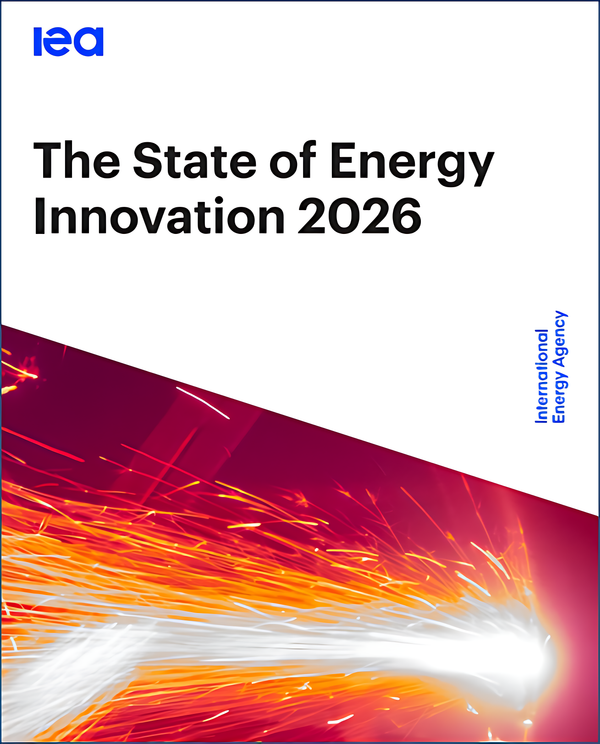
The International Energy Agency’s Energy Technology Perspectives 2026 lands at a moment when the energy system is no longer defined by a single variable. For most of the twentieth century, the central problem was scale: how to produce more energy, more cheaply, and deliver it reliably. The early twenty-first century added a second axis—carbon—forcing the system to decarbonize while continuing to grow.
Now a third dimension has emerged. The system is becoming constrained—not by any one factor, but by many at once. Electricity, materials, manufacturing capacity, trade policy, infrastructure timelines, and physical resources are beginning to bind together. The result is a system that is expanding and tightening at the same time. The IEA’s report does not state this outright. But read carefully, it documents the transition from a single-constraint system to a multi-constrained one.
From Policy-Driven Growth to Market Momentum
Beneath the market expansion is a set of reinforcing technical dynamics that the report captures but does not foreground.
Solar PV’s cost decline is not only a function of scale, but of incremental efficiency gains in cell architectures—TOPCon and heterojunction designs pushing module efficiencies beyond 23–25 percent in commercial deployments. Manufacturing improvements, including wafer thinning and reduced silver content, are lowering material intensity per watt even as total output rises.
Battery systems are undergoing a similar evolution. Lithium iron phosphate (LFP) chemistries have displaced nickel-rich cathodes in many applications due to cost, safety, and cycle life advantages. At the same time, cell-to-pack and cell-to-chassis integration are reducing inactive material, improving energy density at the system level rather than the cell level alone. These engineering shifts are as important as raw cost declines in enabling deployment.
Wind technologies are scaling through rotor diameter expansion and higher hub heights, increasing capacity factors rather than relying solely on cost reductions. Offshore wind, in particular, is moving toward turbines exceeding 15 MW, introducing new challenges in installation logistics, transmission integration, and reliability.
These technology-level improvements explain why cost curves have continued to fall even as input prices fluctuate. The system is learning not just how to build more, but how to build differently.
The report opens with a fact that would have been controversial even five years ago: clean energy technologies now represent a market approaching $1.2 trillion.¹ Solar, wind, batteries, and electric vehicles are no longer emerging sectors. They are industrial systems with global scale.
The pace of growth is equally striking. Over the past decade, these technologies have expanded at roughly 20 percent per year.² Even under conservative policy assumptions, the IEA projects that their market value will double again by 2035.
What matters is not only the magnitude of this growth, but its source. For most of the transition, policy created the market. Subsidies, mandates, and carbon targets drove deployment.
That relationship is now shifting. Costs have fallen to the point where economics, not policy, increasingly drives adoption. Around 80 percent of global solar and wind generation now occurs at lower cost than coal or gas.³ Battery prices have declined by roughly 75 percent over the past decade.⁴ In some markets, electric vehicles are approaching or achieving cost parity with internal combustion engines.
This is the quiet turning point. Technologies that once required justification now propagate through the system on their own terms. And yet, the system is not stabilizing. It is becoming more complex.
The Structure Beneath the Growth Curve
The report’s most consequential insight lies beneath its market projections: the clean energy transition is structurally dependent on a narrow set of supply chains.
China’s position is not simply dominant; it is foundational. Across key technologies, it controls between 60 and 85 percent of manufacturing capacity—and in some stages, more than 95 percent.⁵ These concentrations are especially acute in midstream processing and critical minerals, where substitution is difficult and lead times are long.
The implications are measurable. The IEA estimates that a one-month disruption in Chinese battery exports would remove approximately $17 billion in output from global electric vehicle production.⁶ A similar disruption in solar supply chains would erase roughly $1 billion in monthly output from manufacturing outside China.⁷
These figures describe more than exposure. They describe system behavior. A localized disruption propagates globally because the system has become tightly coupled. The modern energy system is not just electrifying. It is becoming interdependent in ways that amplify both efficiency and fragility.
Trade Policy Enters the System Core
For decades, trade policy sat at the periphery of energy analysis. In Energy Technology Perspectives 2026, it moves to the center.
The number of restrictive trade measures worldwide has increased nearly sixfold since 2015.⁸ Tariffs, export controls, and industrial subsidies are no longer episodic responses. They are structural features of the system.
Governments are acting with clear intent: to secure domestic industries, reduce dependence, and capture economic value from the energy transition. But the outcomes are more ambiguous than the intent.
Tariffs raise costs, but often less than expected. In many cases, their impact is diluted by falling commodity prices, shifts in trade flows, and increased domestic production.⁹ Solar modules, for example, account for only 10 to 15 percent of the total cost of a residential installation in many advanced economies, limiting the effect of tariffs on end users.¹⁰
At the same time, trade continues to expand. The IEA projects that the global value of clean energy technology trade will more than double by 2035, even in a more fragmented geopolitical environment.¹¹ The system is fragmenting politically while remaining integrated economically. That tension is not temporary. It is structural.
A System Moving at Multiple Speeds
The divergence in technology maturity is rooted in underlying engineering realities. Hydrogen production, for example, is constrained not only by cost but by electrolyser performance characteristics. Alkaline electrolysers offer durability and lower cost but limited dynamic response, while proton exchange membrane (PEM) systems provide flexibility suited to variable renewables but at higher capital cost due to reliance on scarce materials such as iridium. Solid oxide electrolysers promise higher efficiencies but remain in early stages of deployment, with durability challenges under real-world cycling conditions.
Carbon capture systems face a different set of constraints. Post-combustion capture using amine solvents is commercially available, but energy penalties—often 15–25 percent of plant output—remain a barrier. Emerging approaches, including solid sorbents and membrane-based separation, aim to reduce these penalties but have yet to scale. Transport and storage infrastructure further complicate deployment, requiring coordinated development of pipelines and geological storage sites.
In heavy industry, near-zero emissions steel production using direct reduced iron (DRI) with hydrogen introduces process integration challenges. Hydrogen purity, temperature control, and reactor design all affect metallurgical quality. Similarly, low-carbon cement pathways—such as calcination with carbon capture or alternative clinker chemistries—must balance cost, durability, and compatibility with existing construction standards.
At the frontier, nuclear fusion and electrochemical processes represent a different class of innovation. Advances in high-temperature superconducting magnets have enabled recent fusion milestones, but confinement stability and net energy gain remain unresolved. Electrochemical pathways for ammonia and iron production offer theoretical efficiency gains but face scaling challenges in current density, catalyst durability, and system integration.
These are not marginal technical hurdles. They define the pace at which each technology can move from concept to system integration. The energy transition is therefore governed not only by economics and policy, but by the physics and engineering limits embedded in each pathway.
One of the report’s strengths is its refusal to treat clean energy as a single category. Instead, it maps technologies along a continuum of maturity. At one end are industrialized systems—solar, wind, batteries, electric vehicles—where scale and cost reductions reinforce each other.
In the middle are technologies such as hydrogen and carbon capture. Investment is rising—global spending on low-emissions hydrogen reached nearly $8 billion in 2025, and CCUS investment has increased more than fifteen-fold since 2020—but deployment remains uneven.¹² Many projects have yet to reach final investment decision.
At the far end are technologies still in early development: fusion, advanced materials, electrochemical processes. These attract capital and attention, but their timelines remain uncertain. The implication is straightforward. The energy transition is not a single curve. It is a layered system evolving at different speeds. That layering introduces friction. Technologies do not integrate smoothly when their timelines diverge.
Industrial Competitiveness as a Binding Constraint
Industrial competitiveness is ultimately anchored in manufacturing detail. In battery production, yield rates, electrode coating uniformity, and formation cycling protocols determine both cost and performance. Small improvements in yield—moving from 90 to 95 percent—can materially shift cost structures at scale. Similarly, advances in dry electrode processing have the potential to reduce energy consumption and capital intensity, though they are not yet widely commercialized.
Solar manufacturing competitiveness depends on upstream integration. Control over polysilicon purification, ingot growth, and wafer slicing enables cost reductions that downstream assembly alone cannot achieve. Diamond wire sawing and kerfless wafer technologies are reducing material waste, while automation is driving labor cost differentials.
Wind turbine manufacturing reflects a different set of constraints. Blade production is limited by transport logistics as much as by fabrication cost, driving interest in modular blade designs and on-site manufacturing. Gearbox reliability, power electronics, and condition monitoring systems increasingly determine lifecycle cost rather than upfront capital alone.
In electrolysers, manufacturing scale is still emerging. Stack design, catalyst loading, and balance-of-plant integration all influence cost trajectories. Unlike solar or batteries, there is not yet a dominant design paradigm, leaving room for regional differentiation—but also increasing uncertainty.
These details matter because they accumulate. Competitiveness is not determined by a single breakthrough, but by thousands of incremental improvements across the production chain.
That accumulation is what currently separates leading manufacturing systems from those attempting to catch up. Perhaps the most important shift in the report is its emphasis on industrial competitiveness. Energy transitions were once framed in terms of resources and emissions. Increasingly, they are framed in terms of manufacturing advantage.
China’s cost position reflects decades of accumulated scale, integrated supply chains, workforce development, and sustained policy support.¹³ The IEA disaggregates this advantage with unusual clarity. In battery manufacturing, efficiency accounts for more than 40 percent of the cost gap between China and Europe.¹⁴ In upstream solar production, energy and labor costs account for roughly 65 percent of the difference.¹⁵
These are structural gaps. They do not close quickly. At the same time, energy costs themselves are reasserting their influence. In energy-intensive industries, they can account for more than two-thirds of total production cost.¹⁶ This creates a new geography of advantage. Regions with access to low-cost energy—parts of the Middle East or North Africa—may outcompete traditional industrial centers in producing next-generation materials. The transition is reorganizing industrial geography as much as it is decarbonizing energy.
Closing
Energy Technology Perspectives 2026 is disciplined in tone. It avoids exaggeration and resists narrative overreach. Its value lies in its clarity. But its most important contribution may be indirect.
It shows a system that is expanding rapidly while becoming structurally tighter. It documents growth that is real, but increasingly conditional. It reveals a transition that is no longer governed by a single dominant constraint, but by the interaction of many.
What it leaves largely unstated is the implication. As energy systems become more electrified, more digital, and more interdependent, the central challenge shifts. It is no longer sufficient to deploy technology at scale. The task becomes governing a system where constraints interact, propagate, and occasionally conflict. That is the next phase of the transition.
The IEA’s report captures a system in motion—past the point of proof, but not yet in equilibrium. The technologies are scaling. The markets are expanding. The capital is flowing. But the system is tightening.
And within that tightening—across supply chains, trade, manufacturing, and infrastructure—the next set of risks, and the next opportunities, are already forming.
Notes
- International Energy Agency, Energy Technology Perspectives 2026 (Paris: IEA, 2026), Executive Summary.
- Ibid.
- Ibid.
- Ibid.
- Ibid.
- Ibid.
- Ibid.
- IEA, Energy Technology Perspectives 2026, Chapter 1.
- Ibid.
- Ibid.
- IEA, Energy Technology Perspectives 2026, Executive Summary.
- Ibid.
- Ibid.
- Ibid.
- Ibid.
- Ibid.
Bibliography
International Energy Agency (IEA). Energy Technology Perspectives 2026. Paris: IEA, 2026.