
In June 2026, federal energy regulators approved PJM Interconnection’s expedited track for certain large generation projects, a temporary effort to bring qualified capacity resources online faster as the largest U.S. grid operator confronts rising electricity demand, resource adequacy pressure, and the power requirements of AI data centers.¹ The decision was about interconnection. But its significance was larger: artificial intelligence has crossed from the language of software strategy into the physical and institutional machinery of the electric system.
That shift should change how utilities think about AI. For the past two years, the energy conversation around artificial intelligence has focused heavily on load: how much electricity data centers will consume, whether the grid can accommodate them, who should pay for network upgrades, and whether hyperscale demand will raise costs for other customers. These questions are urgent. The International Energy Agency estimates that data centers consumed about 415 terawatt-hours globally in 2024, roughly 1.5 percent of global electricity consumption, and projects that global data center electricity consumption could roughly double by 2030 in its base case.² In the United States, Lawrence Berkeley National Laboratory estimated that data centers used about 176 terawatt-hours in 2023, or 4.4 percent of national electricity consumption, with a modeled range of 325 to 580 terawatt-hours by 2028.³
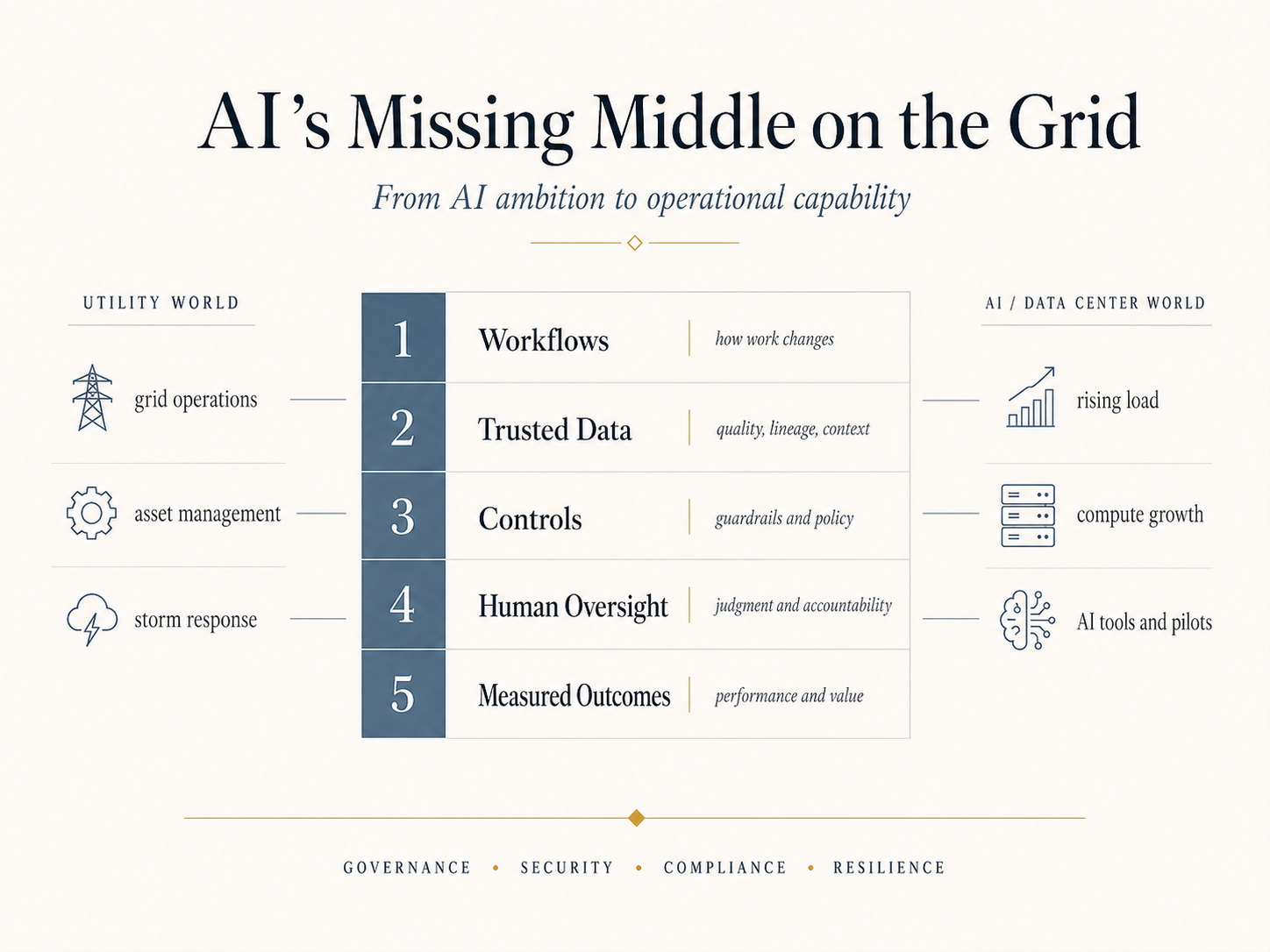
But treating AI only as a new class of electric load misses the more important point. AI is also becoming a new operating layer for the power system. It will shape forecasting, asset management, vegetation planning, storm response, interconnection studies, customer operations, regulatory filings, field work, procurement, capital planning, and executive decision support.
The challenge is not whether utilities should use AI. They already will. The challenge is whether they can absorb AI into governed workflows, accountable decisions, regulatory evidence, and measurable operating performance. This is AI’s missing middle.
It is the layer between executive ambition and technical execution: the managerial discipline of translating an AI priority into a redesigned workflow, a governed product, a clear operating model, and a measurable business result. In most industries, a weak missing middle wastes money and slows transformation. In utilities, it can create reliability risk, regulatory exposure, customer harm, cybersecurity vulnerabilities, imprudent capital spending, and public distrust. The power sector does not need another wave of disconnected AI pilots. It needs utility AI operating models.
The prototype is not the transformation
A generative model can now summarize a regulatory order, draft a customer communication, search engineering standards, generate code, query a document set, or simulate a field-support assistant with impressive speed. That speed is useful. It is also deceptive.
A prototype can show that something is technically possible. It does not prove that the utility is ready to use it. It does not establish whether the data is reliable, whether the workflow has been redesigned, whether operators trust the output, whether compliance concerns have been resolved, whether cybersecurity has approved the architecture, whether decision rights are clear, or whether anyone owns the process after launch.
Those are not implementation details. They are the conditions under which technology becomes performance. A storm-response copilot that works in a demo is not yet a restoration capability. A regulatory filing assistant that summarizes documents is not yet a defensible compliance process. An asset-health model that ranks transformers is not yet a capital planning system. A load forecast improved by machine learning is not yet a planning assumption that a utility can defend before regulators.
Utilities are not slow because they lack imagination. They are slow because they operate under obligations that software companies rarely face: safe service, just and reasonable rates, cyber resilience, nondiscriminatory access, storm restoration performance, worker safety, public accountability, and asset lives measured in decades. In that context, AI adoption is not a technology rollout. It is institutional redesign.
The workflow, not the model, is the unit of value
Many AI initiatives begin with the wrong question: what can the technology do? That question is not irrelevant. It is premature.
The better starting question is: what work needs to change? In a utility, the answer may be faster capital planning, better demand forecasting, shorter interconnection studies, earlier identification of operational risk, more consistent regulatory analysis, improved storm restoration, more accurate vegetation prioritization, better customer triage, or more reliable field knowledge transfer.
Those are not model categories. They are workflows. Each has users, data sources, decision points, handoffs, controls, exceptions, and accountability structures. AI creates value only when it changes one of those workflows in a way the organization can adopt.
Without workflow clarity, AI becomes an overlay on top of existing inefficiency. The utility automates fragments of a flawed process and then wonders why value is limited. The goal is not to automate every step. Some work should be accelerated. Some should be augmented. Some should be redesigned. Some should be governed more tightly. Some should remain firmly in human hands.
A serious utility AI program therefore begins by mapping the work. Who performs it? What information do they use? Where is judgment applied? Where do delays occur? Which handoffs break down? Which decisions require escalation? Which data is authoritative? Which parts of the process are formal, and which depend on tacit knowledge?
Only then should the organization decide whether the right solution is a copilot, a predictive model, a retrieval system, an optimization tool, an agentic workflow, a dashboard, a process redesign, or no AI at all.
Utility AI needs risk tiers
The phrase “AI use case” is too blunt for a regulated utility. A document assistant and a grid-operations recommender should not live under the same governance model. A disciplined utility AI program should classify applications into at least three risk tiers.
Tier 1: Knowledge augmentation. These applications search, summarize, draft, classify, or retrieve information for human review. Examples include regulatory filing support, internal knowledge assistants, contact center copilots, engineering standards search, procurement document review, and meeting synthesis. They still require data security, privacy controls, provenance, and quality checks, but they do not directly control operational decisions.
Tier 2: Decision support. These systems influence operational, financial, or planning decisions but leave approval with accountable employees. Examples include asset risk scoring, vegetation inspection prioritization, outage prediction, storm crew staging, DER hosting-capacity screening, customer propensity models, and capital planning analytics. They require stronger validation, explainability, performance monitoring, bias testing, exception handling, and business-owner accountability.
Tier 3: Operational orchestration. These are agentic or semi-autonomous workflows that can coordinate steps across systems: creating work packages, routing approvals, drafting customer notices, preparing regulatory responses, initiating procurement steps, or orchestrating restoration logistics. These systems require human-in-the-loop controls, role-based permissions, deterministic guardrails, rollback procedures, audit logs, and clear prohibitions on unsafe closed-loop behavior.
No utility should allow language-model agents to improvise inside operational technology environments. The point of agentic AI in utilities is not autonomy for its own sake. It is controlled orchestration: a system that can gather information, recommend actions, prepare work products, and route decisions through accountable human authority.
Agentic AI requires a control plane
“Agentic AI” is often described as if it were simply a more capable chatbot. In a utility, the term should mean something more precise: an AI system that can interpret a goal, access approved data sources, call approved tools, execute bounded tasks, and maintain a traceable record of what it did, why it did it, and where human approval occurred. That requires an AI control plane.
A utility-grade AI control plane should include identity and access management tied to enterprise roles; data entitlements that prevent models from retrieving or exposing unauthorized records; retrieval provenance so users can see which documents, tables, sensor feeds, or cases support an answer; policy enforcement that blocks prohibited actions; prompt and response logging for auditability; model and tool registries that document approved models, versions, capabilities, and limitations; evaluation harnesses that test accuracy, hallucination risk, robustness, latency, and safety; human approval gates for high-consequence actions; monitoring for drift, misuse, and degraded performance; and incident-response procedures for AI failures, data leakage, or unsafe recommendations.
This is where responsible AI becomes operational. The National Institute of Standards and Technology’s AI Risk Management Framework identifies trustworthy AI characteristics including validity, reliability, safety, security, resilience, accountability, transparency, explainability, privacy enhancement, and fairness.⁴ For utilities, those principles must be translated into engineering controls, procurement requirements, operating procedures, and regulatory evidence.
A board, regulator, or consumer advocate will not be reassured by the phrase “responsible AI.” They will ask: Who owns the model? Which data trained or informed it? How is access controlled? How often is it tested? What happens when it is wrong? Can the utility reproduce the recommendation? Can an auditor inspect the record? Can a customer challenge an outcome? Can operators override it? Can the system fail safely? Those questions are not obstacles to innovation. They are the architecture of trust.
Utility-grade GenAI is an architecture, not a prompt
For utilities, GenAI should be designed as a governed architecture rather than a loose interface to a foundation model. A production-grade pattern will often include retrieval-augmented generation over approved enterprise content; role-based access to source systems; a semantic layer that maps utility terminology, assets, locations, and processes; orchestration services that determine which tools or data sources may be used; model evaluation pipelines that test accuracy, citation quality, latency, toxicity, and failure modes; and LLMOps practices for versioning, monitoring, red-teaming, incident response, and continuous improvement.
The architecture matters because utility AI systems do not merely produce text. They influence work. A regulatory copilot may shape discovery responses. A field knowledge assistant may affect safety practices. A storm-response agent may synthesize crew, weather, outage, and asset data for operational decisions. A capital-planning model may influence billions of dollars of investment. In each case, the model is only one component. The larger system includes data pipelines, retrieval logic, access controls, workflow integration, monitoring, human approval, and auditable evidence.
This is why the distinction between a model, an application, and an operating capability matters. A model can generate an answer. An application can place that answer inside a user interface. An operating capability changes how work is performed, governed, measured, and improved. Utilities should be building the third.
The data architecture is the strategy
AI in utilities will rise or fall on data integration. The highest-value use cases require information scattered across operational, enterprise, customer, geospatial, market, and regulatory systems: SCADA, EMS, DMS, OMS, GIS, EAM, AMI, CIS, work management, weather feeds, inspection records, vegetation data, interconnection queues, wholesale market prices, and commission documents.
A useful GenAI system for utility planning cannot simply retrieve PDFs from SharePoint. It must understand asset hierarchies, feeder topology, service territories, equipment condition, work history, operating constraints, customer classes, outage events, and regulatory commitments. A field copilot cannot simply summarize a manual. It must retrieve the right standard for the asset, location, crew role, job type, weather condition, safety rule, and work order.
That is why the most important AI investments may look boring: data catalogs, metadata standards, master data management, semantic layers, API governance, document classification, geospatial indexing, and integration patterns between systems of record. Without those foundations, GenAI becomes a polished interface to unreliable context.
The technical architecture should usually separate four layers. First is the systems-of-record layer: operational, asset, customer, market, and document systems. Second is the data and context layer: governed data products, vector indexes, knowledge graphs, semantic models, and metadata. Third is the AI services layer: models, retrieval pipelines, orchestration frameworks, evaluation tools, and policy engines. Fourth is the workflow layer: copilots, dashboards, work queues, approval processes, mobile field applications, and executive decision tools.
The winning utilities will not be those with the largest model budgets. They will be those with the cleanest path from trusted data to accountable workflow.
The implementation roadmap should be Agile, but the controls cannot be improvised
A practical utility AI roadmap should combine Agile delivery with regulated-industry discipline.
Discovery sprints can identify high-value workflows, user pain points, data gaps, and adoption barriers. Prototype sprints can test retrieval quality, workflow fit, user trust, and integration complexity. Pilot sprints can validate performance, controls, and operating procedures with real users. Scale sprints can harden the architecture, expand the user base, formalize support, and connect adoption to measurable business outcomes.
But Agile does not mean ungoverned. For AI systems in regulated utilities, each sprint should carry explicit control questions: what data is being used, what decision is being influenced, what human review is required, what failure modes are unacceptable, what monitoring is needed, and what evidence must be preserved. This is how utilities can move quickly without treating safety, reliability, compliance, and customer trust as afterthoughts.
AI should improve capital discipline, not just labor productivity
The early business case for GenAI often focuses on hours saved: faster drafting, faster research, faster customer responses, faster code. That matters. But in utilities, the larger prize is capital discipline.
Utilities are entering a period of rising load growth, aging infrastructure, electrification, resilience spending, DER integration, and large-load interconnection pressure. NERC has warned that resource adequacy risks are intensifying as demand growth surges, with new data centers for AI and the digital economy accounting for much of the projected increase.⁵ Meanwhile, data center demand forecasts remain uncertain, and utilities face the risk of building infrastructure for demand that may shift, delay, self-supply, or fail to materialize.⁶
That uncertainty makes AI valuable not only as automation, but as decision support. Utilities need better ways to evaluate scenarios: what happens if large-load projects arrive on schedule, slip by three years, change location, self-supply, co-locate with generation, or become interruptible? What happens if EV adoption lags but data centers accelerate? What if transformer supply constraints persist? What if interconnection costs are assigned differently? What if regulators require stronger customer protections before approving network upgrades?
AI-enabled planning systems can help by combining scenario generation, probabilistic forecasting, document retrieval, asset analytics, and portfolio optimization. But they must be used with humility. The goal is not to generate a single “AI forecast.” The goal is to widen the aperture of planning, expose assumptions, stress-test capital decisions, and make uncertainty legible to executives, regulators, and customers.
Data centers should become grid-interactive customers
The AI-energy debate is often framed as a conflict between hyperscale growth and grid reliability. That conflict is real, but incomplete. Data centers are not just large loads. With the right technical and commercial structures, some can become flexible grid resources.
Research and field demonstrations are beginning to test whether AI workloads can be shifted or curtailed in response to grid conditions. One 2025 field demonstration reported a software-only approach that reduced cluster power usage by 25 percent for three hours during peak grid events while maintaining quality-of-service constraints for representative AI workloads.⁷ The practical lesson is not that all compute is flexible. Training, inference, latency-sensitive services, contractual obligations, cooling systems, backup requirements, and customer commitments differ sharply. The lesson is that utilities, grid operators, and data center operators need more granular categories than “firm” and “interruptible.”
A more sophisticated tariff and interconnection framework would distinguish among nonflexible critical load, time-shiftable AI training, deferable batch processing, latency-sensitive inference, storage-backed load, co-located generation-backed load, load capable of voltage or frequency ride-through, load capable of dispatchable curtailment, and load capable of providing telemetry and operating visibility.
This is not just a commercial issue. It is a reliability issue. Large, converter-dominated loads that disconnect simultaneously during grid disturbances can create operational risks. Utilities and system operators need telemetry, ride-through requirements, commissioning tests, disturbance-behavior standards, and visibility into load flexibility.
The AI industry wants faster power. The grid needs better behavior. The bargain should be clear: speed in exchange for transparency, flexibility, cost responsibility, and reliability-supportive operating characteristics.
Regulators will ask for evidence
The next phase of utility AI will be regulator-facing. That means utilities should design AI programs as if they will eventually need to explain them in a rate case, prudence review, reliability investigation, cybersecurity audit, or customer complaint proceeding.
For each material AI use case, utilities should maintain an evidence file: business purpose, risk classification, data sources, data quality assessment, model or vendor selection rationale, validation results, human oversight design, cybersecurity and privacy review, performance metrics, known limitations, incident history, cost-benefit analysis, customer impact assessment, and retirement or rollback plan.
This may sound bureaucratic. It is actually an adoption accelerator. When evidence exists, legal, compliance, cybersecurity, operations, and regulatory teams can say yes faster. When evidence is missing, every AI project becomes a bespoke negotiation with institutional risk.
The same discipline applies to procurement. Utilities should not buy “AI solutions” in the abstract. They should buy governed capabilities tied to workflows, system integration, performance obligations, auditability, and evidence requirements. Vendor contracts should address data rights, model access, cybersecurity, indemnity, monitoring, explainability, subcontractors, regulatory cooperation, and exit rights. In regulated utilities, procurement is part of governance.
The framework is reusable
The same operating model can become a repeatable delivery asset. For each utility AI initiative, leaders should work through a standard sequence:
- Define the outcome: What operating, financial, customer, reliability, or regulatory result matters?
- Map the workflow: What work changes, who performs it, and where does judgment sit?
- Assess data readiness: Which systems, documents, and data products are authoritative?
- Tier the risk: Is the use case knowledge augmentation, decision support, or operational orchestration?
- Select the architecture pattern: Does the use case require RAG, predictive analytics, optimization, agentic orchestration, or a hybrid approach?
- Design the controls: What access, monitoring, human approval, auditability, and fallback mechanisms are required?
- Plan delivery: What can be prototyped, piloted, hardened, and scaled?
- Measure value: How will adoption, performance, risk reduction, cycle time, quality, and business value be measured?
This is not a theoretical checklist. It is the delivery spine for moving from AI ambition to operational capability. the moat
Utilities should resist two extremes: the belief that AI is too risky for serious operational use, and the belief that AI can be safely diffused through the enterprise by giving everyone access to tools. The better path is federated control.
A utility AI operating model should combine a central governance function with embedded business ownership. The center should set standards, approve platforms, maintain risk frameworks, manage model inventories, define security requirements, provide reusable technical patterns, and monitor enterprise exposure. Business units should own use cases, workflow redesign, adoption, benefits realization, and accountable decisions.
The critical roles are not exotic. They include AI product owners, data stewards, model risk leads, cybersecurity reviewers, regulatory liaisons, field operations representatives, change managers, procurement specialists, and executive sponsors. Without these roles, AI remains a side project. With them, it becomes an operating capability.
The same logic should shape the AI portfolio. Not every use case deserves investment. Leaders should prioritize opportunities based on business value, feasibility, data readiness, risk, adoption complexity, and scalability. They should distinguish among quick productivity tools, workflow-specific capabilities, and enterprise-scale operating changes. Each has a different investment logic, ownership model, and risk profile. A serious AI portfolio is not a catalog of ideas. It is a set of managed bets.
The next grid modernization challenge is organizational
The first phase of grid modernization was physical and digital: sensors, smart meters, communications networks, distribution management systems, forecasting tools, and analytics platforms. The next phase is organizational. Utilities must learn how to put AI into the decision fabric of the enterprise without weakening accountability.
That will require new habits. Engineers will need to work with data scientists. Regulatory lawyers will need to understand model evidence. Cybersecurity teams will need to review AI orchestration. Field leaders will need to shape technician copilots. Customer teams will need to test AI-mediated interactions for fairness and accuracy. Finance teams will need to distinguish activity from value. Executives will need to ask better questions than “What is our AI strategy?”
They should ask: Which workflows are we changing? Which decisions are AI systems allowed to influence? Which systems are off limits? Which data sources are authoritative? Which use cases require audit trails? Which models are approved? How do we know performance is improving? Who is accountable when the AI is wrong? What would we tell regulators, customers, employees, and investors? These questions may seem less exciting than a demo. They are also the difference between experimentation and transformation.
AI will test the compact between utilities and society
Electric utilities occupy a privileged position. They are granted monopoly franchises or regulated access to essential infrastructure because society expects them to deliver safe, reliable, affordable service. AI does not change that compact. It raises the stakes.
If AI is used poorly, it could amplify bad data, obscure accountability, accelerate imprudent spending, worsen customer inequities, introduce new operational risks, or erode public trust. If used well, it could improve reliability, sharpen capital allocation, speed restoration, reduce administrative burden, support field workers, improve customer service, and help utilities manage the most complex load-growth environment in a generation.
The choice is not between adopting AI and resisting it. The choice is between unmanaged adoption and governed adoption. The grid will not be saved by AI demos. It will be strengthened by utilities that build the operating models, data foundations, control planes, evidence files, and institutional trust needed to use AI where it matters.
That is AI’s missing middle on the grid. And increasingly, it is the main event.
Notes
- Reuters, “US Energy Regulator Approves PJM’s Fast-Tracked Power Plant Interconnection Plan,” June 10, 2026, updated June 11, 2026. (Reuters)
- International Energy Agency, “Energy Demand from AI,” in Energy and AI, 2025. (IEA)
- Arman Shehabi et al., 2024 United States Data Center Energy Usage Report (Berkeley, CA: Lawrence Berkeley National Laboratory, 2024); Harvard Kennedy School Belfer Center, “AI, Data Centers, and the U.S. Electric Grid: A Watershed Moment,” February 10, 2026. (Energy Technologies Area)
- National Institute of Standards and Technology, Artificial Intelligence Risk Management Framework (AI RMF 1.0), NIST AI 100-1 (Gaithersburg, MD: National Institute of Standards and Technology, 2023). (NIST Publications)
- North American Electric Reliability Corporation, “Resource Adequacy Risks Intensify Across North America as Demand Growth Surges,” January 29, 2026. (NERC)
- Harvard Kennedy School Belfer Center, “AI, Data Centers, and the U.S. Electric Grid: A Watershed Moment,” February 10, 2026. (Belfer Center)
- Philip Colangelo et al., “Turning AI Data Centers into Grid-Interactive Assets: Results from a Field Demonstration in Phoenix, Arizona,” arXiv, July 2025. (arXiv)
Bibliography
Colangelo, Philip, Ayse K. Coskun, Jack Megrue, Ciaran Roberts, Shayan Sengupta, Varun Sivaram, Ethan Tiao, Aroon Vijaykar, Chris Williams, Daniel C. Wilson, Zack MacFarland, Daniel Dreiling, Nathan Morey, Anuja Ratnayake, and Baskar Vairamohan. “Turning AI Data Centers into Grid-Interactive Assets: Results from a Field Demonstration in Phoenix, Arizona.” arXiv, July 2025. (arXiv)
Harvard Kennedy School Belfer Center. “AI, Data Centers, and the U.S. Electric Grid: A Watershed Moment.” February 10, 2026. (Belfer Center)
International Energy Agency. “Energy Demand from AI.” In Energy and AI. Paris: International Energy Agency, 2025. (IEA)
International Energy Agency. “Executive Summary.” In Key Questions on Energy and AI. Paris: International Energy Agency, 2026. (IEA)
National Institute of Standards and Technology. Artificial Intelligence Risk Management Framework (AI RMF 1.0). NIST AI 100-1. Gaithersburg, MD: National Institute of Standards and Technology, 2023. (NIST Publications)
North American Electric Reliability Corporation. “Resource Adequacy Risks Intensify Across North America as Demand Growth Surges.” January 29, 2026. (NERC)
Reuters. “US Energy Regulator Approves PJM’s Fast-Tracked Power Plant Interconnection Plan.” June 10, 2026. Updated June 11, 2026. (Reuters)
Shehabi, Arman, Sarah J. Smith, Eric Masanet, and Jonathan Koomey. 2024 United States Data Center Energy Usage Report. Berkeley, CA: Lawrence Berkeley National Laboratory, 2024. (Energy Technologies Area)