America’s AI buildout is usually described as a race for power. It is also becoming a race for proof. On June 9, 2026, the U.S. Energy Information Administration raised its forecast for electricity demand, projecting that American power use would reach record highs in both 2026 and 2027. The agency’s forecast reflected a new load-growth cycle driven by data centers, electrification, and economic activity. For the first time in modern records, commercial electricity use was expected to exceed residential consumption.¹
A day later, federal regulators approved a fast-track interconnection process for PJM Interconnection, the nation’s largest grid operator, to move a limited number of “shovel ready” generation projects more quickly through the queue. The program was designed for a power system under pressure: rising demand, resource adequacy concerns, and the slow machinery of interconnection review.²
The following day, a Reuters/Ipsos poll showed the political edge of the same problem. Most surveyed Americans expressed concern that AI data centers could raise electricity costs, and many opposed rapid construction in their own communities.³
The same week, NVIDIA was promoting a different front in the AI buildout: powerful AI systems moving closer to users. Its RTX Spark and DGX Spark announcements pointed toward a world in which advanced models are not confined to hyperscale data centers but spread across personal computers, enterprise systems, and local devices.⁴
Together, these developments mark something larger than an electricity-demand story. AI is increasing the physical load on the grid while also changing the way grid decisions are produced, defended, challenged, and trusted.
That second shift has received less attention. It may prove just as important. Artificial intelligence is making analysis cheap. Forecasts, summaries, risk memos, regulatory comments, technical explanations, scenario narratives, investment cases, and stakeholder briefs can now be produced in minutes. They can be fluent, specific, and persuasive. They can also be wrong, incomplete, untraceable, or impossible to reproduce.
The power sector is entering a new bottleneck. It is no longer enough to produce analysis. The next scarce resource is analysis that can survive verification. That is the emerging verification economy.
It is the market and institutional shift from scarce analysis to scarce trust. It includes provenance, auditability, reproducibility, model governance, evidence trails, professional accountability, and institutional authority. It will matter across finance, law, medicine, science, media, and government. But electricity may be where it arrives first in its hardest form, because the grid is already governed by proof.
The verification economy is the market-facing form of a deeper institutional problem. In The Cognitive Grid, the issue is delegated power: the quiet movement of judgment into models, optimization routines, rankings, and defaults that shape what people perceive as the reasonable decision. The danger is not that machines suddenly seize control. It is that advisory systems become indispensable, defaults harden, and authority moves before governance catches up. Verification is the first defense against that migration becoming invisible.
The smart grid was about sensing and control. The cognitive grid is about delegated judgment. That distinction matters. A grid does not become cognitive simply because it uses AI, sensors, automation, or advanced forecasting. It becomes cognitive when machine systems begin to shape the decision space itself: ranking risks, narrowing options, recommending actions, compressing uncertainty, prioritizing assets, and making some choices appear more reasonable than others before a human being formally acts.
That is why proof matters. In critical infrastructure, verification is not just a technical safeguard. It is the record of permission. It shows what data was treated as authoritative, what assumptions were encoded, what constraints were in force, what alternatives were visible, what uncertainty was suppressed or disclosed, and who remained accountable when machine-shaped judgment entered public consequence.
When Analysis Becomes Abundant
For most of the modern electricity industry, serious analysis was expensive. Load forecasts required specialized data and trained analysts. Transmission plans required engineers, models, assumptions, contingency analysis, and formal study processes. Integrated resource plans involved months of scenario work and stakeholder review. Interconnection studies moved through technical screens, power-flow analysis, cost estimates, facility studies, and queue rules. Rate cases required testimony, exhibits, discovery, and adversarial review.
The bottleneck was often the production of analysis itself. Who had the data? Who could run the model? Who understood the tariff? Who could translate engineering results into a decision that regulators, executives, customers, and counterparties could understand?
Generative AI changes that cost structure. It can summarize a thousand-page docket, draft a ten-page policy memo, compare technology options, generate scenarios, classify stakeholder comments, explain technical findings, and convert fragmented information into polished executive language.
That capability is useful. It is also destabilizing. When analysis was expensive, scarcity acted as a crude filter. Not every organization could produce material that looked like expert work. AI weakens that filter. Developers, utilities, regulators, consultants, investors, advocacy groups, law firms, public agencies, and local opponents can all produce more analysis, faster, at lower cost.
The result is not the end of expertise. It is a migration of expertise to a harder part of the workflow. AI will not remove the need for expertise in energy. It will move expertise to the task of proving which machine-generated claims deserve to shape real infrastructure.
That migration has historical precedent. The printing press made text abundant and forced societies to develop new systems of publishing, indexing, censorship, libraries, and scholarly authority. The telegraph made information fast and raised the value of trusted wire services. The internet made publishing cheap and created scarcity around attention, ranking, reputation, moderation, and cybersecurity. Cloud computing made compute elastic and pushed strategic value toward security, compliance, audit, observability, and governance.
AI extends the sequence. It makes analytical output abundant. That makes verified analysis scarce. Herbert Simon described the earlier logic in 1971: a wealth of information creates a poverty of attention.⁵ In the AI era, the logic moves deeper. A wealth of machine-generated analysis creates a poverty of proof.
The Grid is Where Proof Already Matters
Electricity is one of the first sectors where this shift becomes unavoidable because the grid already runs on evidence.
Reliability standards require documented studies. Transmission plans require assumptions, scenarios, and benefit calculations. Interconnection processes require technical review of how new resources or loads affect the system. Market rules require data, settlement logic, monitoring, and dispute resolution. Rate cases require records that can survive scrutiny.
NERC’s transmission planning standard requires annual planning assessments supported by documented assumptions and study results.⁶ NERC’s interconnection standard exists to ensure that new or materially modified facilities are studied for their impact on the bulk electric system.⁷ FERC’s long-term transmission planning rule requires transmission providers to plan over at least a 20-year horizon using multiple scenarios and transparent criteria.⁸ FERC’s interconnection reforms moved the system toward cluster studies, readiness requirements, site control, and greater cost transparency.⁹
These rules are often described as process burdens. In the AI era, they look like something else: the trust architecture of the power system. The timing is difficult. AI is arriving just as the physical system faces a new load-growth cycle. Lawrence Berkeley National Laboratory estimated that U.S. data centers consumed 176 terawatt-hours of electricity in 2023, about 4.4 percent of total U.S. electricity use. The same report estimated that data-center consumption could rise to 325–580 terawatt-hours by 2028, depending on demand growth and efficiency.¹⁰
The supply side is also constrained. Berkeley Lab’s 2025 interconnection queue analysis found roughly 10,300 active projects seeking grid connection at the end of 2024, representing about 1,400 gigawatts of generation and 890 gigawatts of storage.¹¹
NERC has been warning that emerging large loads, including data centers and computational loads, raise reliability questions that existing standards and practices may not fully capture. Its large-load work has identified concerns around interconnection processes, planning, resource adequacy, balancing, operations, disturbance ride-through, stability, power quality, security, resilience, event analysis, and load modeling.¹²
That list reads like a technical manual. It is also a map of the verification economy. A data-center developer may claim that a facility can curtail during grid emergencies. A utility may claim that new transmission or generation is needed. A hyperscaler may claim that clean energy procurement offsets load growth. A state agency may claim that a project produces economic benefits. A local community may question water use, land use, tax incentives, jobs, or electricity-rate impacts. A market monitor may ask whether costs are being shifted to other customers.
AI can help all of these parties produce more analysis. It can also help evaluate their claims. But if the underlying assumptions, data, contractual obligations, model versions, and operating constraints are not visible, AI simply accelerates the production of competing narratives. The grid’s problem is not a lack of narratives. It is the shortage of trusted evidence at the speed now required.
The First Test: Data Center Flexibility
The first major test of the verification economy may be data-center flexibility. As large-load interconnection pressure grows, developers and technology companies increasingly point to flexibility as a way to reduce grid impacts. Some AI workloads can be shifted across time. Some batch processes can pause. Some facilities may use on-site generation, batteries, thermal storage, backup systems, or operational controls to reduce demand during grid stress. Some may be able to provide visibility, telemetry, or emergency curtailment commitments to grid operators.
Those claims matter. If they are real, enforceable, and measurable, they could change how data centers connect to the grid. If they are vague, voluntary, or modeled under unrealistic assumptions, they could shift risk to utilities, customers, or system operators.
The question is no longer whether a data center can produce a flexibility narrative. It is whether that narrative can be verified. What is the minimum load? How fast can the facility ramp down? Which workloads can move? Which cannot? What happens during a heat wave? What happens during a generator outage? What happens if backup fuel is constrained? Who receives the telemetry? What contractual penalties apply if the facility does not perform? Are curtailment commitments reflected in interconnection studies, market rules, and reliability planning? Are claims about clean energy, emissions, and water tied to measurable operating data?
Those are not communications questions. They are verification questions. They show why the AI-era grid cannot rely on generic claims of flexibility, sustainability, or readiness. It needs evidence packages that can be inspected by grid planners, regulators, counterparties, communities, and investors. That is where planning-grade AI begins.
Planning-Grade AI
The Department of Energy’s 2024 report on AI for energy captured the central distinction. The report said AI could improve planning, permitting, grid operations, reliability, and clean-energy deployment. It also said grid AI systems should be rigorously validated, interpretable, ethically implemented with humans in the loop, scalable, physically informed where relevant, and compliant with power-grid governance standards.¹³
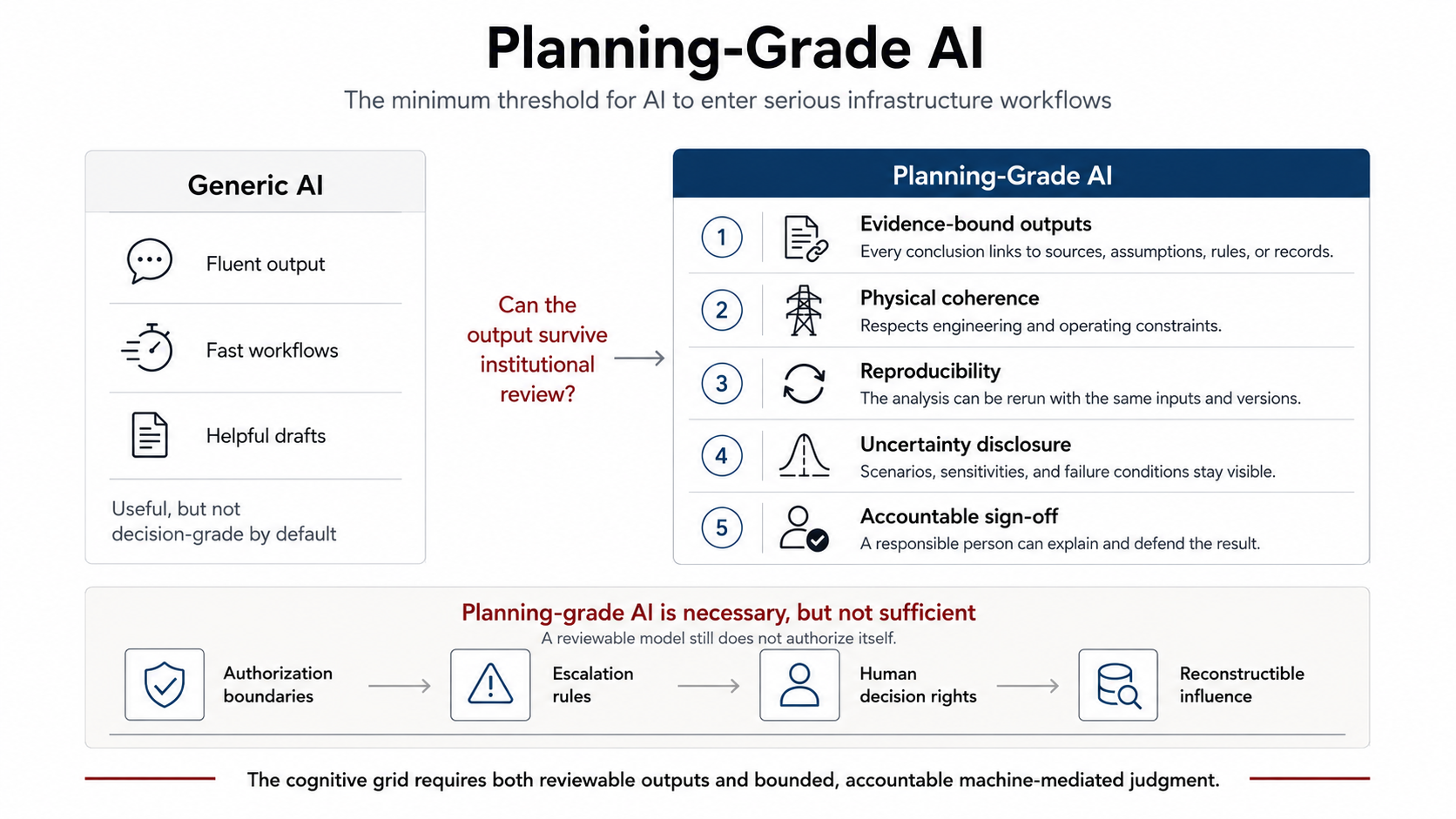
That is the dividing line between generic AI and planning-grade AI. Planning-grade AI is AI whose outputs can survive institutional review. It is not defined by how fluent the answer sounds or how quickly a workflow runs. It is defined by whether the answer can be traced, tested, challenged, reproduced, and signed off by an accountable person or institution.
In practice, planning-grade AI requires five capabilities:
First, evidence-bound outputs. A conclusion about grid capacity, load flexibility, reliability risk, rate impact, clean-energy matching, project readiness, or infrastructure need should link back to source data, assumptions, models, statutes, standards, tariffs, studies, or operating records.
Second, physical coherence. Energy AI must respect engineering constraints: power flows, voltage, thermal ratings, ramp rates, contingency behavior, protection systems, fuel supply, weather correlations, outage risk, and the difference between nameplate capacity and dependable capability. Language fluency is not a substitute for physics.
Third, reproducibility. A study should be rerunnable with the same inputs, model versions, assumptions, code, prompts, and data transformations. Reproducibility does not prove truth. A system can be reproducibly wrong. But without reproducibility, serious review becomes nearly impossible.
Fourth, uncertainty disclosure. Infrastructure planning is not prediction with a single number. It is decision-making under uncertainty. Scenarios, sensitivities, assumptions, and failure conditions matter. AI systems that compress uncertainty into confident prose are poorly matched to high-consequence planning.
Fifth, accountable sign-off. AI can support an engineer, planner, executive, regulator, auditor, market monitor, or system operator. It cannot replace accountability. If no responsible person can explain why a result is fit for use, the workflow is not planning grade.
Planning-grade AI is not the final governance model for the cognitive grid. It is the minimum threshold for allowing AI-supported analysis to enter serious infrastructure workflows. A planning-grade system can show its sources, preserve its assumptions, disclose uncertainty, respect physical constraints, and support accountable review. But even a planning-grade system does not authorize itself. Performance is not permission. Accuracy is not legitimacy. A model can be useful, well-documented, and still be exercising influence in a way the institution has not explicitly approved.
That is the deeper governance challenge. The system must not only produce a reviewable answer. It must operate inside boundaries that define what it is allowed to shape, when it must escalate, what must remain human, and how its influence can be reconstructed after the fact.
This is where many AI products will struggle in energy. A generic copilot may help with drafts and summaries. But high-stakes workflows require more than fluency. They require evidence environments.
Trust is a Stack, not a Feature
The market is already searching for verification tools. Retrieval-augmented generation, provenance systems, watermarking, content credentials, remote attestation, explainability, audit logs, benchmarking, and AI-based evaluators all have roles to play.
None solves the trust problem alone. Retrieval-augmented generation, or RAG, connects AI systems to external sources. It can improve grounding and reduce hallucinations. But recent research on RAG trustworthiness warns that these systems still face risks around factuality, robustness, fairness, transparency, accountability, and privacy.¹⁴ RAG databases can be incomplete, stale, biased, or poisoned. A model can retrieve the right document and still draw the wrong conclusion.
Provenance systems address a different part of the problem. NIST has said provenance tracking can help establish the authenticity, integrity, and credibility of digital content by recording information about its origin and history.¹⁵ C2PA’s Content Credentials standard uses cryptographically bound structures to record an asset’s provenance.¹⁶ That matters in a world where documents, images, audio, video, and analytic summaries may be machine-generated or modified.
But provenance is not truth. It can show where something came from. It cannot prove that a load forecast is accurate, a cost estimate is fair, or a reliability assumption is valid. Remote attestation can verify that a device or software environment is in an intended state.¹⁷ Explainability can help users understand an AI system’s output and limits.¹⁸ Audit logs can show who changed what, when, and with which inputs. Certification can show that an organization has a management system for AI risk. ISO/IEC 42001 establishes requirements for AI management systems, and ISO/IEC 42006 sets requirements for bodies that audit and certify those systems.¹⁹
Each layer helps. Each layer also has limits. A system can be well logged and wrong. It can be explainable and wrong. It can be reproducible and wrong. It can have provenance and still omit decisive evidence. It can be certified and still fail in a specific operational context.
The same lesson appears in the emerging literature on AI evaluation. Automated judges can help compare model outputs, but studies have documented biases and fragility in LLM-as-judge methods, including self-preference, prompt sensitivity, and ordering effects.²⁰ Anthropic’s own guidance on AI agent evaluations warns that poorly designed graders and tasks can distort results.²¹
AI can help verify AI. But AI verifying AI is not the endpoint of trust. In critical infrastructure, the final court of appeal remains institutional: evidence, procedure, accountable judgment, and consequences.
A Market Forms Around Proof
The verification economy is already becoming a commercial category. The United Kingdom’s Department for Science, Innovation and Technology has identified an estimated 161 UK-based AI assurance firms and reported that 80 percent of specialized AI assurance companies showed growth signals.²² Its AI assurance work defines trustworthy AI use as use that is deserving of trust based on reliable evidence.
That definition matters. It moves the market away from vague confidence and toward demonstrable proof. The emerging assurance market is likely to include several kinds of players. Specialized AI assurance firms will test, audit, and validate systems. Professional-services firms will extend existing risk, compliance, audit, and advisory practices into AI. Certification bodies will assess AI management systems. Insurers will price risks tied to model failure, cyber exposure, operational disruption, and liability. Software vendors will build tools for provenance, traceability, monitoring, and governance. Domain experts will validate whether AI-supported conclusions make sense in the physical world.
Energy will be one of the most demanding markets for these services because the consequences are tangible. A weak consumer recommendation engine can annoy users. A weak energy-planning system can misallocate capital, raise customer costs, delay infrastructure, distort public decisions, or undermine reliability.
The likely winners in energy AI may not be the companies with the largest generic models. They may be the organizations with the strongest evidence infrastructure: clean data lineage, scenario libraries, validated models, domain constraints, audit trails, reviewer workflows, and regulator-ready documentation.
Utilities with disciplined model governance will have an advantage. Grid operators with transparent assumptions and better data exchange with large-load customers will have an advantage. Developers that can document flexibility, performance, emissions, and grid impacts will have an advantage. Regulators that can inspect AI-assisted analysis without drowning in it will have an advantage.
The systems that maximize fluent output while neglecting traceability will face a harder path into serious infrastructure workflows. In consumer AI, weak traceability is often a product flaw. In infrastructure, it becomes a procurement barrier.
The Public Trust Problem
The backlash against AI data centers is often described as a siting problem. It is also a trust problem. Communities are being asked to accept large facilities with consequences for electricity infrastructure, water use, land use, local tax bases, transmission buildout, backup generation, air emissions, and utility rates. In many places, the benefits and costs are not distributed evenly. Construction jobs may be temporary. Permanent employment may be limited. Energy costs may be shared broadly. Tax incentives may be negotiated privately. Power procurement claims can be difficult to evaluate. Water and emissions impacts can vary by region and technology.
AI makes this harder because it increases the supply of confident claims. Developers can produce polished economic-impact narratives. Opponents can produce polished risk narratives. Utilities can produce technical justifications. Public agencies can summarize benefits. Advocacy groups can model alternatives. Consultants can generate scenarios. Media accounts can amplify selective facts.
The issue is not that these claims are necessarily false. It is that communities, regulators, and investors need ways to distinguish evidence from narrative. That is why verification is likely to become central to social license. Communities may not need every technical detail of a power-flow study. But they will increasingly ask whether the study was independently reviewed, whether assumptions were disclosed, whether costs are being shifted, whether flexibility claims are enforceable, whether emissions and water claims are measurable, and whether someone is accountable if projections fail.
The data-center debate is an early preview of a broader AI-era problem. As machine-generated analysis becomes cheaper, institutional trust becomes harder to maintain.
From Smart Grid to Cognitive Grid
The energy sector has spent two decades talking about the smart grid. The phrase usually referred to sensors, communications, automation, advanced meters, distributed energy resources, and more responsive operations.
The next stage is different. The cognitive grid is a power system in which machine intelligence becomes embedded in planning, operations, markets, regulation, customer behavior, and infrastructure investment. Forecasts update continuously. Grid assets are inspected by AI vision systems. Interconnection requests are screened by automated tools. Distributed resources respond to prices, constraints, and carbon signals. Data centers shift workloads across time and geography. Utilities use AI to manage vegetation, predict equipment failure, and prioritize capital. Regulators receive filings shaped by models they did not build. Investors evaluate projects through machine-generated scenarios.
In that world, intelligence becomes part of the grid’s operating fabric. But intelligence without verification is a liability. The cognitive grid cannot be built on more sensors, more models, and more automation alone. It requires a governance architecture that lives where judgment is prepared: at the point where priorities are ranked, constraints are encoded, uncertainty is compressed, and options are narrowed into recommended action.
The central question is no longer whether AI will enter the power sector. It already has. The question is whether the sector can distinguish three categories that are often blurred together: AI that helps draft, AI that helps analyze, and AI that is reliable enough to support high-consequence decisions. Those are not the same thing. The first category is already spreading. The second is advancing quickly. The third is where the verification economy will be built.
This is the point where the verification economy and the cognitive grid meet. Verification asks whether an output can be trusted. Cognitive-grid governance asks whether the machine-mediated judgment behind that output was authorized, bounded, reconstructible, and accountable. The first is an evidentiary question. The second is a constitutional one. Energy institutions will need both.
The Questions that will Decide the Next Phase
The next stage of AI in energy will be shaped by a short set of questions.
What data was used?
What assumptions changed?
Can the result be reproduced?
Does the model respect physical constraints?
Who reviewed the output?
What uncertainty remains?
What did the system make more visible?
What did it make less visible?
What options did it narrow?
What happens if the claim fails?
Who is accountable?
These questions are not anti-innovation. They are what allow innovation to survive in public infrastructure. The energy transition is already constrained by permitting, interconnection, supply chains, affordability, siting, cost allocation, reliability, institutional capacity, and public trust. AI can help relieve some of those constraints. It can accelerate studies, improve forecasting, identify risks, synthesize evidence, and expand analytical capacity.
But if AI floods decision processes with unverifiable claims, it will make bottlenecks worse. The result will be more disputes, more procedural delay, more public skepticism, and more difficulty distinguishing real readiness from narrative readiness.
The power sector has spent more than a century learning how to operate a synchronized machine across vast distances. It built reliability standards, planning rules, market mechanisms, control rooms, protection systems, engineering disciplines, public utility commissions, and operating procedures to keep that machine stable.
AI now adds a new layer: machine-generated judgment at institutional scale. The AI era will reward organizations that can generate intelligence. The infrastructure era will reward organizations that can prove, bound, and answer for it. That is the threshold now coming into view. The verification economy is not a side market for AI compliance. It is the trust layer of the cognitive grid.
The grid’s next bottleneck is proof. Its deeper challenge is permission.
Sources
- Reuters, “US Power Use to Beat Record Highs in 2026 and 2027 as AI Use Surges, EIA Says,” June 9, 2026; U.S. Energy Information Administration, Short-Term Energy Outlook, June 2026.
- Reuters, “US Energy Regulator Approves PJM’s Fast-Tracked Power Plant Interconnection Plan,” June 10, 2026; Federal Energy Regulatory Commission, Commissioner Rosner concurrence, June 2026.
- Reuters, “Americans Wary of AI-Driven Data Center Boom, Reuters/Ipsos Poll Shows,” June 11, 2026.
- NVIDIA, “NVIDIA and Microsoft Reinvent Windows PCs for the Age of Personal AI,” May 31, 2026; NVIDIA, “Faster Local AI Agents on RTX PCs and DGX Spark,” June 2026.
- Herbert A. Simon, “Designing Organizations for an Information-Rich World,” in Martin Greenberger, ed., Computers, Communications, and the Public Interest (Baltimore: Johns Hopkins Press, 1971).
- North American Electric Reliability Corporation, TPL-001-5.1: Transmission System Planning Performance Requirements.
- North American Electric Reliability Corporation, FAC-002-4: Facility Interconnection Studies.
- Federal Energy Regulatory Commission, Building for the Future Through Electric Regional Transmission Planning and Cost Allocation, Order No. 1920, 2024.
- Federal Energy Regulatory Commission, Improvements to Generator Interconnection Procedures and Agreements, Order No. 2023, 2023.
- Lawrence Berkeley National Laboratory, 2024 United States Data Center Energy Usage Report, December 2024.
- Lawrence Berkeley National Laboratory, Queued Up: Characteristics of Power Plants Seeking Transmission Interconnection, 2025 edition.
- North American Electric Reliability Corporation, Large Loads Action Plan; NERC, Assessment of Gaps in Existing Practices, Requirements, and Reliability Standards for Emerging Large Loads, 2026.
- U.S. Department of Energy, AI for Energy: Opportunities for a Modern Grid and Clean Energy Economy, April 2024.
- Yujia Zhou et al., “Trustworthiness in Retrieval-Augmented Generation Systems: A Survey,” 2024.
- National Institute of Standards and Technology, Reducing Risks Posed by Synthetic Content: An Overview of Technical Approaches to Digital Content Transparency, NIST AI 100-4, 2024.
- Coalition for Content Provenance and Authenticity, C2PA and Content Credentials Explainer.
- Internet Engineering Task Force, RFC 9334, Remote ATtestation procedureS Architecture, 2023.
- National Institute of Standards and Technology, Four Principles of Explainable Artificial Intelligence, NISTIR 8312, 2021.
- International Organization for Standardization, ISO/IEC 42001:2023, Artificial Intelligence Management System; ISO/IEC 42006:2025, Requirements for Bodies Providing Audit and Certification of Artificial Intelligence Management Systems.
- K. Wataoka et al., “Self-Preference Bias in LLM-as-a-Judge”; “Bias in the Loop: Auditing LLM-as-a-Judge for Software Engineering,” 2026.
- Anthropic, “Demystifying Evals for AI Agents,” 2025.
- UK Department for Science, Innovation and Technology, Trusted Third-Party AI Assurance Roadmap, 2025.