
In early 2026, The Wall Street Journal reported a revealing shift in corporate language. Companies were still talking aggressively about artificial intelligence, but one word had begun to disappear from executive vocabulary: “pilot.” The reason was not subtle. In many organizations, the term had come to signal motion without consequence: a small test, an impressive demo, a proof of interest, and then no production deployment, no operating change, and no measurable value.¹
That linguistic retreat captures the current stage of enterprise AI better than another forecast or model release. The first phase of generative AI was about access. The second was about experimentation. The third is about absorption.
Most organizations now have access to capable AI tools. Many have funded pilots. Some have deployed copilots, agents, chat interfaces, document summarizers, code assistants, forecasting tools, and workflow automations. Yet the managerial question has become sharper: can the organization turn these tools into operating performance?
For many enterprises, the answer remains uncertain. MIT’s 2025 GenAI Divide report found a stark split between experimentation and value. Despite large enterprise investment, only a small share of integrated GenAI pilots were producing material financial results, while most remained stalled without measurable profit-and-loss impact. The report’s central finding was not that AI models were too weak. It was that enterprise systems, workflows, and organizational learning were not ready to absorb them.²
This is AI’s missing middle: the layer of work between executive ambition and technical execution. It is the managerial discipline of translating an AI priority into a redesigned workflow, a governed product, a clear operating model, and a measurable business result. It is also where much of the value will be won or lost.
The prototype is not the transformation
The current AI cycle has made experimentation cheap. A team can build a working prototype in days. A generative model can draft a report, summarize a regulatory filing, query a document set, generate code, produce a dashboard mockup, or simulate a customer-support interaction with impressive speed.
That speed is useful. It is also deceptive. A prototype can show that something works in a controlled setting. It does not prove that the organization is ready to use it. It does not establish whether the data is reliable, whether the workflow has been redesigned, whether users trust the output, whether compliance concerns have been resolved, whether decision rights are clear, or whether anyone owns the process after launch.
Those are not implementation details. They are the conditions under which technology becomes performance. This is why many AI efforts stall after early promise. The tool works, but the workflow does not change. The model performs, but the data environment is fragile. The demo impresses executives, but frontline users see another system layered onto an already crowded workday. The innovation team declares progress, but the operating business never takes ownership.
The result is innovation activity without institutional absorption. Executives should be careful about what they count. The number of AI pilots underway is a weak measure of maturity. A better measure is the organization’s ability to turn a promising use case into a repeatable, governed, adopted capability.
AI value begins with managerial clarity
Many AI initiatives begin with the wrong question: what can the technology do? That question is not irrelevant. It is just premature. The better starting questions are managerial: What decision needs to improve? What process is too slow, expensive, inconsistent, fragmented, or opaque? Where does institutional knowledge fail to reach the people who need it? What work requires faster synthesis, better judgment, or more disciplined execution? Which bottleneck prevents better performance?
These questions force leaders to begin with the work itself. They move the conversation from technical possibility to organizational value. That distinction matters most in complex sectors: energy, infrastructure, finance, health care, manufacturing, government, law, insurance, and professional services. These organizations do not operate inside clean digital abstractions. They operate across legacy systems, regulatory obligations, public scrutiny, fragmented data, long capital cycles, physical assets, professional judgment, and deeply embedded routines.
In such environments, AI cannot simply be inserted into an existing process and expected to create value. The process often has to be rethought. The decision architecture has to be clarified. The workflow has to be mapped. The governance model has to be built into the design rather than attached after the fact.
This is not a job for technologists alone. It requires leaders who can move between strategy, operations, technology, finance, risk, and human behavior. It requires product discipline, but not only product management. It requires governance, but not only compliance. It requires technical fluency, but not technical determinism. Above all, it requires the discipline to define the work before automating it.
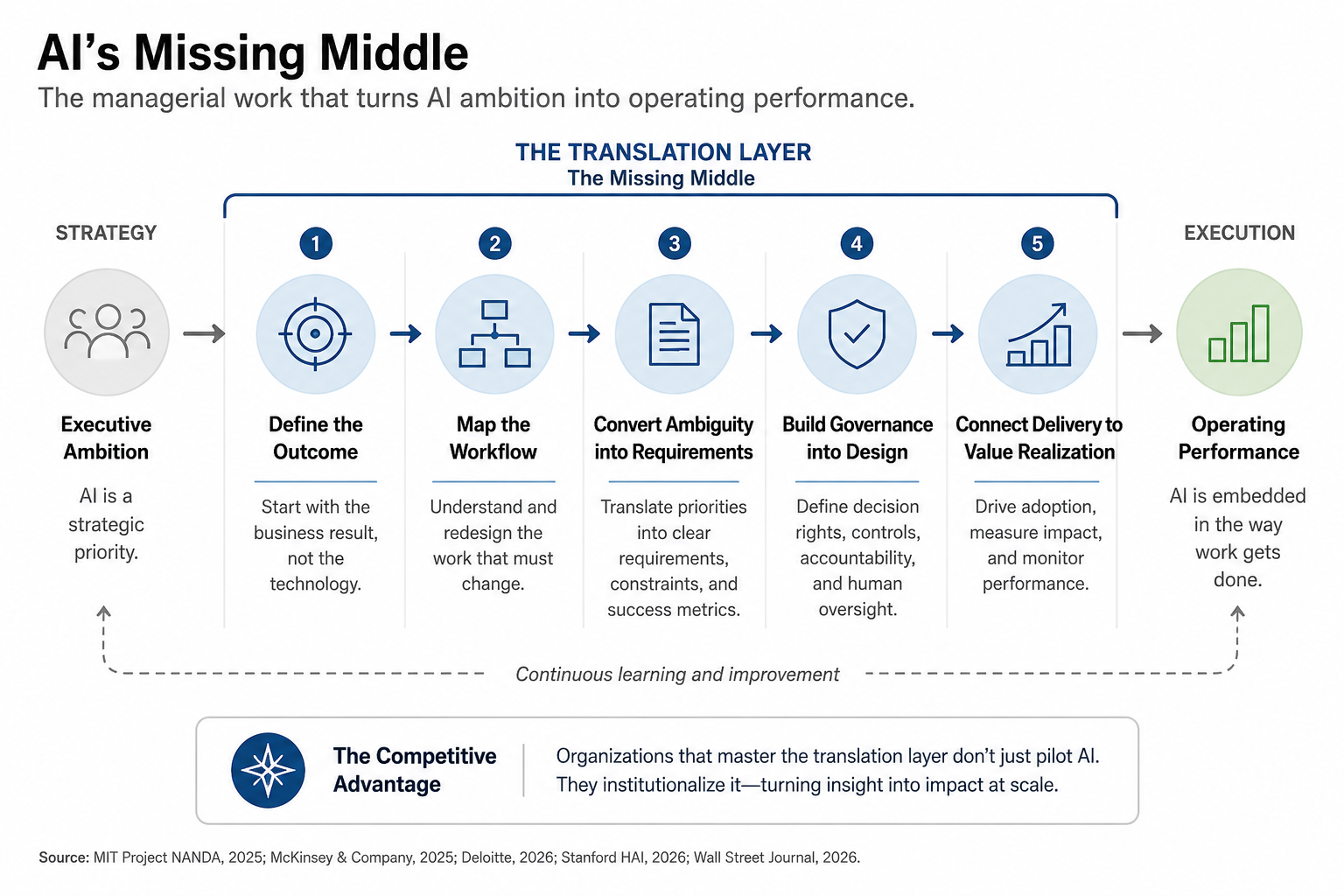
The translation layer has five jobs
Organizations that consistently turn AI into value build a strong translation layer between leadership ambition and technical delivery. That layer performs five essential jobs.
1. Define the outcome before the use case
Too many AI initiatives begin with a capability: a chatbot, an agent, a forecasting model, a summarization tool, a copilot, a dashboard. Stronger organizations begin with the outcome.
In an infrastructure organization, the outcome might be faster capital planning, better demand forecasting, shorter interconnection studies, earlier identification of operational risk, or more consistent regulatory analysis. In a professional services firm, it might be faster proposal development, better knowledge reuse, improved delivery management, or higher margins on complex engagements. In government, it might be shorter review cycles, better case triage, stronger fraud detection, or more consistent public-facing guidance.
The use case should follow from the outcome. When the order is reversed, organizations end up asking where a tool might fit rather than asking which business problem deserves investment.
That is how AI portfolios become crowded with plausible but weak initiatives. They are technically feasible, politically attractive, and easy to demonstrate, but they are not anchored to a performance problem that matters enough to justify adoption.
2. Map the workflow that must change
AI creates value only when it changes how work gets done. That means leaders must understand the current workflow in detail. Who performs the work? What information do they use? Where is judgment applied? Where do delays occur? Which handoffs break down? Which decisions require escalation? Where does accountability sit? Which parts of the process are formal, and which depend on tacit knowledge?
Without that map, AI becomes an overlay on top of existing inefficiency. The organization automates fragments of a flawed process and then wonders why value is limited. The goal is not to automate every step. Some work should be accelerated. Some should be augmented. Some should be redesigned. Some should be governed more tightly. Some should remain firmly in human hands. The translation layer determines which is which. This is where many organizations underestimate the challenge. They treat AI adoption as a technology rollout when it is often a workflow redesign problem.
3. Convert ambiguity into requirements
Engineering teams cannot build against aspiration. Yet many AI initiatives are defined at the level of aspiration. Leaders want better insights, faster analysis, more efficient operations, or smarter decision support. Technical teams then interpret those goals through the lens of available tools. The result may be elegant but misaligned.
The translation layer closes this gap. It converts business priorities into user stories, data requirements, workflow specifications, acceptance criteria, risk controls, operating assumptions, implementation plans, and adoption metrics. It gives technical teams enough clarity to build and business leaders enough specificity to make trade-offs.
This is also one of the most practical places to use AI itself. Generative tools can help synthesize stakeholder interviews, draft requirements, compare workflow options, generate mockups, identify dependencies, surface inconsistencies, and pressure-test implementation plans. Used well, AI can accelerate the translation process before scarce engineering capacity is committed.
But there is an important distinction. AI can draft requirements. It cannot create organizational agreement. That remains a leadership task.
4. Build governance into design
For AI-enabled capabilities, governance cannot be a late-stage review. It has to shape the product from the beginning.
Leaders should decide early what data is approved for use, what decisions the system may support, where human review is required, how outputs will be validated, how performance will be monitored, and who is accountable when something goes wrong.
This becomes more important as organizations move from AI systems that generate content to AI systems that execute tasks. An agent that summarizes documents creates one class of risk. An agent that initiates procurement actions, changes customer records, drafts regulatory filings, dispatches field crews, or recommends capital allocation creates another.
The more autonomous the system, the more explicit the operating boundaries must be. Decision rights, escalation paths, audit trails, exception handling, model monitoring, and human override cannot be improvised after deployment. Trustworthy AI is not produced by policy statements alone. It is produced by operating mechanisms.
5. Connect delivery to value realization
An AI initiative is not complete when the tool launches. It is complete when the organization changes how it works and captures measurable value.
That requires delivery discipline: milestones, dependencies, adoption planning, change management, training, risk management, leadership alignment, and performance tracking. It also requires the willingness to stop or redesign initiatives that are not producing value.
Many organizations fund experimentation more readily than adoption. They celebrate launch more readily than sustained performance. They count use cases more readily than outcomes.
That bias is costly. The economic value of AI depends less on invention than on institutionalization. A technically modest tool embedded deeply into a high-value workflow can matter far more than an impressive prototype that no one uses.
Prototypes should force decisions
One of the most useful shifts executives can make is to treat prototypes as decision instruments rather than demonstrations.
A good prototype should not merely show what is possible. It should help the organization decide whether a concept is worth building, what would have to change for it to work, what risks must be managed, what requirements remain unclear, and what scale would demand.
In that sense, a prototype is not a miniature product. It is a structured management conversation. It gives executives, users, technologists, risk leaders, operators, and product teams something concrete to react to. It reveals disagreement. It exposes missing data. It tests workflow assumptions. It clarifies what adoption would require. It reduces the cost of being wrong early.
This is one of AI’s most underappreciated contributions to strategy execution. Lightweight prototypes, mockups, workflow simulations, and AI-generated artifacts can compress the time between idea and alignment. They can help organizations avoid months of abstract discussion. They can prevent technical teams from building against vague intent.
But the discipline matters. A prototype without decision criteria becomes theater. A prototype tied to clear thresholds becomes a management tool.
Before a prototype is built, leaders should define what decision it is meant to support. Are we testing user desirability? Data feasibility? Workflow fit? risk tolerance? business value? integration complexity? operating-model implications? If the organization cannot answer that question, the prototype is likely to produce motion rather than learning.
The next advantage is absorption
As AI tools become more accessible, competitive advantage will shift. Access will matter less. Absorption will matter more.
The question will not be which organization has AI. Most will. The question will be which organization can integrate AI into the operating system of the enterprise. That requires new organizational muscle.
Strategy teams must become more delivery-literate. Technology teams must become more business-literate. Product teams must understand governance and change management. Risk teams must engage early enough to shape design rather than block deployment. Finance teams must measure value beyond activity. Executives must ask not only whether an AI initiative is innovative, but whether it is adoptable.
Recent enterprise surveys point in the same direction. McKinsey’s 2025 global AI survey found that organizations reporting stronger AI value were more likely to have management practices tied to strategy, operating model, data, adoption, scaling, talent, and governance. Deloitte’s 2026 enterprise AI report similarly frames the current challenge as moving from pilot to scale as worker access expands and expectations rise.³
The pattern is clear: the constraint is not only technical capability. It is organizational design. This will be especially urgent where AI intersects with physical infrastructure and public systems.
In energy, AI will increasingly shape forecasting, planning, grid operations, asset management, permitting, customer operations, regulatory analysis, investment strategy, and resilience planning. But the value will not come simply from better models. It will come from connecting AI-enabled insight to actual decisions, workflows, authorities, and responsibilities.
A utility may have a better load forecast, but unless that forecast changes planning assumptions, procurement timing, interconnection strategy, or capital allocation, the value remains theoretical. A regulator may have faster document analysis, but unless it improves review quality or cycle time, the benefit is limited. A clean energy organization may use AI to identify promising technologies, but unless that insight changes program design, funding decisions, technical assistance, or commercialization pathways, it is just better search.
The same pattern holds beyond energy. In any complex enterprise, AI value will be determined by the quality of the translation layer.
A leadership agenda for moving from pilots to performance
Executives who want to move beyond experimentation should focus less on announcing AI activity and more on building the managerial system that converts AI into results. Five actions matter most.
Create a real portfolio discipline
Not every AI use case deserves investment. Leaders should prioritize opportunities based on business value, feasibility, data readiness, risk, adoption complexity, and scalability.
This requires saying no to attractive but low-value experiments. It also requires distinguishing between three types of initiatives: quick productivity tools, workflow-specific capabilities, and enterprise-scale operating changes. Each has a different risk profile, ownership model, and investment logic. A serious AI portfolio should not be a catalog of ideas. It should be a set of managed bets.
Assign clear ownership
Every AI initiative needs a business owner, a technical owner, and a governance owner. The business owner defines the outcome and is accountable for adoption. The technical owner ensures the solution can be built, integrated, secured, and maintained. The governance owner ensures the system operates within acceptable boundaries. When ownership is ambiguous, pilots drift. When accountability is clear, hard trade-offs become possible.
Require delivery-ready requirements before engineering begins
Organizations should use AI to accelerate requirements definition, but they should not confuse a generated requirements document with agreement. Before engineering begins, leaders should be able to answer basic questions. Who are the users? What workflow will change? What data is required? What decisions will the system support? What level of accuracy is acceptable? What risks are unacceptable? What human review is required? What systems must be integrated? What value will be measured?
If these answers are missing, the organization is not ready to build. It is ready to translate.
Build governance into the workflow
Governance should not sit outside the product as a separate compliance exercise. It should be embedded in the workflow.
That means defining decision rights, review points, escalation paths, auditability, monitoring, and exception handling as part of the solution design. It also means recognizing that governance should vary by use case. A low-risk internal summarization tool does not need the same controls as an AI system that influences safety, finance, regulatory filings, customer treatment, or operational dispatch. The goal is not to slow AI adoption. It is to make adoption durable.
Measure adoption and performance, not activity
AI activity is easy to count. Value is harder. Leaders should measure whether AI-enabled capabilities are improving decisions, reducing cycle times, increasing throughput, lowering cost, improving quality, reducing risk, expanding capacity, or creating new revenue. They should also measure adoption: who is using the tool, how often, in which workflows, with what level of trust, and with what effect on performance.
A pilot that works but is not adopted is not a success. A tool that is used but does not improve performance is not a success. A system that improves performance but creates unmanaged risk is not a success. AI maturity is not activity. It is governed performance at scale.
The real work starts before the build
Stanford’s 2026 AI Index shows how rapidly AI adoption and investment are spreading. Generative AI has moved into the economy faster than previous general-purpose digital technologies, and private AI investment more than doubled in 2025.⁴ That speed will intensify pressure on executives to show results.
But speed alone will not solve the absorption problem. In fact, it may worsen it. The easier it becomes to generate prototypes, the more important it becomes to decide which ones deserve to become products, which products deserve to become workflows, and which workflows deserve to become institutional capability.
Before building the next AI tool, leaders should ask:
Have we defined the outcome?
Have we mapped the workflow?
Have we clarified the requirements?
Have we embedded governance?
Have we assigned ownership?
Have we identified the operating changes required for adoption?
Have we defined how value will be measured?
If the answer is no, the organization is not ready to build. It is ready to translate.
The organizations that win with AI will not necessarily be the ones with the most pilots, the largest models, or the most ambitious public statements. They will be the ones that can move from executive intent to operating capability with discipline.
That is the missing middle. And increasingly, it may be the main event.
Notes
- Belle Lin, “‘Piloting’ AI Tools Isn’t Cool Anymore,” Wall Street Journal, February 26, 2026.
- Aditya Challapally et al., The GenAI Divide: State of AI in Business 2025 (Cambridge, MA: MIT Project NANDA, 2025).
- McKinsey & Company, The State of AI: Global Survey 2025, November 5, 2025; Deloitte, The State of AI in the Enterprise: 2026 AI Report, 2026.
- Stanford Institute for Human-Centered Artificial Intelligence, The 2026 AI Index Report, 2026.