By Arshad Mansoor, President and CEO of EPRI
Unprecedented Demand Growth
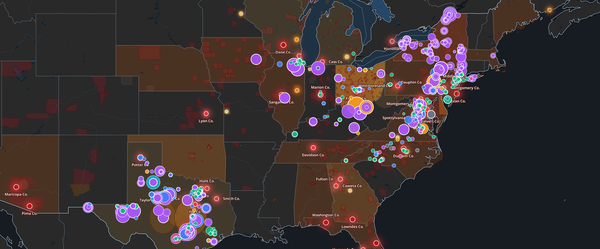
Global electricity demand is expected to grow by an average of 3.6 percent per year between 2026 and 2030, about 50 percent faster than the average increase seen over the previous decade, according to the International Energy Agency (IEA). Through 2030, electricity consumption is projected to grow at least 2.5 times as fast as overall energy demand, underscoring how much this moment is being driven by electrification and not simply broader economic growth.¹ This growth is driven by rising industrial use of electricity, accelerating uptake of electric vehicles, expanded air conditioning use, and the AI-fueled increase in data-center power demand.² In the United States, which is leading the global data-center surge, EPRI scenarios estimate that data centers could account for roughly 9 to 17 percent of US electricity consumption by 2030, up from about 4 to 5 percent in 2024.³
For the first time in three decades (excluding crisis-related disruptions), global electricity demand outpaced economic growth in 2024. We are moving at speed into the age of electricity.⁴ The question that is top of mind for many is, “How will we meet this moment?”
Flexibility can create headroom when it is available where and when the grid needs it
As demand from AI and data centers grows at unprecedented speed, flexibility is becoming the third leg of the speed-to-power stool, alongside generation and transmission.⁵ Flexibility allows large loads to reduce or shift consumption during periods of grid stress through various methods, including on-site generation, on-site battery storage, on-site thermal storage, standby generation, uninterruptible power supply, and/or shifting of chiller and compute workloads. These mechanisms differ in speed, duration, notice, location, emissions profile, and contractual form.
Flexibility can create additional system headroom and, in some cases, reduce or defer infrastructure needs when the response is available at the right location, time, duration, and level of reliability. Under those conditions, flexibility may also shorten interconnection timelines and accelerate time-to-power, subject to the utility study and the contractual arrangement that governs the commitment.
What must be true before flexibility counts in planning
The industry has moved beyond asking whether selected data-center loads can flex. The harder question is what evidence makes a specific flexibility commitment dependable enough to count in a planning study that carries a compliance obligation. Counting a commitment that cannot be relied upon converts a reliability margin into a forecast. To be creditable in a planning study, a flexibility commitment must satisfy all five of the following:
Firm. The obligation to reduce must be contractual, and not discretionary, with defined depth, duration, notification time, and frequency, and with consequences for non-performance.
Deliverable. The reduction must occur at the electrical location where the constraint binds. System-level headroom is not fungible; megawatts of flexibility elsewhere on the network do not relieve a specific post-contingency overload.
Coincident. The commitment must be available in the hours and under the conditions in which the constraint binds, which are not necessarily the hours of highest system load.
Verifiable. Performance must be measured against a defined baseline, reported, and auditable, on the same footing as any other resource on which reliability depends.
Modeled. The load must be represented in planning and operational models with validated dynamic behavior, including its response to voltage and frequency disturbances.
These criteria are a practical test for evaluating planning credit. They are not a claim that one universal five-part rule has already been adopted across the industry. They also align with the direction of recent reliability work: in 2026, the North American Electric Reliability Corporation (NERC) issued a Level 3 Alert on computational loads and advanced standards and registry revisions focused on modeling, instrumentation, commissioning, operations, protection, and control.⁶ That record reinforces why demonstration success and planning credit are related, but not the same.
Is Flexibility Real?
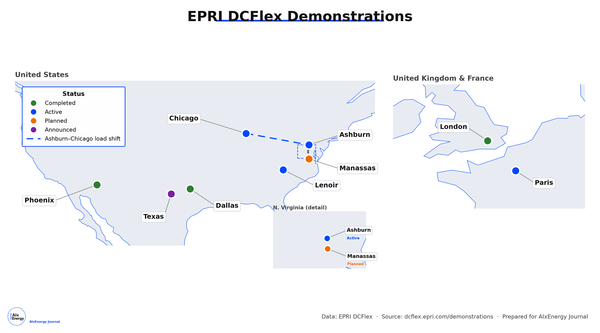
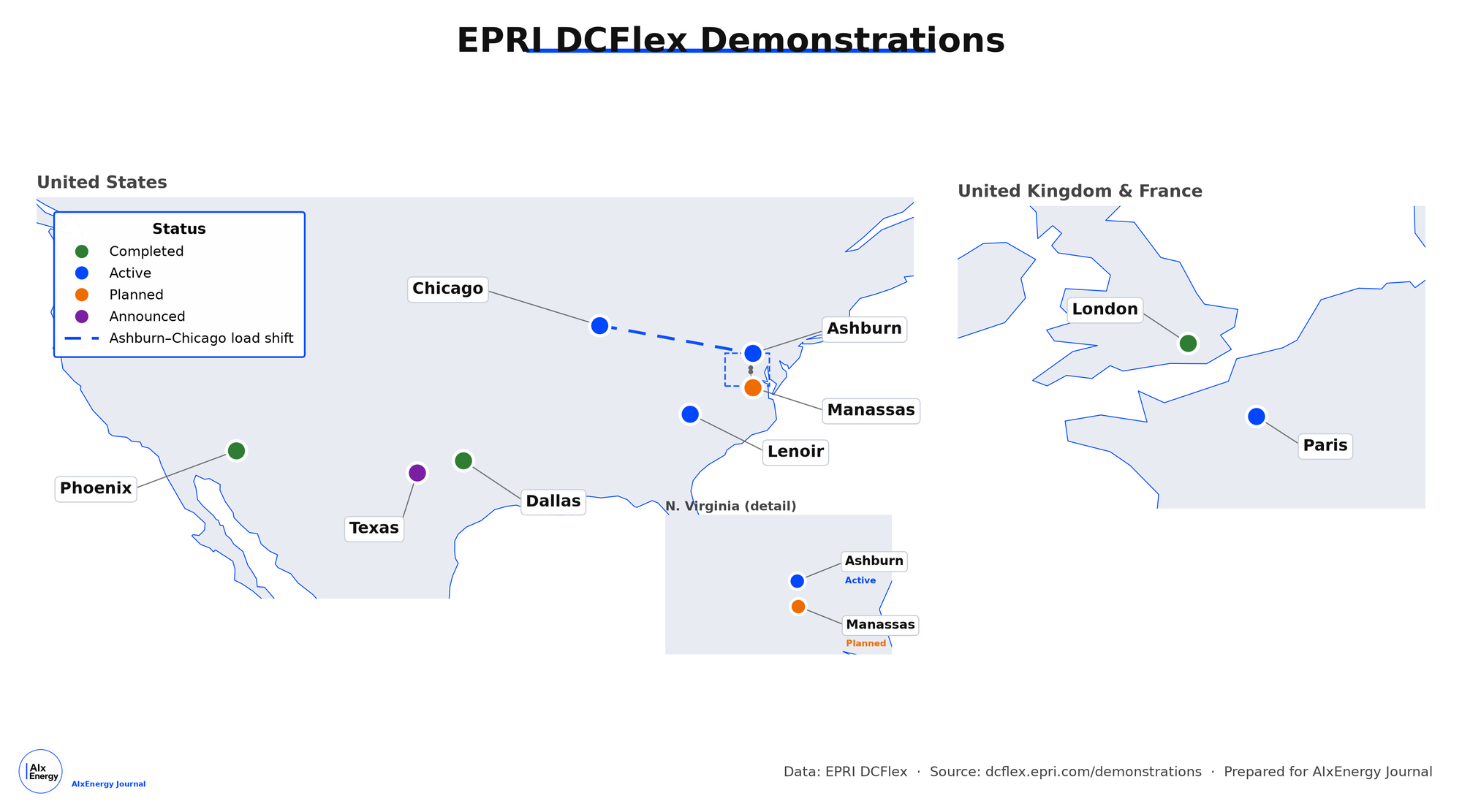
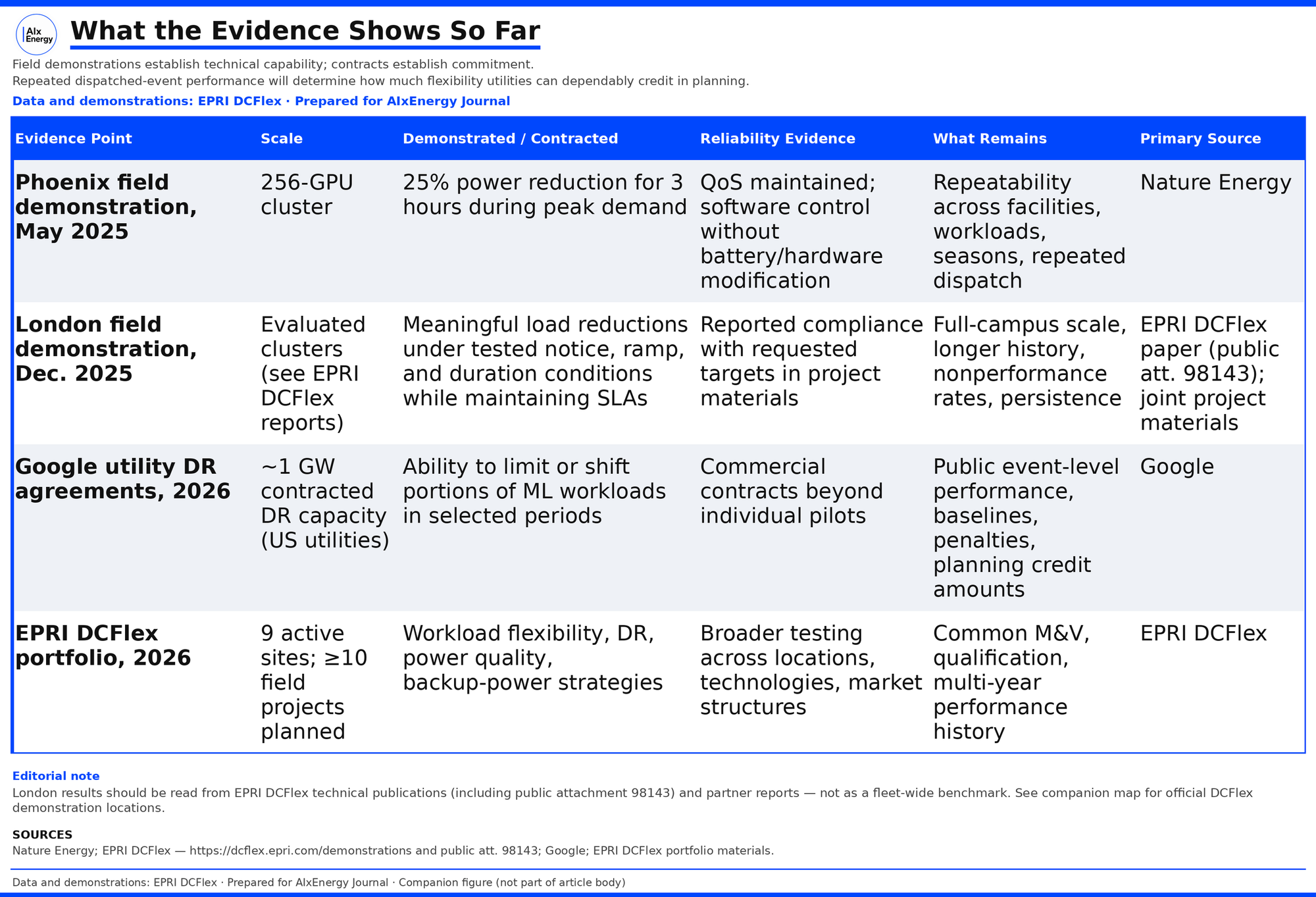
When EPRI’s Data Center Flexible Load Initiative (DCFlex) was founded in November 2024, the question of whether it was even possible for data centers to flex was still outstanding. Since that time, DCFlex has advanced a portfolio of global, in-production data-center demonstrations: nine active sites, with at least ten field projects planned, that highlight this flexibility.⁷
For example:
In May 2025, EPRI, in collaboration with Emerald AI, tested a software-based method that enables AI data centers to operate as flexible grid resources on a 256-GPU cluster running representative AI workloads in a hyperscale cloud facility in Phoenix, Arizona. The system reduced power usage by 25 percent for three hours during a Salt River Project system peak, while maintaining AI quality-of-service guarantees.⁸
In August 2025, a DCFlex demonstration with Google and Duke Energy exercised compute-flexibility protocols in Lenoir, North Carolina, showing how non-urgent workloads could be shifted to support demand response. Separately, Google has since announced demand-response agreements with multiple US utilities totaling on the order of 1 GW of contracted capability, commercial arrangements that extend beyond any single pilot site.⁹
Additional DCFlex demonstrations, including Chicago (ComEd, Constellation, Emerald AI, and NVIDIA), a London-area series of tests with National Grid, Nebius, and Emerald AI, geospatial workload shifting between Ashburn, Virginia, and Chicago, and a field evaluation of hydrotreated vegetable oil (HVO) as a backup-generator fuel at a Compass facility near Dallas, illustrate a range of flexibility pathways across compute, facility systems, and backup power. Public project materials document meaningful load response under tested conditions while maintaining service-level commitments for the evaluated workloads. Detailed metrics should be read from the underlying EPRI and partner project reports, including EPRI’s DCFlex technical publications.¹⁰
These EPRI-led projects demonstrate that flexibility strategies can be tailored to the availability, scale, and duration of grid events. They establish technical capability under tested conditions; they do not by themselves establish the planning value that a utility should assign to flexible load.
Moving from pilots to scale
While DCFlex’s demonstrations have highlighted the benefits of flexibility, they are only the first step. The utility and hyperscaler industries need a common language to define flexibility. In March 2026, DCFlex launched Flex MOSAIC™, collaborating with more than 70 utilities, system operators, technology providers, and hyperscalers.¹¹ The Flex MOSAIC framework defines five classes of flexibility based on the magnitude, timing, duration, and frequency of a load’s response. The purpose of establishing these defined classes is to replace bespoke, project-by-project interconnection negotiations with shared, performance-based descriptions. Without a common vocabulary, every interconnection is a custom negotiation, which can slow down speed-to-power.
Leveraging insights from the Flex MOSAIC™ framework, the DCFlex team is developing tools for base features and reference-design support elements. By year-end 2026, the team expects to roll out the final reference design, as well as structural incentive-program designs and tools for adoption of the framework. By establishing a shared language, transparent facility performance expectations, and repeatable grid responses, the framework can help utilities, system operators, regulators, and data-center developers make faster, more consistent, and more confident decisions when evaluating flexibility. Flex MOSAIC standardizes how flexibility is described; it does not by itself confer planning credit or automatically accelerate interconnection.
The DCFlex team recently released an interactive simulation on its website where users can test the usefulness of Flex MOSAIC™ from the standpoint of a data-center developer, interconnection-study engineer, tariff/program designer, or long-term planner. I invite you to try the simulation and to move from simulations to reality by applying the lessons learned across the energy ecosystem.
Flexibility and speed to power
Flexibility can reduce the need for premature investment in additional power plants and transmission lines, but only if the industry has tools to evaluate when that potential is real. As part of the DCFlex effort, the EPRI team developed a practical industry Headroom Framework to help power-system planners evaluate how much additional load, particularly from rapidly growing data centers, can be integrated without expanding generation, storage, or transmission infrastructure. The framework provides a uniform, stepwise approach to evaluate how increasing data-center flexibility, via Flex MOSAIC™ flexibility classes, may contribute usable headroom under specific system conditions: resource adequacy, transmission topology, operating constraints, contingencies, timing, and location.¹²
These tools can improve information exchange between system planners and data-center developer communities about where system flexibility is most valuable and what type of flexibility is prioritized. With the right signaling, connection requests become more aligned with system needs, which can streamline the interconnection process. The Headroom Framework is an evaluation aid, not an automatic path to faster interconnection or planning credit.
Collaboration can accelerate the path to scale
Thanks to DCFlex and its more than 70 collaborators, including hyperscalers, utilities, independent system operators, power producers, technology providers, consultants, and finance stakeholders, what exists today is a shared language integrated with demonstrations leading to flexibility strategies and dynamic planning tools. Even with these advances, a trust gap remains.
Because DCFlex demonstration projects have validated the physics of flexibility under defined conditions, stakeholders can use a common language from the earliest stages of negotiations and interconnection planning through rate design and long-term planning. The next step is turning individual results into a track record: aggregating dispatched-event outcomes across many facilities and evaluating them against consistent baselines, the same way generation resources have been assessed for decades. That is how flexibility earns trust and a place in planning, not just in pilots.
As DCFlex progresses, large-load flexibility is becoming more viable as a planning resource. The path to fuller utilization will require ongoing industry-wide collaboration and recognition that gains in efficiency can override one-off solutions created by individual utilities and hyperscalers, making outcomes more predictable, effective, and affordable.
We have shown that data centers can flex. Now the work is proving, together and at scale, that they can be trusted to. Applying the five-part test of firm, deliverable, coincident, verifiable, and modeled performance is the next phase of DCFlex. That is how we meet this moment: with flexibility that is not just possible, but dependable enough to plan on.
Arshad Mansoor is president and CEO of EPRI. The institute is an independent, nonprofit energy research and development organization. EPRI does not advocate for policy or commercial outcomes.
Notes
- IEA (2026), Electricity 2026 – Analysis and forecast to 2030, IEA, Paris, published February 2026. https://www.iea.org/reports/electricity-2026/demand
- IEA Global EV Outlook 2026; IEA electricity-demand analysis identifying EV uptake as a contributor to demand growth.
- EPRI, Powering Intelligence 2026: Updated Scenarios of U.S. Data Center Electricity Use and Power Strategies, February 2026.
- IEA World Energy Outlook 2024, “Moving at speed into the Age of Electricity.”
- See, e.g., Skidmore, Zachary, “EPRI launches data center flexibility framework to speed up grid connections,” Data Center Dynamics, April 23, 2026.
- NERC Level 3 Computational Load Alert (May 4, 2026); subsequent FERC/NERC record on computational-load reliability standards and registry revisions (2026).
- EPRI DCFlex, Demonstrations, https://dcflex.epri.com/demonstrations.
- Colangelo et al., “AI data centres as grid-interactive assets,” Nature Energy, December 5, 2025, https://doi.org/10.1038/s41560-025-01927-1.
- Google announcements of US utility demand-response agreements (including TVA, Entergy Arkansas, DTE, AEP Indiana Michigan, and Minnesota Power), 2026.
- ⁰ EPRI DCFlex demonstration materials and technical publications, including EPRI public attachment 98143 (DCFlex technical paper) and related partner project reports for the London tests. See also https://dcflex.epri.com/demonstrations.
- https://dcflex.epri.com/flex-mosaic/open-letter
- EPRI, A Proposed Framework to Assess Headroom for Integrating Data Centers into Regional Power Systems, April 27, 2026.