Every year, the International Energy Agency's World Energy Investment report serves as one of the most important scorecards in the global economy. Markets fluctuate, technologies rise and fall, governments change priorities, and headlines shift from one crisis to the next. Investment, however, reveals where governments, corporations, utilities, investors, and developers are actually placing their bets. Capital allocation is ultimately the most honest expression of belief.
The 2026 edition arrives at a particularly consequential moment. Global energy investment is expected to reach approximately $3.4 trillion this year, representing a 5% increase despite geopolitical instability, elevated interest rates, persistent supply-chain constraints, and growing uncertainty across global markets. Roughly $2.2 trillion will flow toward renewables, nuclear power, grids, storage, electrification, efficiency, and other low-emissions technologies, while approximately $1.2 trillion will be invested in oil, natural gas, and coal.
Top 5 Takeaways from the IEA’s World Energy Investment 2026 Report
-
1
The Age of Electricity Has Arrived
Nearly 60% of global energy investment now flows into electricity generation, grids, storage, and electrification. The energy system is no longer organized around fuels; it is increasingly organized around electrons.
-
2
Energy Security Is Driving Investment Decisions
The strongest case for electrification is no longer just climate. It is resilience, affordability, and reduced exposure to volatile fuel imports. The IEA estimates that renewables, efficiency, electrification, and nuclear avoided approximately $260 billion in fossil fuel imports in 2025 alone.
-
3
Artificial Intelligence Has Become an Energy Industry
Data-center-related energy investment exceeded $100 billion globally in 2025, while gas turbine orders reached a 25-year high. AI is no longer simply creating electricity demand; it is reshaping generation, transmission, storage, and utility planning.
-
4
The Grid Is Now the Critical Bottleneck
The challenge is no longer producing electricity. It is moving it, storing it, and integrating it. Transmission, transformers, interconnection queues, permitting, and workforce constraints are becoming limiting factors for economic growth and AI deployment.
-
5
The Future Belongs to Infrastructure Intelligence
The biggest trend in the report is convergence. Energy systems are merging with digital systems. The rise of AI-driven infrastructure, the emergence of the Shadow Grid, and the need for a Cognitive Grid point toward a future where power and computation become increasingly inseparable.
Those figures alone would make the report noteworthy. Yet the real significance of the report lies not in the magnitude of investment, but in what the pattern of investment reveals about the future. For much of the last decade, discussions about energy revolved around climate change, decarbonization targets, renewable deployment, and emissions trajectories. Those themes remain important, but the 2026 report documents a broader transformation: the global economy is increasingly reorganizing itself around electricity, infrastructure resilience, digital systems, and artificial intelligence.
The transition now underway is not simply a shift from fossil fuels to clean energy. It is a shift from an economy organized around fuels to one organized around infrastructure. Viewed through this lens, the report becomes much more than a catalog of investment statistics. It becomes an early map of a new economic architecture in which electricity, computation, and infrastructure increasingly converge.
The Arrival of the Age of Electricity
The most important conclusion in the report is surprisingly easy to miss. Electricity-related investments now account for nearly 60% of all global energy investment. Spending on electricity generation, transmission, distribution, storage, and related infrastructure has reached approximately $1.6 trillion annually and approaches $2 trillion when end-use electrification is included.
This statistic represents a fundamental restructuring of the global energy system. For most of modern history, energy systems were organized around fuels. Coal powered industry. Oil powered transportation. Natural gas heated buildings and fueled industrial processes. Electricity served as a delivery mechanism, but fuels remained the foundation of economic activity.
That relationship is reversing. Transportation is increasingly electrified. Buildings are increasingly electrified. Industrial processes are increasingly electrified. Data centers are entirely dependent upon electricity. Future fuels such as hydrogen derive their value from electricity. Even energy security strategies increasingly revolve around expanding electrical infrastructure rather than securing access to imported fuels.
The report's investment data demonstrates that this shift is no longer theoretical. Renewable power investment now reaches approximately $665 billion annually. Solar alone accounts for roughly $365 billion, equivalent to nearly one billion dollars invested every day. Wind investment remains substantial at roughly $200 billion annually, while hydropower contributes approximately $75 billion. Together, renewable technologies account for roughly 70% of global power-sector investment.
At the same time, nuclear energy is experiencing a resurgence that would have seemed improbable only a few years ago. Global nuclear investment now exceeds $80 billion annually, while seventy-eight gigawatts of capacity are under construction across fifteen countries. More than forty nations now maintain active policies supporting new nuclear development.
The significance of these numbers extends beyond individual technologies. Collectively, they reveal that electricity has become the dominant destination for global energy capital. The world's largest economies are increasingly investing not only in fuels themselves, but in the infrastructure required to generate, move, store, and manage electricity. This distinction matters because it changes the nature of competition. In the twentieth century, economic power often depended upon access to fuel resources. In the twenty-first century, economic power may increasingly depend upon access to electrical infrastructure.
Energy Security Has Become a Dominant Investment Driver
One of the most striking themes throughout the report is the reemergence of energy security as a dominant force shaping investment decisions alongside cost, climate, reliability, and affordability. The IEA devotes considerable attention to the geopolitical disruptions that have unfolded during the past year. Damage to energy facilities, attacks on shipping infrastructure, uncertainty surrounding key maritime corridors, and concerns about future supply disruptions have materially altered how governments and investors evaluate risk.
The result has been a shift in emphasis. For much of the previous decade, energy investment decisions were frequently framed through the lens of carbon reduction. Increasingly, they are also being framed through the lens of resilience, reliability, and strategic autonomy.
This change helps explain several trends that might otherwise appear contradictory. Natural gas investment is projected to reach approximately $330 billion in 2026, the highest level in a decade. Coal investment is expected to rise to roughly $180 billion, the highest level since 2012. Nuclear investment continues to accelerate. Grid investment is expanding rapidly. Domestic manufacturing of energy technologies is becoming a strategic objective across multiple regions.
Viewed through a narrow climate lens, these developments can appear inconsistent. Viewed through a security lens, they become more understandable. Countries are not simply abandoning decarbonization. They are expanding their definition of energy security and, in many cases, attempting to balance emissions goals against resilience, affordability, and exposure to geopolitical risk.
The report highlights one of the strongest examples of this shift. Investments in renewables, electrification, efficiency, and nuclear energy avoided approximately $260 billion in fossil fuel import costs across major regions during 2025. China alone accounted for roughly $110 billion of those savings.
This finding may ultimately prove more important than many emissions-related statistics. The strongest argument for electrification is increasingly economic and strategic as well as environmental. Countries that generate more energy domestically through electricity reduce exposure to volatile fuel markets, geopolitical disruptions, and import dependencies. The energy transition is therefore becoming inseparable from national security policy.
Artificial Intelligence Has Entered the Energy Investment Equation
No section of the report better illustrates the changing nature of energy demand than the discussion of artificial intelligence and data centers. Only a few years ago, AI barely registered within most energy forecasts. Today it has become a meaningful driver of investment decisions across multiple segments of the energy sector.
The report estimates that energy-sector investment associated with data-center development exceeded $100 billion globally during 2025. To put that figure in perspective, it exceeds total energy investment across Africa. The implications extend far beyond electricity demand forecasts.
The IEA documents a surge in gas-fired generation orders to approximately 130 GW during 2025, the highest level in twenty-five years. A substantial portion of this increase is directly linked to growing data-center demand. Nearly $28 billion in gas turbine orders are associated with onsite generation serving computational infrastructure.
These developments reveal an important reality that many energy discussions still fail to recognize. Data centers are no longer simply customers of the grid. They are becoming infrastructure actors.
Technology companies increasingly influence generation development, transmission planning, storage deployment, advanced nuclear investment, geothermal commercialization, and utility resource decisions. The report notes that technology companies now account for approximately 40% of corporate power purchase agreements globally, underscoring the degree to which computational infrastructure is reshaping energy markets.
Historically, economic growth drove energy demand. Increasingly, energy availability may determine where digital economic growth occurs. This inversion represents one of the most important developments identified in the report.
The Grid Has Become a Binding Constraint
For decades, energy debates focused primarily on generation technologies. Policymakers argued about the optimal mix of coal, gas, nuclear, wind, and solar. Analysts built scenarios around competing generation portfolios. Investors sought opportunities within specific technology categories.
The report suggests that the central challenge has shifted. Generation is no longer the only binding constraint; integration, interconnection, grid equipment, permitting, and system operation are becoming equally decisive.
Global grid investment now approaches $550 billion annually. Battery storage investment exceeds $100 billion. Both categories are growing rapidly because the constraints facing modern energy systems increasingly reside outside generation itself.
Transmission corridors have become scarce. Transformers have become strategic assets. Interconnection queues have become barriers to investment. Permitting timelines have become economic bottlenecks. Workforce shortages have become deployment constraints.
The challenge facing energy systems is no longer merely producing electrons. It is transporting them, storing them, managing them, and integrating them into increasingly complex networks. This shift carries profound implications for investors and policymakers. Regions that can accelerate transmission deployment, streamline permitting, modernize planning processes, and expand grid infrastructure will likely capture disproportionate shares of future economic growth. Regions that fail to address these constraints risk becoming increasingly unattractive locations for industrial development and computational infrastructure.
Capital Markets Will Determine the Pace of the Transition
Energy transitions are often described as technological transformations. In practice, they are capital allocation transformations. One of the report's most important findings is that financing conditions increasingly influence deployment outcomes. Interest rates, risk premiums, financing costs, and policy certainty often matter as much as technology costs.
This reality is particularly important because the emerging energy system is fundamentally capital intensive. Renewable generation requires substantial upfront investment. Transmission projects require enormous capital commitments years before revenue generation. Nuclear projects require long-term financial certainty. Battery storage requires significant initial expenditures. Artificial intelligence infrastructure follows a similar pattern.
Data centers, advanced semiconductors, dedicated generation assets, cooling systems, and transmission upgrades all require large upfront investments supported by expectations of future growth. As a result, the AI economy and the energy economy increasingly share common financial characteristics. Both depend upon long-duration capital, predictable regulatory environments, and confidence in future demand.
The report highlights another important challenge. Financing costs remain dramatically higher across many developing economies than in advanced economies and China. This disparity represents one of the most significant barriers to global energy development. While technology costs continue to decline, financing costs frequently determine whether projects proceed at all.
The countries that succeed in attracting affordable capital may ultimately gain a larger advantage than those that merely possess superior technology.
Critical Minerals and the New Resource Competition
The report also highlights a growing tension within the global energy transition. For much of modern history, energy security centered on access to fuels. The emerging energy system increasingly depends upon access to materials.
Copper, lithium, nickel, graphite, rare earth elements, semiconductors, advanced steel, and power electronics now occupy a strategic position within global supply chains. The report notes that investment in critical minerals declined during 2025 after several years of rapid growth. Lithium investment experienced particularly sharp declines following price corrections. Copper investment, however, continued to rise.
This distinction is important. Copper sits at the center of nearly every major trend identified in the report. Electrification requires copper. Data centers require copper. Transmission expansion requires copper. Electric vehicles require copper. Renewable energy deployment requires copper. The Age of Electricity is, in many respects, also the Age of Copper.
The report further highlights China's extraordinary position within global manufacturing supply chains. China accounts for approximately 75% of clean-energy manufacturing investment, roughly 80% of lithium-ion battery production supply-chain capacity, and approximately 95% of photovoltaic wafer production capacity.
These figures reflect more than industrial success. They represent a strategic concentration of manufacturing capability that will influence energy markets, supply chains, and geopolitical relationships for years to come.
Innovation Remains the Ultimate Force Multiplier
Perhaps the most encouraging finding in the report concerns innovation. The energy transition is often portrayed as a story of deployment. The data suggest it is equally a story of technological progress.
The report notes that without the cost reductions achieved through innovation over the last decade, delivering the same amount of energy additions expected in 2026 would require nearly twice as much investment. Solar costs have fallen dramatically. Battery costs have fallen dramatically. Power electronics have improved dramatically. Operational efficiency has increased dramatically.
Innovation has quietly become one of the most important drivers of energy investment. This lesson matters because the next decade will likely depend upon continued innovation. Artificial intelligence, advanced nuclear systems, enhanced geothermal technologies, next-generation storage, advanced materials, and digital grid technologies all have the potential to reshape investment patterns.
The report also highlights growing public and private investment in energy-related research and development. China now accounts for more than one-third of public energy R&D spending globally and more than 40% of corporate energy-related R&D.
Innovation leadership increasingly influences industrial leadership. The countries that develop technologies often become the countries that manufacture technologies. The countries that manufacture technologies frequently become the countries that dominate supply chains.
The Emergence of the Shadow Grid
The report does not use the term Shadow Grid. That is AIxEnergy's analytical lens for describing one of the most important developments implied by the data.
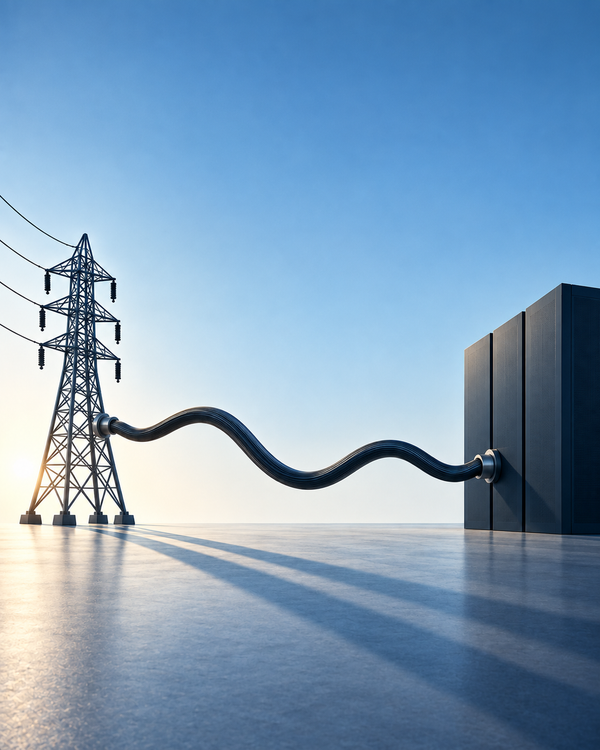
The Shadow Grid consists of infrastructure developed outside traditional utility planning frameworks to support mission-critical loads. This includes dedicated generation, microgrids, private transmission assets, behind-the-meter energy systems, dedicated renewable portfolios, long-duration storage facilities, and potentially small modular reactors developed specifically to serve large computational and industrial loads.
The rise of onsite generation supporting data centers represents one of the clearest early examples of this phenomenon. The IEA's data on captive data-center generation and gas turbine orders provide a strong empirical signal that some customers are no longer waiting for traditional infrastructure processes to catch up with demand.
Historically, customers adapted to available infrastructure. Increasingly, infrastructure is being developed around specific customers. When interconnection timelines become too long, alternatives emerge. When transmission expansion cannot keep pace with demand, alternatives emerge. When reliability becomes uncertain, alternatives emerge.
The Shadow Grid should not be viewed as a temporary response. It represents a structural adaptation to the growing mismatch between infrastructure development timelines and digital economic growth.
The Rise of the Cognitive Grid
The report also does not use the term Cognitive Grid. That is AIxEnergy's interpretive framework for understanding the intelligence layer required to operate the kind of electricity system the IEA describes.
The report focuses primarily on physical assets, yet the future system it describes will require far more than generation, transmission, and storage. It will require intelligence. The twentieth-century grid was mechanical. The late twentieth-century grid became digital. The twenty-first-century grid is becoming cognitive.
Managing millions of distributed assets, increasingly variable generation portfolios, growing electrification loads, electric vehicles, batteries, microgrids, and data centers exceeds the capabilities of traditional operating models. Artificial intelligence increasingly becomes a practical necessity rather than a novelty.
Forecasting, planning, asset management, maintenance optimization, outage response, market operations, and system balancing will all depend upon advanced computational capabilities. The same technologies driving electricity demand are increasingly becoming essential for operating electricity systems.
Electricity powers computation, and computation increasingly optimizes electricity. This feedback loop may become one of the defining characteristics of the next phase of economic development.
From the Age of Fuels to the Age of Infrastructure Intelligence
The IEA's World Energy Investment 2026 report will be remembered for its headline figures: $3.4 trillion in annual investment, nearly $2.2 trillion flowing toward clean energy and electrification, unprecedented investment in grids and storage, renewed momentum for nuclear energy, and the emergence of artificial intelligence as a material force in energy markets.
Yet the deeper significance of the report lies beneath the numbers. It documents the emergence of a world increasingly organized around electricity rather than fuels, infrastructure rather than commodities, resilience rather than efficiency alone, and intelligence rather than hardware alone.
The most important investment trend is not solar, nuclear, batteries, gas, or even data centers. The most important trend is convergence. Energy systems are converging with digital systems. Electricity systems are converging with computational systems. Infrastructure investment is converging with artificial intelligence investment.
The result is the emergence of a new economic architecture in which power, data, and computation become increasingly inseparable. The report captures the early stages of that transformation. The Shadow Grid represents the physical adaptation to growing infrastructure constraints. The Cognitive Grid represents the intelligence layer required to manage growing infrastructure complexity. Together they provide a framework for understanding why traditional energy models are becoming increasingly inadequate.
The next decade will not simply determine how the world generates electricity. It will determine how the world organizes economic activity, technological leadership, and national competitiveness. The capital flows documented in this year's report suggest that this transformation is already underway.
The Age of Electricity is not a forecast. The investment decisions have already been made. What remains uncertain is which countries, companies, utilities, and investors will recognize soon enough that the future of energy and the future of artificial intelligence are becoming the same story.