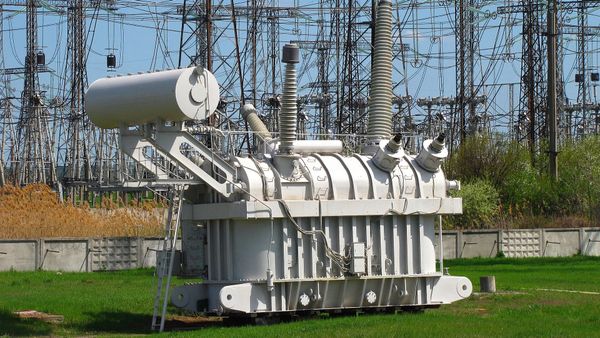
• Published lead times run from about 52 weeks for 15 kV switchgear to 100 to 150 weeks or more for large step-up transformers.
• Utilities and hyperscalers now reserve factory capacity under framework agreements, and no source cited here publishes how slots are split.
• New plants in Alabama (April 2027 target) and Mississippi (2029) mostly serve projects not yet planned.
• Texas allows pooled inventory for outage recovery; California limited a utility’s increase in unused transformer stock.
GE Vernova announced on October 28 that it would pay $9.0 billion for Trench Group, a Berlin-based maker of bushings, instrument transformers and other high-voltage components, and described the purchase as vertically integrating an existing supplier.1 The company put Trench's backlog and framework agreements at about $5 billion, some of them reaching into the next decade.1 Trench's chief executive had said, in an interview published in September, that bushing lead times run up to two years and that his company signs capacity agreements with major transformer makers to reserve production slots.2 A bushing is a small part of a transformer, and the part is now sold years ahead. That is a fair summary of where speed to power stands at the end of October 2026: the date a campus can energize is set by the factory calendar as much as by the interconnection study, and the factory calendar is allocated by contract, not through any public queue.
This article treats the equipment calendar as a second queue and asks who gets the slots. The question has a cost-allocation side, because a utility buying transformers for its distribution system and a developer buying them for a campus draw on the same production lines. It has a regulatory side, because the few rules on advance procurement that exist were written for outage recovery or for inventory, not for load growth. And it has a diligence side, because a campus with a transformer slot and one without can look identical in an interconnection filing.
Lead times as an energization date
Published lead times are ranges, and the ranges differ by source, voltage class and what counts as a quoted slot. Terrapin Construction Group, a contractor that buys this equipment for data center and storage projects, lists 52 to 80 weeks for 15 kV switchgear and 100 to 150 weeks or more for step-up transformers above 50 MVA, with 38 kV switchgear, substation transformers and large diesel generators in between.3 A Cushman & Wakefield guide, as relayed by DC Market Insights, reports 68 to 113 weeks for pad-mounted transformers and 38 to 63 weeks for medium-voltage switchgear.4 Those ranges do not line up with Terrapin's, and neither is an audited series. The defensible reading is narrower than either: the equipment that matters most to a large campus is quoted in years, not months.
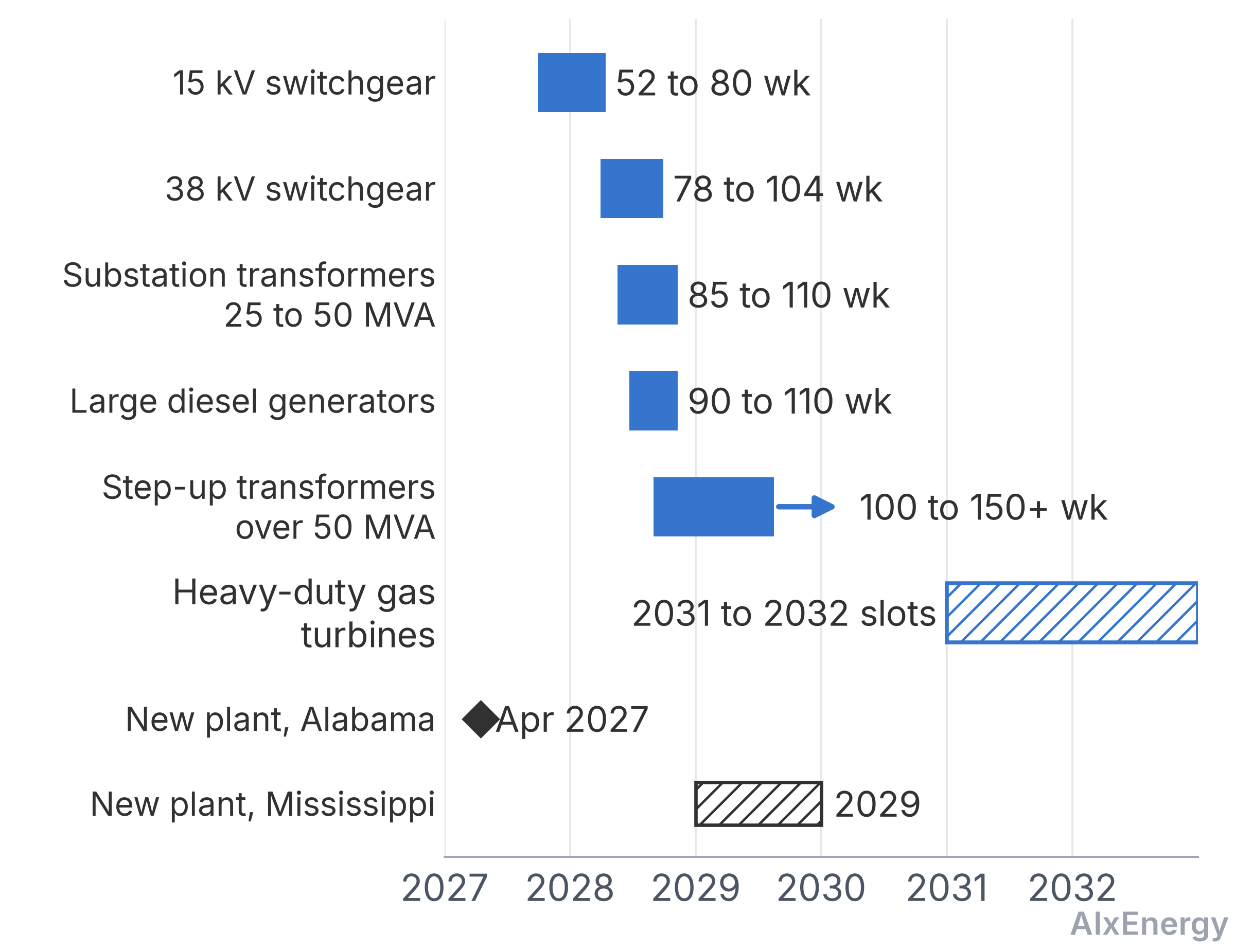
Figure 1 applies Terrapin's ranges to an order placed on October 1, 2026. On that arithmetic, 15 kV switchgear arrives between the end of September 2027 and mid-April 2028, and step-up transformers between the end of August 2028 and mid-August 2029, with the upper end open. These are factory delivery dates. Installation, integration and commissioning follow them, and an energization date follows the last item to arrive, not the first.
Heavy-duty gas turbines do not fit the week arithmetic. SAVRN, a vendor of on-site power that tracks equipment lead times, reports that GE Vernova described itself in July as mostly sold out through 2030 and was selling 2032 slots by mid-September; I could not review the earnings-call transcripts it cites, so the hatched bar in the figure is its reading, not a computed lead time.5 GE Vernova's third-quarter results, as summarized by DC Market Insights, show 11 GW of orders and slot reservations in the quarter, which moved contracted gas capacity from 116 GW to 122 GW.4 In that summary, a reservation is counted alongside an order.
An interconnection study answers whether the grid can serve a load and which upgrades are needed. A delivered transformer answers whether the upgrade exists. The two clocks run in parallel only if someone has paid to start the second, and a buyer who starts the equipment clock after the study ends adds its length to the schedule. Terrapin advises ordering at land close, six to twelve months before groundbreaking, and holding a manufacturer slot with a partial payment, which it puts at 10 to 30 percent of equipment cost; without a reservation, it says, the nominal lead time can lengthen by 8 to 16 weeks once specifications are final.3 SAVRN, citing trade sources, gives 10 to 20 percent for a switchgear slot and 20 percent for a turbine slot.5 These are a contractor's and a vendor's claims about market practice. They still describe a mechanism that bears on fairness: a slot is an option, and it belongs to whoever pays first.
The supplier-side view is consistent. Trench's chief executive told POWER that delivery timing is the biggest risk to whether a campus comes online on schedule.2 He also sells the equipment, so the statement is an interested one, but it matches what SAVRN, summarizing SemiAnalysis, reports about which 2026 projects are still progressing: those with site control, equipment on order and signed interconnection agreements.5
Who is reserving, and who is left
Hyperscalers and their equipment suppliers have begun to contract for capacity, not just for units. Schneider Electric and Digital Realty announced a $373 million supply capacity agreement in November 2025 covering uninterruptible power supplies, low-voltage switchgear and prefabricated skids, with a dedicated low-voltage switchgear production line.6 Hitachi's investor materials say its 2030 backlog forecast of about $100 billion includes framework agreements and capacity reservations, which means the maker itself counts a reservation as part of the order book.7 POWER reports that Trench has also signed a strategic capacity agreement with Meta for dry-type bushings.2
Utilities are contracting the same way, abroad at least. Hitachi Energy's agreement with E.ON is worth up to $700 million and, in the maker's words, reserves manufacturing capacity for transformers over a long-term period.8 Its September agreements with Enedis in France, worth 350 million euros, are described as long-term framework agreements for distribution and power transformers.9 Neither release states a term, a volume or a delivery schedule, so an outside regulator could not tell from them what the buyer paid to hold its place or what happens if demand falls short.
Consider how these arrangements interact. McKinsey estimates that in Europe and North America demand for power transformers was 914 GVA in 2025 against supply of 566 GVA, and that announced additions of about 186 GVA by 2030 only modestly exceed projected demand growth of 150 GVA, leaving the annual shortfall near 312 GVA.10 The same report advises utilities to sign multiyear framework agreements and developers to lock in sourcing years before commissioning.10 When every class of buyer follows that advice, an additional reservation does not create a transformer; it moves someone else's delivery later. The buyers least able to commit volume early, such as small distribution utilities, are the ones a first-come reservation system disadvantages. I have not found data on how production slots are divided between utilities and developers, and none of the sources cited here publishes it.
The cost-allocation problem follows. If a developer's reservation displaces a utility's order, ratepayers bear the delay or the premium, while the developer bears the deposit. If a utility buys ahead for a campus that later slips or cancels, ratepayers hold a stranded asset unless the contract assigned the risk elsewhere. AIxEnergy has looked at how data center deals allocate infrastructure delay risk, and the same logic applies one level down, to who carries the risk of an unused slot.
What the new factories change
New plants help, but mostly later than the projects now in line. Hitachi Energy says it will build a $528 million transformer factory in Gallman, Mississippi, with construction starting late in 2026 and production starting in 2029; the company describes the site as more than twice the size of its existing Crystal Springs plant.11 HD Hyundai's second plant in Montgomery, Alabama, broke ground on March 6, with completion targeted for April 2027 and extra-high-voltage capacity expected to rise by about 50 percent.12 Both dates are company targets, and a plant that is complete is not yet a plant at full output. Hitachi's South Boston expansion, which broke ground in June, comes with no start date in the Mississippi release.11 Taken together, the additions land mostly between 2027 and 2029, which is when projects not yet planned will be ordering, not when current ones need their units.
Forecasts of how fast the gap closes disagree. The Physical Layer, a personal blog by Tommy Lau that reads company disclosures closely, reports that Siemens Energy's November 2025 capital markets presentation showed demand exceeding capacity by roughly 40 percent in fiscal 2025 and by roughly 10 percent in fiscal 2030.13 McKinsey, with a different geography and definition, sees a shortfall that stays broadly unchanged through 2030.10 Makers also have reasons not to close the gap quickly. Hitachi's plan expects the backlog to stay at 2.5 to 3 times revenue through fiscal 2030, and its chief executive told investors the company is not building over-capacity.7 By the Physical Layer's arithmetic, Hitachi Energy's backlog stood at about 3.1 years of revenue at the end of September.13 A maker that plans to keep three years of orders on the books is, in effect, planning to keep a queue.
Owning the bottleneck
GE Vernova's chief executive described Trench's bushings as 5 to 8 percent of a transformer's bill of materials, according to DC Market Insights, which read the point as one about control of supply, not cost.4 The price, $9.0 billion or 13 times Trench's forecast 2028 adjusted EBITDA before synergies, is a bet that owning a small, slow-to-source component is worth a large premium.1 The release says Trench's Charlotte plant is expected to begin 765 kV manufacturing in late 2027, and the Trench chief executive told POWER that the first 765 kV bushings would ship in early 2028.1, 2 Those statements describe different milestones, and I have not tried to reconcile them.
What the deal does to allocation is less clear. Trench says it signs capacity agreements with major transformer makers and sells to makers, utilities and hyperscalers alike.2 GE Vernova is itself a transformer maker, so after closing, expected in late 2027 and subject to regulatory approvals, it would own a supplier to whichever of its competitors are among those customers.1 Trench's chief executive said in GE Vernova's release that he looks forward to serving all existing and future customers.1 Whether that commitment is enforceable, and whether competition authorities will ask for it to be, is open.
Rules for buying ahead
Two regulators have already faced the question of when buying ahead is prudent, and they answered it differently. Texas rule 25.59, effective in January 2025, lets a transmission and distribution utility in ERCOT procure, own and operate long lead-time facilities, jointly with other utilities, through shared inventories or through procurement subscriptions with an equipment supply service, and earn a return from the date of procurement.14 The definition is limited to facilities that would aid in restoring power after a significant outage and that take at least six months to obtain, so the rule is a template for pooled inventory, not an authorization to buy for load growth.14 California's decision on San Diego Gas & Electric's energization ratemaking under SB 410, issued in October 2025, went the other way on inventory: it accepted that the utility should maintain a stock of transformers, but found that the utility had not shown a need to enlarge its unused inventory and declined to let it record costs for purchases that simply increased stock.15
Neither rule addresses a utility that wants to reserve factory slots for a campus load that has not yet been built. Advance procurement of that kind is easiest to defend when it is tied to load that has posted security, and when the slot can be passed to another utility if the load does not arrive. Pooling standard units across utilities, as Texas allows for outage equipment, lowers the cost of being wrong. The European framework agreements are a different model, because they trade volume commitments for reserved capacity, but their terms are not public, and a regulator would need them to judge prudence.
Slot position as diligence
For a developer, the practical consequence is that a slot belongs in the diligence file next to the queue position. The relevant questions are when the order was placed, which units it covers, what delivery window the maker has confirmed, what deposit is at risk and whether the position can be assigned. A campus whose interconnection agreement is signed but whose step-up transformers are not on order has an energization date that is a hope, not a schedule. The pricing of land and of power purchase terms should reflect that. So should the design of flexible load: if the full transformer set arrives in stages, a phased energization with curtailable service in the interim may bring revenue earlier than waiting for the last unit, and the study and the order can be shaped to allow it. That is my reasoning, not something the sources demonstrate.
Public project data can show where the question matters, but not the answer. The AIxEnergy Map's page for Meta's Hyperion campus in Richland Parish, Louisiana lists 5,000 MW of announced IT load and an under-construction status, and the Map's AI data center corridors view shows where such loads cluster. What an outside reader cannot see from either is which of those projects hold factory slots for the equipment that follows the building shell. That information sits in purchase orders.
Several dates will show how much of this holds. GE Vernova's acquisition of Trench is expected to close in late 2027, after regulatory review. HD Hyundai's Alabama plant is targeted for April 2027, and Hitachi's Mississippi plant for 2029. Whether any state commission will accept a utility's request to reserve slots ahead of signed load, and on what terms, is not yet on any docket I know of.
Notes
- GE Vernova, “GE Vernova to Acquire Trench Group,” press release, October 28, 2026, https://www.gevernova.com/news/press-releases/ge-vernova-acquire-trench-group. Trench financial figures are GE Vernova’s forecasts of a standalone business. ↩
- Sonal C. Patel, “Can U.S. High-Voltage Grid Equipment Supply Keep Pace With 765-kV Expansion and Data Center Demand?,” POWER, September 7, 2026, https://www.powermag.com/can-u-s-high-voltage-grid-equipment-supply-keep-pace-with-765-kv-expansion-and-data-center-demand/. Interview with Bahadir Basdere, chief executive of Trench Group, who sells the equipment discussed. ↩
- William Goodin, “Switchgear, Transformer, and Generator Lead Times in 2026,” Terrapin Construction Group, June 10, 2026, https://terrapincg.com/news/switchgear-transformer-generator-lead-times-2026. A contractor’s published ranges, which accompany its procurement services; ranges vary by source and equipment class and are not audited. ↩
- Satyabrat Rajawat, “AI Power Gear Costs More: Vertiv Orders Doubled, GE Vernova’s Backlog Hit US$197bn. Amazon Reports 29 Oct,” DC Market Insights, October 29, 2026, https://www.dcmarketinsights.com/news/ai-power-gear-costs-more-vertiv-orders-doubled-ge-vernovas-backlog-hit-us197bn-amazon-reports-29-oct. The Cushman & Wakefield lead-time ranges are reported there via CRE Daily, and the GE Vernova figures are DC Market Insights’ summary of the company’s call; I did not review the originals. ↩
- SAVRN, “What’s Really Delaying Data Centers, and for How Long,” September 30, 2026 update, https://savrn.com/blog/data-center-delivery-lead-times-2026. Vendor-authored; SAVRN sells on-site power. Its statements about GE Vernova’s calls and about SemiAnalysis are as reported there. ↩
- Schneider Electric, “Schneider Electric and Digital Realty Announce $373M Supply Capacity Agreement to Meet Rising Data Center Demand,” press release, November 19, 2025, https://www.se.com/us/en/about-us/newsroom/news/press-releases/schneider-electric-and-digital-realty-announce-373m-supply-capacity-agreement-to-meet-rising-data-center-demand-691d192005c0c16f5902ca3c. ↩
- Hitachi, Ltd., “Hitachi Energy,” Investor Day presentation, June 10, 2026, https://www.hitachi.com/content/dam/hitachi/global/en/press/files/2026/06/260610/20260610_01_energy_en.pdf; and Investor Day question-and-answer session, June 10, 2026, https://www.hitachi.com/content/dam/hitachi/global/en/press/files/2026/06/260610/20260610_06_qa_session_en.pdf. The statements are the company’s own. ↩
- Hitachi Energy, “Hitachi Energy and E.ON Sign Deal Worth up to $700 Million USD for Critical Grid Infrastructure to Bolster Energy Security and Resilience in Germany,” press release, July 28, 2025, https://www.hitachienergy.com/news-and-events/press-releases/2025/07/hitachi-energy-and-e-on-sign-deal-worth-up-to-700-million-usd-for-critical-grid-infrastructure-to-bolster-energy-security-and-resilience-in-germany. ↩
- Hitachi Energy, “Hitachi Energy and Enedis Have Signed €350 Million Agreements to Power France’s Energy Future,” press release, September 24, 2026, https://www.hitachienergy.com/news-and-events/press-releases/2026/09/hitachi-energy-and-enedis-have-signed-350-million-agreements-to-power-france-s-energy-future. ↩
- Carsten Hirschberg, Eike Reus, and Thorsten Schleyer, “The Transformer Supercycle: Why Demand Is Outrunning Supply,” McKinsey & Company, September 18, 2026, https://www.mckinsey.com/industries/electric-power-and-natural-gas/our-insights/the-transformer-supercycle-why-demand-is-outrunning-supply. The demand and supply comparison is for Europe and North America combined. ↩
- Hitachi Energy, “Hitachi Deepens Commitment to U.S. Manufacturing with $528 Million Mississippi Transformer Factory,” press release, September 15, 2026, https://www.hitachienergy.com/us/en/news-and-events/press-releases/2026/09/hitachi-deepens-commitment-to-u-s-manufacturing-with-528-million-mississippi-transformer-factory. Dates are company targets. ↩
- HD Hyundai, press release on the groundbreaking of its second Montgomery, Alabama transformer plant, March 8, 2026, https://www.hd.com/en/newsroom/media-hub/press/view?detailsKey=4028. The April 2027 completion date is a company target. ↩
- Tommy Lau, “The Equipment Queue: Transformer and Switchgear Makers Are Building to Keep the Wait, Not to End It,” The Physical Layer, October 7, 2026, updated October 30, 2026, https://thephysicallayer.fyi/journal/the-equipment-queue/. A personal blog; the readings of Siemens Energy’s and Hitachi’s disclosures are the author’s, and I did not review the underlying Siemens Energy presentation. ↩
- Public Utility Commission of Texas, 16 Tex. Admin. Code § 25.59, “Long Lead-Time Facilities,” effective January 8, 2025, https://ftp.puc.texas.gov/public/puct-info/agency/rulesnlaws/subrules/electric/25.59/25.59.pdf. ↩
- California Public Utilities Commission, Decision 25-10-034, “Decision Authorizing a Ratemaking Mechanism for Energization Projects Pursuant to Senate Bill 410,” Application 25-04-015, October 30, 2025, https://docs.cpuc.ca.gov/PublishedDocs/Published/G000/M586/K499/586499719.PDF. The decision concerns San Diego Gas & Electric. ↩
Bibliography
- California Public Utilities Commission. Decision 25-10-034, “Decision Authorizing a Ratemaking Mechanism for Energization Projects Pursuant to Senate Bill 410.” Application 25-04-015, October 30, 2025. https://docs.cpuc.ca.gov/PublishedDocs/Published/G000/M586/K499/586499719.PDF.
- GE Vernova. “GE Vernova to Acquire Trench Group.” Press release, October 28, 2026. https://www.gevernova.com/news/press-releases/ge-vernova-acquire-trench-group.
- Goodin, William. “Switchgear, Transformer, and Generator Lead Times in 2026.” Terrapin Construction Group, June 10, 2026. https://terrapincg.com/news/switchgear-transformer-generator-lead-times-2026.
- HD Hyundai. Press release on the groundbreaking of its second Montgomery, Alabama transformer plant. March 8, 2026. https://www.hd.com/en/newsroom/media-hub/press/view?detailsKey=4028.
- Hirschberg, Carsten, Eike Reus, and Thorsten Schleyer. “The Transformer Supercycle: Why Demand Is Outrunning Supply.” McKinsey & Company, September 18, 2026. https://www.mckinsey.com/industries/electric-power-and-natural-gas/our-insights/the-transformer-supercycle-why-demand-is-outrunning-supply.
- Hitachi Energy. “Hitachi Energy and E.ON Sign Deal Worth up to $700 Million USD for Critical Grid Infrastructure to Bolster Energy Security and Resilience in Germany.” Press release, July 28, 2025. https://www.hitachienergy.com/news-and-events/press-releases/2025/07/hitachi-energy-and-e-on-sign-deal-worth-up-to-700-million-usd-for-critical-grid-infrastructure-to-bolster-energy-security-and-resilience-in-germany.
- Hitachi Energy. “Hitachi Energy and Enedis Have Signed €350 Million Agreements to Power France’s Energy Future.” Press release, September 24, 2026. https://www.hitachienergy.com/news-and-events/press-releases/2026/09/hitachi-energy-and-enedis-have-signed-350-million-agreements-to-power-france-s-energy-future.
- Hitachi Energy. “Hitachi Deepens Commitment to U.S. Manufacturing with $528 Million Mississippi Transformer Factory.” Press release, September 15, 2026. https://www.hitachienergy.com/us/en/news-and-events/press-releases/2026/09/hitachi-deepens-commitment-to-u-s-manufacturing-with-528-million-mississippi-transformer-factory.
- Hitachi, Ltd. “Hitachi Energy.” Investor Day presentation, June 10, 2026. https://www.hitachi.com/content/dam/hitachi/global/en/press/files/2026/06/260610/20260610_01_energy_en.pdf. Investor Day question-and-answer session, June 10, 2026. https://www.hitachi.com/content/dam/hitachi/global/en/press/files/2026/06/260610/20260610_06_qa_session_en.pdf.
- Lau, Tommy. “The Equipment Queue: Transformer and Switchgear Makers Are Building to Keep the Wait, Not to End It.” The Physical Layer, October 7, 2026, updated October 30, 2026. https://thephysicallayer.fyi/journal/the-equipment-queue/.
- Novoklimov. “High-voltage transformer 750 kV.” Photograph. Wikimedia Commons, CC0. https://commons.wikimedia.org/wiki/File:High-voltage_transformer_750_kV_%D0%A2%D1%80%D0%B0%D0%BD%D1%81%D1%84%D0%BE%D1%80%D0%BC%D0%B0%D1%82%D0%BE%D1%80_750_%D0%BA%D0%92.jpg.
- Patel, Sonal C. “Can U.S. High-Voltage Grid Equipment Supply Keep Pace With 765-kV Expansion and Data Center Demand?” POWER, September 7, 2026. https://www.powermag.com/can-u-s-high-voltage-grid-equipment-supply-keep-pace-with-765-kv-expansion-and-data-center-demand/.
- Public Utility Commission of Texas. 16 Tex. Admin. Code § 25.59, “Long Lead-Time Facilities.” Effective January 8, 2025. https://ftp.puc.texas.gov/public/puct-info/agency/rulesnlaws/subrules/electric/25.59/25.59.pdf.
- Rajawat, Satyabrat. “AI Power Gear Costs More: Vertiv Orders Doubled, GE Vernova’s Backlog Hit US$197bn. Amazon Reports 29 Oct.” DC Market Insights, October 29, 2026. https://www.dcmarketinsights.com/news/ai-power-gear-costs-more-vertiv-orders-doubled-ge-vernovas-backlog-hit-us197bn-amazon-reports-29-oct.
- SAVRN. “What’s Really Delaying Data Centers, and for How Long.” September 30, 2026 update. https://savrn.com/blog/data-center-delivery-lead-times-2026.
- Schneider Electric. “Schneider Electric and Digital Realty Announce $373M Supply Capacity Agreement to Meet Rising Data Center Demand.” Press release, November 19, 2025. https://www.se.com/us/en/about-us/newsroom/news/press-releases/schneider-electric-and-digital-realty-announce-373m-supply-capacity-agreement-to-meet-rising-data-center-demand-691d192005c0c16f5902ca3c.