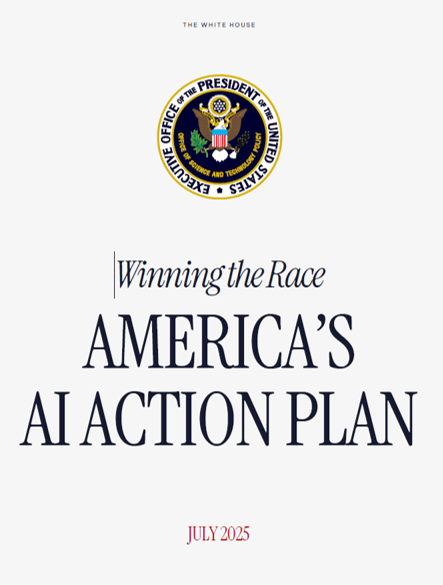
In July 2025, the White House released its America’s AI Action Plan, a blueprint intended to secure U.S. leadership in the artificial intelligence revolution. The document arrives at a moment of inflection: hyperscale data centers are consuming power on a scale once reserved for metropolitan grids, interconnection queues are bloated with gigawatts of speculative projects, and the public conversation oscillates between AI as savior and AI as destabilizer. Against this backdrop, the plan’s three pillars—Accelerate AI Innovation, Build American AI Infrastructure, and Lead in International AI Diplomacy and Security—invite both admiration and critique. From the perspective of AIxEnergy, a platform devoted to mapping the convergence of computation and electricity, the plan represents a monumental recognition of reality. Yet it also reveals fault lines that could determine whether the United States enters the AI age as master builder or captive consumer.
The First Strength: Unflinching Recognition of AI’s Energy Appetite
Rarely does a policy document state so bluntly that artificial intelligence is “the first digital service that compels a step-change in U.S. energy generation.” This is more than rhetoric—it is an admission that bits and electrons have fused into one economy. Where the early internet could piggyback on existing infrastructure, AI compels new wires, new substations, and new generation. The plan wisely calls for streamlined permitting under NEPA, FAST-41 coverage for data centers and power plants, and categorical exclusions for low-impact expansions. For developers stalled in queues or waiting years for environmental reviews, this signals the possibility of accelerated buildouts. For utilities, it provides political cover to retain dependable assets that might otherwise retire prematurely.
But recognition is not the same as resolution. While the plan directs agencies to “stabilize, optimize, grow,” the sequence betrays a bias: keep the old fleet online, squeeze existing corridors, then—only then—pursue frontier technologies. For an administration otherwise keen to tout decarbonization, this prioritization of stability over transformation risks baking in fossil incumbency.
Strength in Workforce Strategy
Equally notable is the plan’s treatment of workforce policy as infrastructure. Treasury guidance to expand tax-advantaged AI upskilling, creation of an AI Workforce Research Hub, and a national skills framework for electricians, advanced HVAC specialists, and controls engineers reflect a long-overdue acknowledgement: without human hands, no server rack hums and no cooling loop closes. In positioning trades as strategic assets, the plan echoes mid-twentieth-century mobilizations where welders and machinists underpinned shipyards and airfields. States and utilities now have a federal invitation to tie economic development packages to training consortia—a competitive lever for those vying to host hyperscale campuses.
Yet the workforce vision stops short of addressing the geographic mismatch between where skills reside and where campuses sprout. Apprenticeship programs in the Midwest do little for a cluster in northern Virginia unless labor mobility is supported. Nor does the plan address the attrition risk posed by older workers retiring faster than replacements are trained. A hub-and-framework is laudable, but execution will hinge on state-level implementation.
Safety and Standards: NIST’s Expanding Role
On evaluation and safety, the plan expands the National Institute of Standards and Technology’s role. The emphasis is no longer on abstract principles but on measurement science, model interpretability, robustness, and mission-specific testbeds. This is a pragmatic shift, aligning safety with engineering discipline rather than political debate. By linking safety to metrics, the plan strengthens the hand of developers seeking predictable evaluation criteria.
Still, the tilt toward measurement carries risks of its own. The plan largely sidesteps the social impacts that animated earlier debates: algorithmic bias, disinformation, and labor displacement. For a document that aspires to be comprehensive, the omission of social trust could erode legitimacy. Moreover, NIST’s expanded remit comes without clear funding commitments. Scaling measurement science to frontier models requires resources as vast as those being poured into chip fabs and cloud campuses. Without them, standards may lag practice.
Diplomatic Ambition: Exporting the Full Stack
The third pillar, international diplomacy and security, envisions exporting a “full-stack AI package”—chips, models, software, and standards—while tightening compute export controls. The ambition is to make the U.S. not just a leader but an architect of the global AI order. For allies, this is reassurance: access to U.S. technology and standards promises interoperability. For rivals, it signals resolve: location verification and end-use monitoring aim to close loopholes in semiconductor tooling.
Yet ambition can shade into overreach. Allies may bristle at controls that feel less like partnership and more like dependency. The plan also risks conflating economic advantage with diplomatic cohesion. Just as OPEC learned that dominance breeds defection, the U.S. may discover that too tight a grip invites parallel supply chains. Technology diplomacy is most effective when it fosters resilience, not monopoly.
Weakness in Grid Prescription
Perhaps the most consequential weakness lies in the grid prescription itself. By privileging dispatchable resources in interconnection, the plan offers clarity—but at the expense of innovation. Enhanced geothermal and long-duration storage are nodded to, yet the near-term bias tilts unmistakably toward natural gas. For hyperscalers desperate for reliable power, this may be welcome news. For climate commitments, it is a precarious gamble.
The risk is twofold. First, privileging quick-to-grid resources risks crowding out investment in technologies that need nurturing. Second, by aligning markets around resource adequacy rather than emissions reduction, the plan could exacerbate the very climate vulnerabilities it claims to address. The danger is that the United States enters the AI age with secure servers but a destabilized climate.
Permitting Acceleration: A Double-Edged Sword
The promise of streamlined NEPA reviews and categorical exclusions for low-impact projects is undeniably attractive. Developers have long lamented multi-year permitting cycles that render projects obsolete before shovels break ground. Acceleration can unleash capital and meet surging demand.
Yet history warns that acceleration without accountability breeds backlash. The interstate highway program, celebrated for its speed, also left scars of dislocation and inequity. Without safeguards, fast-tracked data centers and power projects may ignite local resistance, from water usage concerns to land-use disputes. Speed, in other words, must be balanced with legitimacy.
Public Lands and Federal Siting
The plan’s invitation to expand federal siting of data centers and generation assets marks a radical departure. Traditionally, federal lands were reserved for mining, drilling, or conservation. To imagine them dotted with AI campuses is to reconfigure the geography of the Republic. The opportunity is vast: access to transmission corridors, renewable resources, and federal oversight could de-risk development.
But here too lie hazards. Concentrating critical infrastructure on public lands risks making them geopolitical targets. It also raises questions of federalism: will states acquiesce to federal siting decisions that bypass local control? A strategy that accelerates siting may simultaneously ignite sovereignty disputes.
The Plan’s Industrial Philosophy
Stepping back, the plan represents a philosophy of industrial mobilization. Its ethos is less about nudging markets and more about commanding them. By calling AI an industrial, information, and renaissance revolution, it casts the moment as one akin to railroads or electrification. The ambition is refreshing, especially after decades of policy drift.
Yet the mobilization frame also courts risk. Industrial mobilization has historically thrived under conditions of consensus—wartime, existential competition, or crisis. Whether the American public perceives AI as such a cause remains uncertain. If consensus falters, so too may the political durability of the plan.
Implications for Hyperscalers and States
For hyperscalers, the plan offers three actionable levers: permitting acceleration, priority interconnection for dispatchable capacity, and alignment with federal procurement standards. Each of these can be operationalized in corporate strategy. A hyperscaler planning a 1 GW campus can pair behind-the-meter gas turbines with expedited permitting, then advertise compliance with federal security standards to attract enterprise clients.
For states, the plan reframes competitiveness. Economic development is no longer just about tax breaks; it is about workforce pipelines, public land siting, and alignment with federal grid directives. States that can bundle these elements will secure campuses and the jobs they bring. Those that cannot will watch demand migrate elsewhere.
The Unfinished Business of Decarbonization
Perhaps the most glaring omission is a coherent pathway to reconcile AI’s energy appetite with climate imperatives. The plan does not explicitly mention climate change or carbon targets—an omission that underscores its political character. By focusing on reliability and resource adequacy while sidestepping decarbonization, the plan leaves the most consequential question unanswered: how to power AI without undermining climate commitments.
Here lies the unfinished business. Wind, solar, and batteries—technologies now proven at scale—are capable of being deployed at timelines and costs that match, and in many cases outpace, fossil incumbents. In 2024 alone, the U.S. added nearly 30 gigawatts of wind and solar capacity and over 10 gigawatts of battery storage, with project lead times often measured in months rather than years. These are no longer experimental add-ons; they are the backbone of new capacity additions. The plan’s failure to give them equal priority to dispatchable fossil capacity is not merely a policy oversight but a strategic blind spot.
The accelerated deployment schedule for renewables is especially critical in the AI era. Data centers, though demanding in load, are also predictable and locationally concentrated. That predictability dovetails with renewable development zones and the rapid build-out of batteries capable of shifting solar and wind output into evening peaks. Indeed, the same permitting acceleration the plan envisions for fossil plants could supercharge renewable integration if applied symmetrically.
An objective view recognizes that reliability remains paramount. Fossil plants today deliver firm capacity with high confidence. But a forward-looking strategy would place wind, solar, and batteries on a glidepath to equal footing—using incentives, procurement mandates, and market design to ensure that the cleanest resources also become the firmest. Without such measures, the United States risks meeting the AI challenge with yesterday’s fuels rather than tomorrow’s ingenuity.
Conclusion: A Political Document with Practical Implications
The America’s AI Action Plan is an important and useful document, but it is also undeniably political in nature. Its framing, emphases, and omissions reveal as much about what policymakers are willing to confront as what they are eager to avoid. It recognizes AI as both economic engine and energy disruptor, and it offers practical levers—permitting reform, workforce investment, safety standards, and international diplomacy—that can accelerate U.S. leadership.
Yet its weaknesses are equally notable: a bias toward fossil incumbency, an underdeveloped decarbonization strategy, and potential overreach in diplomacy. These gaps show the limits of political consensus more than the limits of technical imagination. Its success will depend less on the words of July 2025 than on the choices of the next decade: whether the United States can convert recognition into reinvention, whether hyperscalers embrace flexibility rather than redundancy, and whether the grid evolves into an architecture of optionality rather than a scaffold for fossil dependence.
In the end, the plan’s strengths and weaknesses converge on a single question: will America’s AI future be powered by yesterday’s fuel or tomorrow’s ingenuity? For AIxEnergy, that is the fulcrum upon which both competitiveness and climate balance will turn.