The White House expanded its Ratepayer Protection Pledge on July 23, announcing that more than 200 additional utilities, data-center developers, cooperatives, states, and other participants had joined the effort. The administration says the pledge now covers 80 percent of electricity delivered to U.S. homes and businesses and 263 million people. Those figures describe the reach claimed by the administration, not an independent audit of customer protection.[1]
A pledge is not a tariff, a commission order, or an enforceable service agreement. It does not by itself determine which facilities a data-center customer must finance, how shared network costs should be divided, what happens when a project is delayed, or who pays if contracted electricity is never used.
Its importance is nonetheless substantial. The federal government is giving national political force to a basic cost-causation principle: large computing customers should finance the incremental generation and infrastructure required to serve them and should continue paying for capacity procured on their behalf even when their actual use falls short. The original pledge calls for separate rate structures and commitments to pay for power and related infrastructure whether or not the electricity is ultimately consumed.[1] That principle moves the AI-energy debate away from one of its most visible but least useful symbols: the electricity assigned to a single prompt.
The immediate infrastructure question is not whether one chatbot response consumes a fraction of a watt-hour or several watt-hours. It is whether a 100-megawatt, 500-megawatt, or gigawatt-scale campus can be supplied on schedule—and what happens when utilities begin ordering equipment, reserving capacity, acquiring land, reinforcing transmission, and procuring generation before the project’s final size and operating date are certain. The public consequences of AI are increasingly determined before the first prompt is typed.
The grid plans for campuses, not prompts
Per-query energy estimates remain relevant to model design, efficiency improvement, product comparisons, and emissions accounting. They are poorly suited to deciding whether a particular data-center campus requires a new substation, transmission line, generation resource, water supply, or long-term capacity commitment.
Research on AI inference shows why. Energy consumption can vary by orders of magnitude depending on the task, model, hardware, output length, utilization, batching, and operating environment. A production-oriented analysis estimated a median of 0.34 watt-hours for a typical frontier-model query under its assumptions, increasing to 4.32 watt-hours when test-time computation raised token use fifteenfold. The same study found that combined improvements in model design, serving systems, and hardware could plausibly reduce energy per query by eight- to twentyfold.[2] These are useful efficiency findings. They do not provide a universal unit for grid planning.
Utilities do not reserve transformers or procure capacity in response to individual prompts. They invest against projected campus load, service level, ramp schedule, utilization, location, operating profile, and the probability that the customer will actually arrive. The relevant unit is therefore not the prompt. It is the project commitment.
Uncertainty is now a planning condition
The scale of prospective data-center demand makes this distinction consequential. The International Energy Agency estimated that data centers consumed approximately 415 terawatt-hours of electricity worldwide in 2024, about 1.5 percent of global consumption. Its base case reaches approximately 945 terawatt-hours in 2030. The global share remains limited relative to total electricity use, but the demand is highly concentrated and can materialize faster than generation, transmission, equipment manufacturing, and permitting.[3]
For the United States, Lawrence Berkeley National Laboratory’s June 2026 update estimated reference-case data-center electricity consumption of 649 terawatt-hours in 2030. Its compounded uncertainty range extends from 521 to 843 terawatt-hours, equivalent to approximately 9.5 to 15.3 percent of total U.S. electricity consumption.[4]
EPRI independently estimated that data centers could account for 9 to 17 percent of U.S. electricity consumption by 2030. In Virginia—the country’s most concentrated data-center market—EPRI projected a 39 to 57 percent share across its scenarios.[5]
These projections do not establish that every announced campus will be built. Their breadth is itself the planning fact. Utilities and system operators may need to make physical and financial commitments before the industry’s ultimate load trajectory is known.
The uncertainty also cannot be managed through national averages. In PJM’s Dominion zone, summer peak load reached 23,905 megawatts in 2025, 23 percent above 2019. The 2025–26 winter peak was 45 percent above the 2019–20 level. PJM expects the zone to experience the largest absolute increase in summer peak demand through 2030, largely because of data-center growth.[6] A nationally manageable percentage can therefore become a dominant local infrastructure problem.
The commitment sequence creates the risk
The central large-load problem is not simply the amount of electricity requested. It is the sequence in which each party must commit.
A developer may request substantial capacity to preserve an option on a site. The utility may then perform studies, reserve engineering resources, acquire property, procure supply, order long-lead equipment, or begin constructing facilities. The customer may not make its final investment decision until it receives a credible service date and price. The utility may be unable to provide that certainty until it undertakes work that creates cancellation exposure.
Each party wants evidence before making an irreversible commitment. Each may depend on the other party’s commitment to produce that evidence. Equipment constraints intensify the circularity. Reuters reported in July 2026 that generator step-up transformer lead times had exceeded 160 weeks and that high-voltage circuit-breaker lead times had reached 125 weeks. Some utilities and developers were securing production slots years before expected need.[7]
Once equipment has been ordered, land acquired, power procured, or construction started, the cost does not disappear if the customer postpones the project, reduces its load, moves to another location, or abandons the development.
Someone must absorb it. The customer can pay through deposits, advances, minimum bills, guarantees, or exit charges. Utility shareholders can absorb some costs through disallowance or reduced returns. Other customers can pay through rates. Taxpayers can pay through subsidies or public financing. Suppliers may bear cancellation costs through negotiated terms. The policy question is therefore not whether project risk exists. It is where that risk moves as commitments become less reversible.
Protection should rise with irreversibility
No single customer guarantee can cover every form of development risk. Ratepayer protection requires a portfolio of instruments activated at the point when each exposure is created.
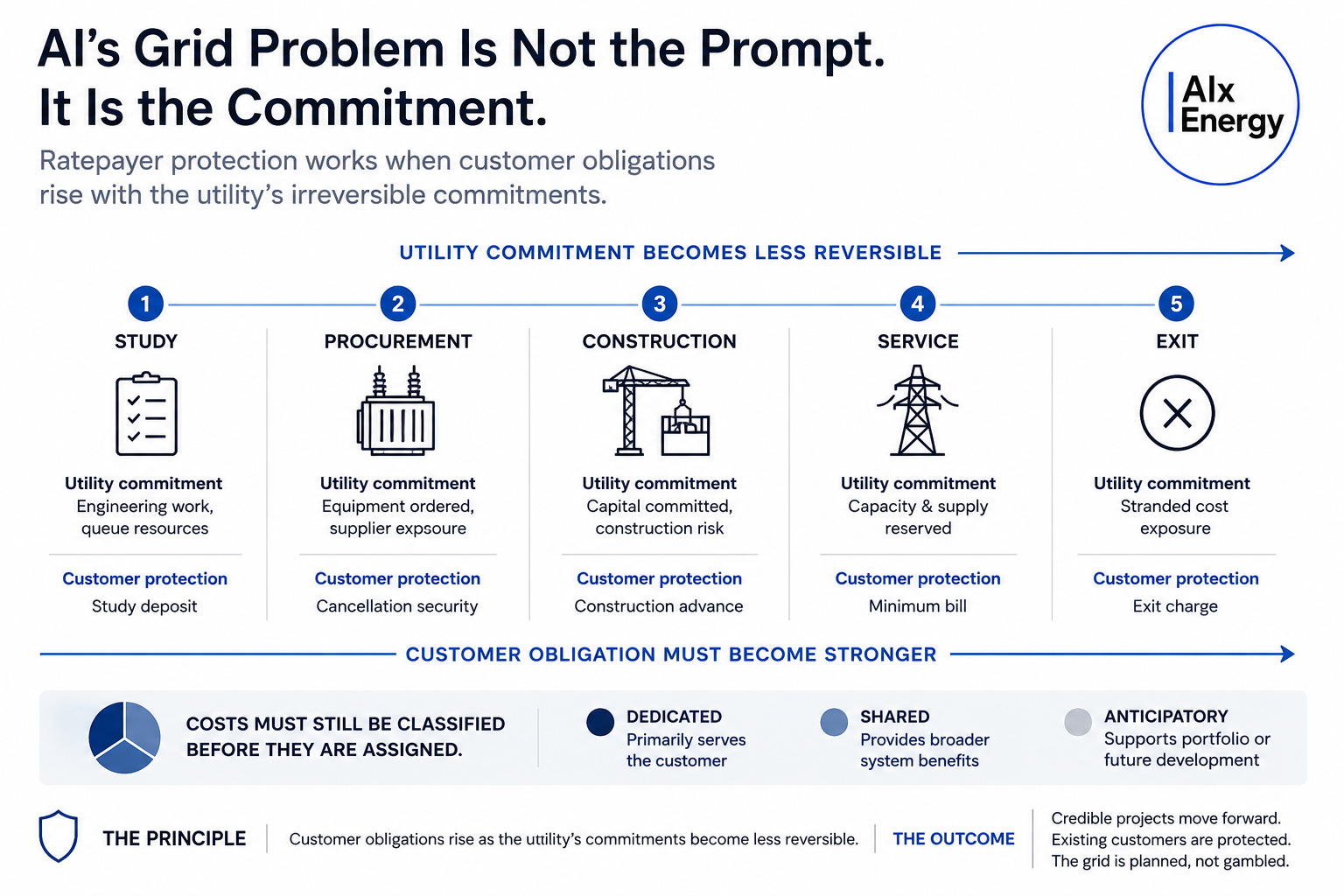
At the preliminary-request stage, a study deposit can ensure that the customer reimburses identifiable engineering and administrative work. When the utility begins reserving equipment or manufacturing capacity, the customer’s security should reflect actual supplier cancellation charges, restocking exposure, and other procurement liabilities.
Before construction begins, the customer should provide evidence of financing, site control, permitting progress, internal authorization, and a credible development schedule. Construction advances or credit support can then correspond to the portion of investment that becomes irreversible.
When the utility is ready to provide service, minimum-demand charges or minimum bills can protect against low utilization of generation, transmission, and capacity procured for the project. If the customer exits early, termination charges can recover reasonably attributable costs that remain after equipment reuse, resale, reassignment, depreciation, insurance, and other mitigation measures.
These instruments are complements, not substitutes. A study deposit does not cover a canceled transformer order. A construction contribution does not necessarily cover long-term capacity procurement. A minimum bill protects against underutilization after service begins but may provide little protection if the project disappears before energization.
The governing principle should be straightforward: Customer obligations should rise as the utility’s commitments become less reversible.
That is more defensible than demanding a large undifferentiated guarantee at the beginning of development. It also avoids allowing a customer to retain unrestricted exit rights after the utility has undertaken costly and project-specific work.
Cost causation is a principle, not a formula
Saying that a data center should pay the costs it causes does not resolve every allocation question. The hardest cases involve infrastructure that serves the project while also providing broader system value.
A dedicated substation serving one campus can usually be attributed directly. A transmission reinforcement may be more complicated. It may be accelerated by the data center but also improve reliability, relieve congestion, support future customers, or enable new generation. A utility may oversize equipment because it anticipates additional development. A supply resource may be procured in response to several proposed loads rather than one project.
A workable framework should distinguish three classes of cost.
Dedicated costs arise from facilities that primarily serve one customer and have limited value without that customer. These costs should generally be assigned directly, subject to normal prudence review.
Triggered shared costs arise when a project accelerates or enlarges an investment that also benefits other users. Allocation should reflect both the project’s causal role and the measurable system benefits available to others.
Portfolio or anticipatory costs arise from infrastructure built for broader load growth, multiple prospective customers, reliability needs, or economic-development expectations. These costs require system-level planning evidence rather than automatic assignment to the first customer connected.
Cost causation can be distorted in both directions. Assigning every shared upgrade to a single large customer can suppress economically valuable development and allow later users to free-ride. Socializing project-specific costs can force existing customers to finance speculative private infrastructure.
The correct answer is not always “the data center pays everything.” It is that costs should be classified transparently, assigned according to causation and benefit, and revisited when actual development differs materially from the assumptions used to justify the investment.
Obligations must be reciprocal
Customer security is only one side of the commitment sequence. A customer cannot rationally guarantee a project schedule when the utility cannot substantiate a service date, cost range, or required scope of work. A framework that protects ratepayers by transferring nearly all uncertainty to the customer may discourage credible projects while doing little to improve utility performance.
Matched customer obligations should therefore be accompanied by reciprocal utility obligations. Before requiring substantial security, the utility should disclose the basis for its cost estimate, the principal schedule assumptions, the work that will be undertaken, the conditions that could change the estimate, and the portion of the customer’s security that becomes nonrefundable at each stage.
Utilities should provide periodic evidence of procurement, engineering, permitting, construction, and interconnection progress. Customers should have defined release or adjustment rights when the utility misses specified milestones for reasons not attributable to the customer.
Cost ranges should narrow as studies advance. Service commitments should strengthen as the customer’s financial commitments increase. Material changes in scope should trigger review rather than automatic transfer of additional costs.
Reciprocity does not mean that utilities must guarantee outcomes beyond their control. It means that both parties should be required to produce evidence at the point where the other is being asked to take risk.
Flexibility is a service attribute, not an adjective
Flexible and non-firm service may reduce the infrastructure required to connect some large loads. But flexibility has value only when it can be incorporated into planning and operations.
A credible flexibility envelope must specify:
- the amount of load that can be reduced;
- the notice required;
- the duration and frequency of curtailment;
- the speed of response;
- telemetry and control requirements;
- testing procedures;
- restoration conditions; and
- consequences for nonperformance.
Recent modeling indicates that standardized flexibility arrangements could expand the range of feasible data-center locations and reduce the need for some transmission reinforcements. The research is promising, but it is based on modeled systems and assumed operating envelopes, not a nationwide record of demonstrated performance.[8]
A statement that computing workloads are theoretically movable is not equivalent to a dispatchable contractual obligation. The data center may have latency requirements, customer-service commitments, cybersecurity restrictions, backup-power limitations, or internal operating constraints that prevent it from curtailing when the grid needs relief.
Flexible service should therefore receive differentiated treatment only when the operating obligation is measurable, enforceable, and reflected in the infrastructure plan.
The federal process is moving toward enforceable rules
The Ratepayer Protection Pledge provides political direction, but implementation will occur through regulatory proceedings, tariffs, utility contracts, and service agreements.
On June 18, 2026, the Federal Energy Regulatory Commission issued tailored show-cause orders under section 206 of the Federal Power Act to PJM, MISO, SPP, CAISO, ISO New England, and NYISO. FERC directed the six regional operators and their transmission owners to justify existing tariffs or propose reforms addressing study processes, cost shifting, transparency, co-location, flexible service, and generation located near large loads. The orders also required reports on how adequate generation would be secured.[9]
The proceedings are significant, but they are not final national rules. FERC expressly recognized that the six regions differ in market structure, geography, operating conditions, and progress on large-load integration.
That is appropriate. A single national tariff design would struggle to accommodate vertically integrated utility systems, organized wholesale markets, constrained urban networks, generation-rich regions, water-limited areas, and locations with different infrastructure-development timelines.
The durable federal contribution should be a common set of principles and evidence requirements—not an assumption that every system must use the same instrument.
Environmental impacts also follow the project
The same shift from generic claims to project evidence should govern environmental review. Data-center water use, emissions, land requirements, and cooling demand depend on location, grid composition, equipment efficiency, cooling architecture, climate, water source, and operating profile. National averages can indicate scale, but they cannot establish the impact of a particular campus.
Design choices matter. A 2025 life-cycle assessment found that advanced cooling configurations reduced greenhouse-gas emissions by 15 to 21 percent, energy demand by 15 to 20 percent, and blue-water consumption by 31 to 52 percent relative to the study’s air-cooled baseline. Those findings are design-specific, not universal guarantees.[10]
The relevant regulatory question is therefore not whether data centers are generically sustainable or unsustainable. It is what a proposed facility will consume, emit, discharge, and require at its location—and what enforceable design and operating commitments will govern those impacts.
The emerging standard should be project evidence
Before major utility and customer commitments become irreversible, a credible large-load review should require five forms of evidence.
1. A verified load and milestone profile.
The customer should disclose the requested capacity, expected ramp, load factor, operating characteristics, development schedule, site control, financing status, permitting progress, and internal approval milestones.
2. A cost-allocation map.
The utility should identify dedicated, triggered shared, and portfolio costs; explain the causal basis for each classification; disclose expected broader benefits; and specify how allocations will change if the project is delayed, downsized, expanded, or canceled.
3. An enforceable flexibility envelope.
Any claim of flexible, interruptible, or non-firm operation should define quantity, notice, duration, telemetry, testing, restoration, and nonperformance consequences.
4. A location-specific environmental and community account.
The project should disclose expected energy, water, emissions, land, backup-generation, and infrastructure impacts, together with design commitments, mitigation measures, workforce provisions, and applicable community benefits.
5. A performance and exit plan.
The governing agreements should specify what each party owes at every stage, how costs will be mitigated or reassigned, what happens when schedules change, and how stranded or underused investments will be recovered.
These disclosures would not eliminate uncertainty. They would make uncertainty governable. They would also allow regulators to distinguish credible projects from speculative capacity claims without imposing a categorical barrier on large-load development.
Ratepayer protection begins before energization
The White House pledge states the right first principle: existing customers should not be required to subsidize the incremental infrastructure needed for private data-center development.
But the headline size of a guarantee will not determine whether that principle works. Protection depends on the sequence of commitments, the risks created at each stage, the classification of shared costs, the credibility of project evidence, and the obligations imposed on both customer and utility.
The prompt is a useful unit for measuring computational efficiency. It is the wrong unit for governing infrastructure. The grid plans around campuses. Utilities commit capital against forecasts and contracts. Equipment is ordered years in advance. Generation and network capacity may be reserved before the customer makes a final investment decision. When expectations fail, the resulting cost is physical, contractual, and local.
That is where AI’s public consequences are determined. Not when the prompt is entered, but when the commitment becomes irreversible.
Notes and Sources
- The White House, “President Trump’s Ratepayer Protection Pledge Secures American AI Dominance, Protects Consumers,” July 23, 2026; and The White House, “Fact Sheet: President Donald J. Trump Advances Energy Affordability with the Ratepayer Protection Pledge,” March 4, 2026.
- Alexandra Sasha Luccioni, Yacine Jernite, and Emma Strubell, “Power Hungry Processing: Watts Driving the Cost of AI Deployment?,” Proceedings of the 2024 ACM Conference on Fairness, Accountability, and Transparency (2024): 85–99, doi:10.1145/3630106.3658542; Felipe Oviedo et al., “Energy Use of AI Inference: Efficiency Pathways and Test-Time Compute,” Joule 10 (2026): 102430.
- International Energy Agency, Energy and AI (Paris: IEA, 2025), “Energy Demand from AI.”
- Sarah Josephine Smith et al., United States Data Center Energy Usage Report: 2025 Update (Berkeley, CA: Lawrence Berkeley National Laboratory, June 2026).
- Electric Power Research Institute, Powering Intelligence: Updated U.S. Data Center Scenarios (Palo Alto, CA: EPRI, 2026).
- U.S. Energy Information Administration, “Commercial Electricity Sales Have Soared in Virginia, Driven by Data Centers,” May 5, 2026.
- Kavya Balaraman, “U.S. Power Companies Scramble to Secure Equipment as Surging Data Center Demand Strains Supplies,” Reuters, July 9, 2026.
- Dongjoo Kim, Lin Dong, and Le Xie, “Flexibility-Aware Framework for Efficient Planner-Initiated Siting of Data Center,” Nature Communications 17 (2026): article 6512, doi:10.1038/s41467-026-72324-9.
- Federal Energy Regulatory Commission, “FERC Launches Aggressive Targeted Action to Speed Large Load Integration,” June 18, 2026; dockets EL26-67-000 through EL26-72-000.
- Husam Alissa et al., “Using Life Cycle Assessment to Drive Innovation for Sustainable Cool Clouds,” Nature 641 (2025): 331–38, doi:10.1038/s41586-025-08832-3.