Executive Brief
Key Takeaways for Decision Makers
Policy access is now an infrastructure constraint. Land, power, fiber and capital do not guarantee that a data-center project can proceed.
Local decisions have system-level consequences. AIxEnergy identifies 134 current hard restrictions, including 131 associated with local or tribal jurisdictions.
The central issue is ownership of uncertainty. Policymakers increasingly want developers to bear more risk when proposed loads are delayed, reduced or canceled.
Electric service is becoming conditional. Large loads may need to bring supply, accept curtailment, meet performance standards or provide financial protection.
A moratorium is a process, not a permanent classification. Replacement rules, governing institutions and unresolved approval gates matter more than the label alone.
Policy diligence must precede land control. An attractive site may remain unfinanceable without a credible path through zoning, grid access and cost allocation.
Legibility may matter more than permissiveness. Clear requirements, predictable timelines and transparent cost rules create a stronger investment environment.
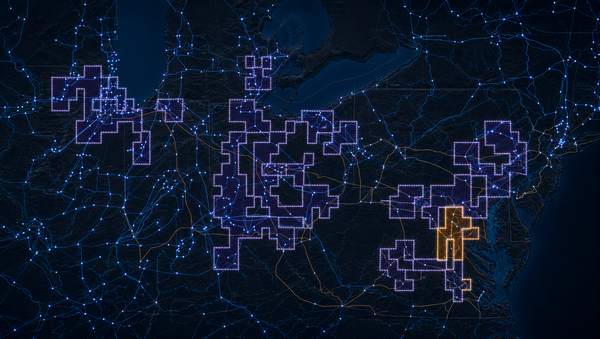
On July 28, 2026, as AIxEnergy completed the first full release of The Moratorium Map, Reuters reported that PJM Interconnection was preparing two filings with federal regulators to address a widening gap between electricity demand and available supply.
PJM’s latest capacity auction ended approximately 6.8 gigawatts below the system’s reliability requirement despite prices reaching the auction cap. The grid operator forecasts roughly 70 gigawatts of additional large-load demand by 2038. Its planned filings include a registry identifying the location and electricity requirements of large loads of at least 50 megawatts and a proposed framework under which certain new loads that have not secured sufficient supply could face curtailment during capacity shortages. The framework remains subject to federal review and, in areas involving retail service or direct customer curtailment, state authority and cooperation.¹
This is not a conventional data-center moratorium. It is potentially more consequential. A local moratorium temporarily withholds permission to build. PJM’s proposal would make the quality of access to the operating power system conditional. A data center might possess land, permits, financing and a utility service arrangement while still facing a different reliability position during stressed conditions if it has not brought or contracted for sufficient supply.
The logic behind the moratorium is moving from the zoning office toward the grid control room. PJM’s action did not emerge in isolation. On June 18, the Federal Energy Regulatory Commission issued show-cause orders directing all six regional grid operators under its jurisdiction either to justify their existing tariffs or propose reforms for integrating data centers and other large energy users. The orders address transmission-study processes, cost transparency, protection against cost shifting, co-location with generation, flexible transmission service and the study of generating facilities serving nearby large loads.²
On July 14, New York State issued Executive Order 62, which the governor’s administration describes as the nation’s first statewide moratorium on new hyperscale data centers. The order directs the Department of Environmental Conservation to hold in abeyance specified incomplete applications for discretionary state permits associated with qualifying new or expanded data centers capable of consuming 50 megawatts or more while the state prepares a generic environmental impact statement. It does not categorically suspend local approvals, and it excludes certain manufacturing, research, education and medical facilities.³
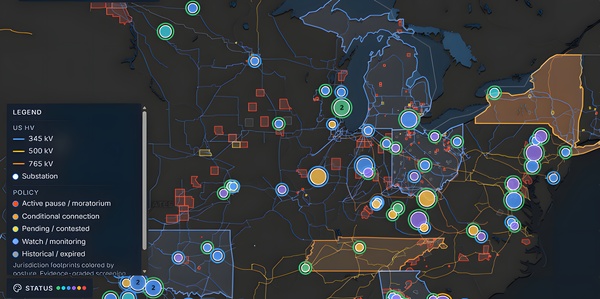
Source: AIxEnergy Map
A new control layer around the AI economy
The physical expansion of artificial intelligence is occurring at a speed that energy systems and governing institutions were not designed to match.
The International Energy Agency estimates that global data-center electricity consumption increased 17 percent in 2025 and could roughly double from 485 terawatt-hours in 2025 to 950 terawatt-hours in 2030. Lawrence Berkeley National Laboratory’s June 2026 U.S. update projects a reference case of 649 terawatt-hours by 2030 and a compounded uncertainty range equivalent to between 9.5 and 15.3 percent of total U.S. electricity consumption.⁴
But the problem is not simply the aggregate quantity of energy. Data centers are unusually large, geographically concentrated and fast to develop relative to much of the infrastructure required to serve them. Developers can propose, resize, phase, postpone or cancel a campus faster than utilities can permit and construct transmission lines, substations and generating resources. The developer retains substantial discretion over whether and when demand materializes. The power system may need to plan and invest before that uncertainty is resolved.
That asymmetry is the policy problem beneath the headlines. Who should pay for infrastructure built in anticipation of a load that arrives late or does not arrive at all? What claim should a new data center have on limited generating capacity during a reliability emergency? How much water, land and local infrastructure should a host community commit before a project’s benefits and operating characteristics are sufficiently established? What evidence should regulators require before allowing one customer’s private investment schedule to influence a regional power system?
Moratoria are one answer—but only one. Across the world, governments and system operators are assembling a broader permission architecture composed of land-use restrictions, environmental reviews, controlled capacity allocations, connection requirements, performance reporting, special tariffs, financial security and community-investment expectations.
The Moratorium Map documents that emerging architecture.
What the map shows
The dataset contains 234 normalized policy-event records across 230 rendered geographies as of July 28, 2026. Four records are incorporated into aggregated map popups rather than displayed as separate geographic features.
The dataset includes 213 U.S. records and 21 international records. It identifies 134 active or extended hard legal restrictions, together with pending proposals, conditional grid-access rules, reporting obligations, market-monitoring signals and historical or superseded policies.
The classifications are intentionally narrower than the language often used in public debate. A proposed restriction is not an enacted restriction. A utility connection standard is not a zoning ban. A reporting rule is not a moratorium. An expired policy should not remain on a current-risk map because it once produced a headline. An area facing power constraints should not be presented as legally closed when no enforceable restriction exists.
Exhibit 1. Policy-constraint taxonomy
Policy Classification
Policy-Constraint Taxonomy
Current legal restrictions account for more than half of the documented policy landscape, while historical actions, proposals and market signals remain important parts of the broader intelligence picture.
- Hard legal restriction 134 57.3%
- Historical or replaced 48 20.5%
- Political proposal 25 10.7%
- Market-monitoring signal 21 9.0%
- Conditional-access rule 5 2.1%
- Reporting obligation 1 0.4%
Key finding: Active or extended hard legal restrictions represent 57.3% of all tracked policy events. The remaining 42.7% captures the broader policy lifecycle—including proposals, monitoring signals and earlier measures that have expired or been replaced.
Source: AIxEnergy, Global Data Center Policy Constraints, version 2.0.0.
The resulting map is not a list of places that oppose data centers. It is a map of the institutions asserting authority over them. That distinction is central. “Restrictive” and “permissive” are inadequate descriptions of markets in which access depends on project design, location, energy strategy, financial commitments and the ability to satisfy multiple decision-makers.
The moratorium is a symptom, not the system
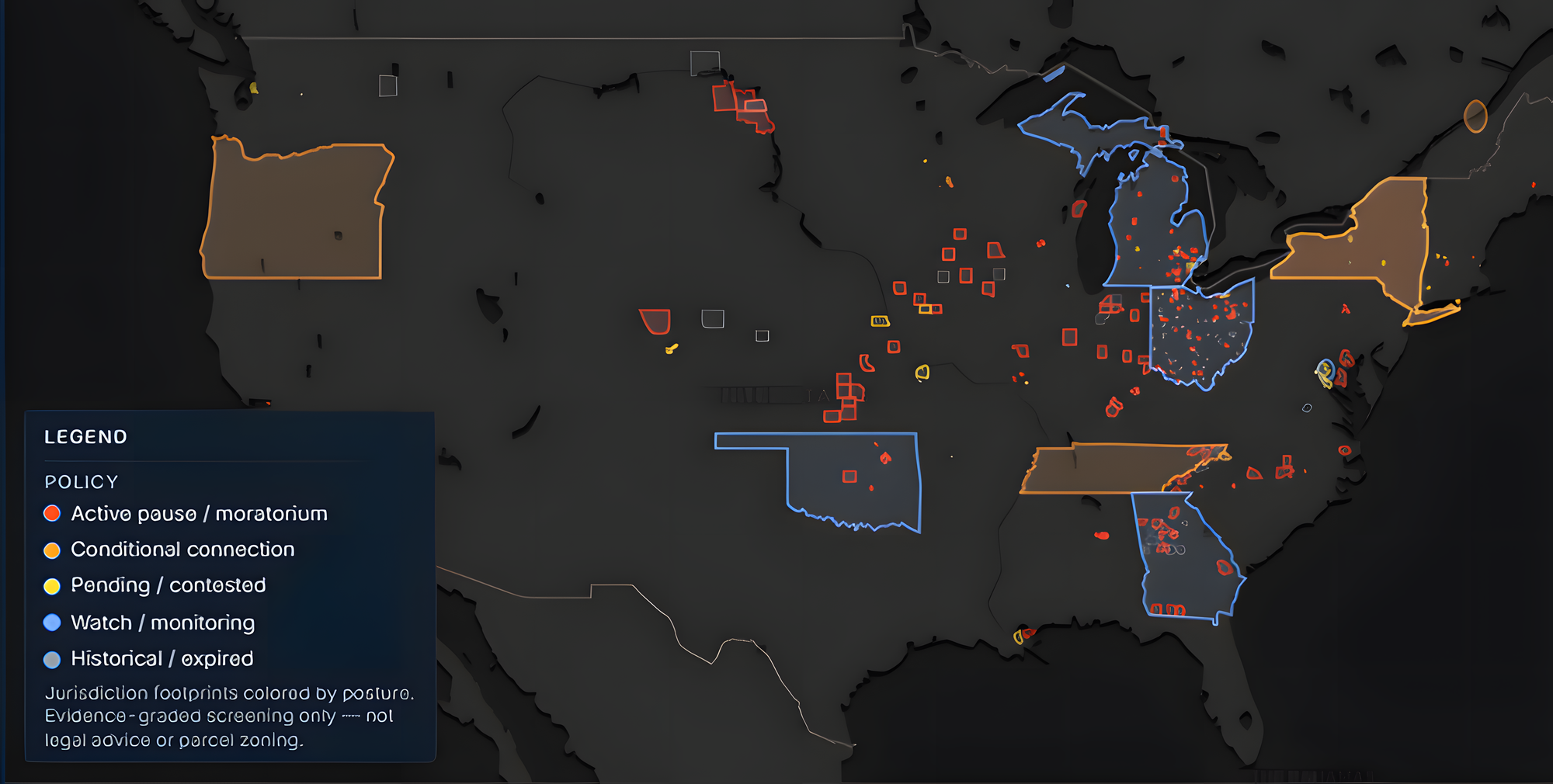
The United States accounts for more than 90 percent of the records in the current dataset, and the overwhelming majority of documented hard restrictions are local.
Of the 134 active or extended hard legal restrictions, 131 are associated with counties, cities, townships, towns, villages or tribal jurisdictions. Only three are classified at a state, utility-authority or broader level. This distribution reflects the fragmented structure of American land-use authority. It also reveals a mismatch between the scale at which the benefits of AI infrastructure are described and the scale at which many of its effects are experienced.
The national government sees strategic competition, productivity, technological leadership and investment. A technology company sees computing capacity, latency, market share and speed to deployment. A utility sees a customer that may require new substations, transmission, generation and reserve capacity.
A county sees rezoning, construction traffic, noise, backup generation, water demand, tax arrangements and a facility that may employ relatively few permanent workers in proportion to its physical and electrical footprint. A household sees a simpler set of questions: Will this project affect my electricity bill, public services or community?
Moratoria tend to emerge where existing institutions have not yet produced a broadly accepted answer. Prince George’s County, Maryland, illustrates the transition. The county established a task force to examine the effects of data centers on energy demand, taxpayers and ratepayers, air, water, woodlands, land use and quality of life. In 2026, county leaders advanced a two-year moratorium intended to create time for a broader review of land use, infrastructure capacity, environmental effects, public safety and the long-term economic implications of development.⁵
The jurisdiction did not simply discover that it opposed technology. It confronted a development model for which its existing rules and analytical capacity were considered inadequate. That is a useful way to interpret many local moratoria. They are institutional pauses used by governments that must make durable land-use and infrastructure decisions using standards often developed for smaller, slower and less electricity-intensive projects. A moratorium buys time. The more important question is what a jurisdiction builds with that time.
The geography of resistance
The documented restrictions are highly concentrated. Ohio and Michigan account for 49 of the 134 current hard restrictions—36.6 percent of the total. The five leading states—Ohio, Michigan, North Carolina, Georgia and Indiana—account for 82, or 61.2 percent.
Exhibit 2. Leading states in the current dataset
| State | Total records | Current hard restrictions | Pending | Monitoring | Historical or replaced | Grade A or B |
|---|---|---|---|---|---|---|
| Ohio | 35 | 27 | 2 | 1 | 5 | 27 |
| Michigan | 30 | 22 | 3 | 1 | 4 | 23 |
| North Carolina | 15 | 13 | 1 | 0 | 1 | 13 |
| Georgia | 25 | 11 | 0 | 1 | 13 | 11 |
| Indiana | 11 | 9 | 0 | 0 | 2 | 9 |
| Iowa | 11 | 8 | 1 | 0 | 2 | 8 |
| Kansas | 8 | 8 | 0 | 0 | 0 | 8 |
| North Dakota | 7 | 4 | 0 | 0 | 3 | 4 |
| Tennessee | 7 | 4 | 0 | 0 | 2 | 5 |
| Oklahoma | 5 | 4 | 1 | 0 | 0 | 5 |
Source: AIxEnergy, Global Data Center Policy Constraints, version 2.0.0.
These figures should not be converted into a simplistic ranking of state hostility. They are counts of documented policy events, not a statistically normalized measure of restrictiveness. States differ in population, number of local governments, development pressure, media coverage, access to primary documents and the maturity of external tracking. A state with fewer formal moratoria may already possess specialized zoning or utility rules. It may also be earlier in the development cycle or less fully represented in the source record.
The concentration nevertheless carries an important signal. The policy frontier is moving beyond established data-center hubs and into communities encountering hyperscale development for the first time. These jurisdictions may welcome investment while remaining uncertain about grid costs, employment benefits, noise, water, land conversion and the reliability of long-term demand projections.
The conflict is not necessarily between communities that support technology and those that oppose it. It is often between the speed of private capital and the speed at which public institutions can establish acceptable terms of entry.
The hidden issue is ownership of uncertainty
The public debate is usually framed around electricity consumption: data centers require too much power. However, the more difficult issue is who owns the risk that future demand will differ from the forecast.
A utility may need to initiate infrastructure investments years before a campus reaches its announced load. If the project is delayed, downsized or canceled, the physical assets and contractual commitments may remain. Unless the applicable tariff, contract or regulatory order assigns the risk elsewhere, some portion may migrate to other customers. The IEA has highlighted the mismatch between the speed of data-center development and the longer timelines required for energy infrastructure, as well as uncertainty around actual peak demand and the possibility that connection capacity may be reserved before server installations are complete.⁶
This helps explain why the policy debate is shifting from whether to serve data centers to the conditions under which they should be served. PJM’s July proposal would exclude certain incremental large loads from the demand used in future capacity auctions when those loads have not brought or contracted for the new supply required to serve them. The PJM board stated that existing customers should not bear higher capacity costs caused by new loads that arrive without sufficient supply. Implementation would still depend on FERC review and the respective responsibilities of PJM, utilities and state regulators.
New York’s order reaches toward the same policy question through different institutions. It directs state agencies to evaluate mechanisms that could include upfront developer contributions, demand-response participation, new clean supply and storage, an insurance pool and protections against infrastructure costs created by project delay, downsizing or cancellation. These are subjects for policy development and regulatory consideration; they are not yet final tariff obligations.
FERC’s show-cause orders similarly identify prevention of cost shifting and transparency into transmission costs as central areas for regional grid operators to address. A common policy direction is emerging: the customer controlling the load-development decision may be required to bear more of the financial consequences when the project changes.
That direction could reshape study deposits, interconnection agreements, construction advances, milestone requirements, minimum bills, exit charges and the treatment of customer-dedicated supply. It may ultimately matter more than the moratoria themselves.
Four models of conditional permission
The Moratorium Map reveals four emerging models. They overlap, but each controls a different decision point.
1. Pause and rewrite
This is the dominant U.S. local-government model. A jurisdiction temporarily suspends approvals while it studies eligible zoning districts, setbacks, noise, water use, transmission, air permits, emergency response, tax treatment or community benefits. The pause may expire, be extended or be replaced by permanent rules.
The strategic mistake is to treat the moratorium as the final policy. The consequential work occurs during the pause: who writes the replacement ordinance, what evidence is admitted, how thresholds are defined, whether existing applications are grandfathered, and whether the final process creates a viable conditional pathway or an effective prohibition.
Only eight current or extended records in the dataset contain structured future expiration dates. That does not make the remaining restrictions permanent. It demonstrates how often expiration terms are missing, ambiguous or embedded in local legal instruments that require recurring verification.
Exhibit 3. Near-term policy-expiration calendar
| Expiration | Jurisdiction | State | Status | Evidence | Current action |
|---|---|---|---|---|---|
| Sept. 10, 2026 | Sedgwick County | Kansas | Extended | A | Pause extended while land-use regulations are completed |
| Sept. 30, 2026 | DeKalb County | Georgia | Extended | A | Extension during preparation of a data-center text amendment |
| Nov. 20, 2026 | Pittsfield Township | Michigan | Extended | A | Temporary moratorium renewed for six months |
| Dec. 31, 2026 | Clayton County | Georgia | Extended | A | Pause continued while permanent rules are developed |
| Approx. April 13, 2027 | Oakley | California | Extended | B | Extension while the city considers permanent rules |
| May 11, 2027 | Marion County | Kansas | Extended | B | One-year extension adopted in May 2026 |
| July 14, 2027 | New York Executive Order 62 | New York | Active | A | Specified incomplete applications for discretionary state permits paused during a generic environmental review |
| July 7, 2028 | Prince George’s County | Maryland | Extended | A | Two-year pause subject to subsequent county action |
Source: AIxEnergy, Global Data Center Policy Constraints, version 2.0.0. Dates describe the currently documented terms and may be superseded by subsequent action.
An expiration date is not the date at which risk necessarily disappears. A temporary pause may be replaced by more demanding permanent rules, and an expired moratorium may leave the underlying political conflict unresolved. For developers and investors, the replacement process matters more than the countdown clock.
2. Conditional grid access
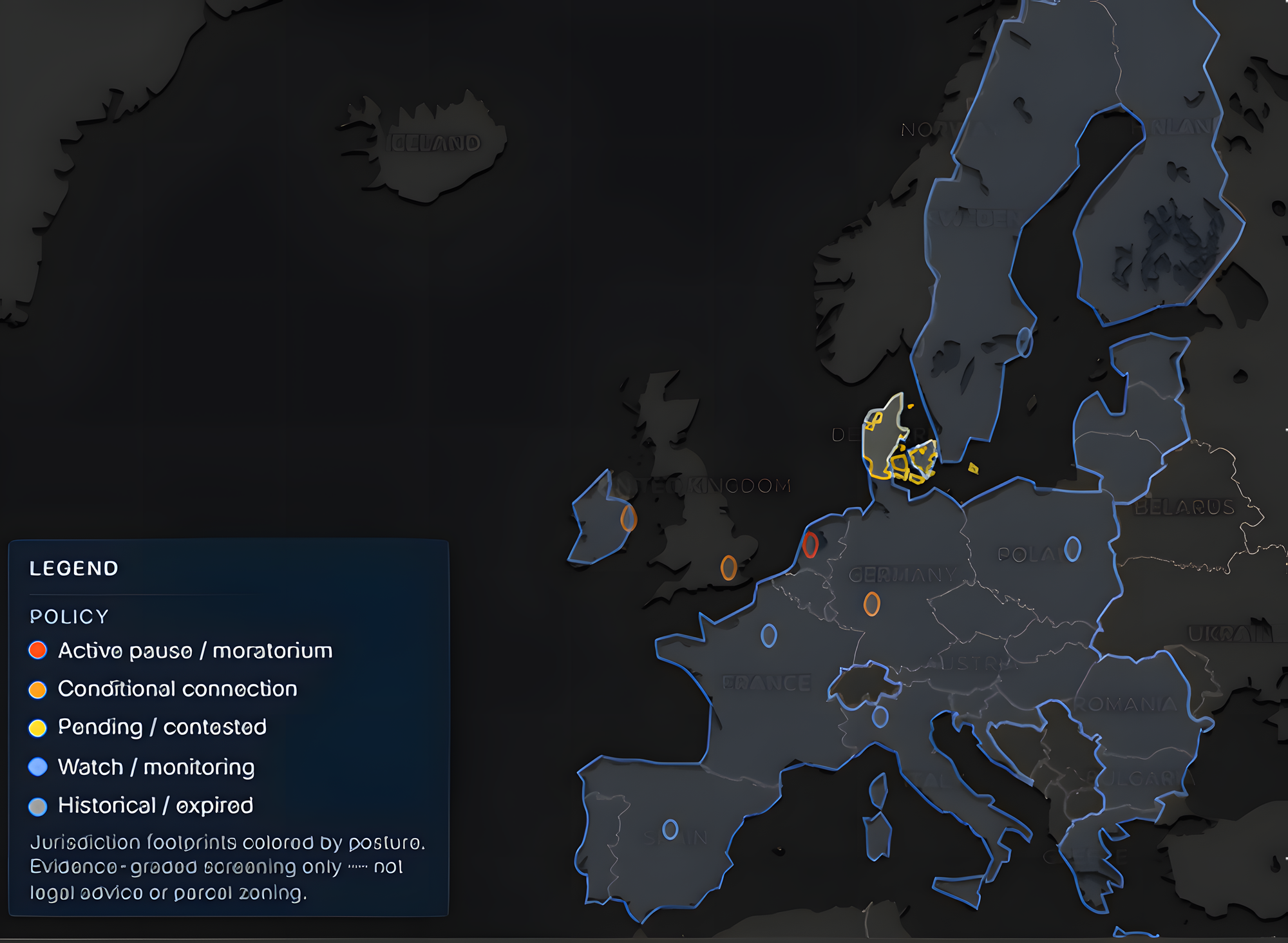
Ireland provides a clearer model of what follows when the power system itself becomes the gatekeeper. Under the connection policy adopted by Ireland’s Commission for Regulation of Utilities, new data centers must provide generation or storage capacity matching their requested maximum import capacity, either onsite or nearby. They must also meet at least 80 percent of annual demand through additional renewable-electricity projects in Ireland, subject to a six-year development pathway. System operators must consider whether each proposed connection is located in a constrained part of the network. Irish data centers consumed 22 percent of national electricity in 2024 and, based on contracted demand, are projected to reach 31 percent by 2034.⁷
This is neither a general prohibition nor an unrestricted right to connect. It is conditional admission to the system. Singapore uses controlled capacity allocation to pursue a related objective. Its Green Data Centre Roadmap seeks to provide at least 300 megawatts of additional capacity in the near term, with expansion linked to improved energy efficiency and lower-carbon energy pathways.⁸ Under this model, power is not merely purchased. It is allocated in exchange for specified performance.
3. Transparency before performance
The European Union is building a third model through information. The Energy Efficiency Directive established data-center reporting requirements, while Delegated Regulation EU 2024/1364 defined common information and performance indicators. The European Commission is using the resulting data to advance a Union-wide rating system and work on minimum performance standards.⁹
Reporting may appear less restrictive than a moratorium. Over time, it can be more structurally significant. Once governments possess comparable information on energy use, water, renewable sourcing and efficiency, they can incorporate those metrics into permitting, procurement, financing, tax treatment and minimum operating standards.
The policy sequence is familiar: disclosure, classification, benchmarking and, potentially, obligation.
4. The negotiated infrastructure compact
New York’s Executive Order 62 points toward a fourth model: permission linked to a broader package of project commitments.
The order directs the state to develop or evaluate frameworks addressing:
- community investment and local infrastructure;
- labor practices and public transparency;
- water withdrawals and environmental review;
- large-load interconnection and grid investment;
- beneficiary-pays cost allocation;
- demand response and system flexibility; and
- protection of ratepayers from stranded or underused infrastructure.
It also establishes a public environmental-review process and assigns roles to multiple state agencies and institutions. The final form of these policies has not yet been determined.
The significance extends beyond conventional permitting. Under this model, a data center is treated as a major infrastructure participant whose entry must be reconciled with the power system, public institutions and the host community. Capital investment and projected tax revenue may therefore no longer be sufficient on their own. A credible project increasingly must answer six questions:
What infrastructure does the project require?
Who will pay for that infrastructure?
How will the load behave during constrained or stressed system conditions?
What protections apply if the project is delayed, downsized or canceled?
What environmental resources will the project consume?
What durable value will remain in the host community?
This is the emerging social contract of hyperscale development: permission in exchange for clearer accountability, more transparent risk allocation and a broader public-value proposition.
Source: AIxEnergy Map
What the Moratorium Map means for capital
Policy geography should now enter site selection before—not after—land control and major interconnection spending.
A conventional screen emphasizes available power, fiber, land, taxes, water and latency. Those factors remain essential, but they do not establish whether a project has a viable institutional path.
The investment-grade question is no longer simply, “Does this jurisdiction have a moratorium?”
It is: Who controls each decision, what legal standard applies, what evidence is required, what costs must the developer secure, and what unresolved event could stop the project?
The distinction matters because policy signals are not equally consequential. A pending legislative proposal may matter less than a local zoning rewrite already approaching adoption. An expired moratorium may represent low risk if it produced a clear approval process—or high risk if community opposition and infrastructure questions remain unresolved. A market-monitoring signal is not a legal restriction, but it may still indicate emerging grid scarcity, water constraints or political resistance capable of affecting schedule, financing and valuation.
The Four Forms of Permission
1. Land permission
Is the proposed use allowed, conditionally allowed or temporarily suspended?
2. Grid permission
Is electricity available as firm service, conditional service or only with dedicated supply, storage or demand flexibility?
3. Economic permission
Are cost-allocation rules, financial-security requirements, minimum payments and cancellation obligations sufficiently defined?
4. Political permission
Is there a durable local bargain—or merely a legally valid approval vulnerable to reversal, litigation or electoral change?
A site that passes only the land-use test is not development-ready.
What governments should build instead of permanent emergency
Moratoria are useful emergency brakes. They are poor operating systems. A durable large-load pathway should require developers to fund appropriate studies, provide milestone security, disclose credible load ramps, protect customers against cancellation risk and identify the supply, storage or flexibility required to support the requested service.
It should also create reciprocal obligations for utilities and governments. Utilities should publish study requirements, connection options, capacity constraints and credible schedule ranges. Regulators should define cost-causation principles before individual controversies arise. Local governments should establish zoning criteria, public-participation requirements and community-investment expectations before a site-specific application forces them to invent policy under pressure.
Conditional access cannot become arbitrary access. The best regimes will not necessarily be the most permissive. They will be the most legible. Legibility allows serious projects to price their obligations and distinguish themselves from speculative announcements. It also gives communities a basis for determining whether the proposed bargain is credible.
Using the Moratorium Map
The Policy Constraints layer is available to all free and paid AIxEnergy subscribers through the AIxEnergy Map.
Users can distinguish current hard legal restrictions from conditional-access rules, reporting obligations, political proposals, monitoring signals and expired or replaced actions. Each record includes legal status, policy type, summary, evidence grade, source information and, where available, effective and expiration dates.
Related policies are aggregated within a single geographic popup so that an original moratorium, later extension and replacement action are not presented as unrelated places. The map is designed for screening and research—not parcel-level legal interpretation. Its geometries include generalized administrative boundaries and approximate market areas. International coverage remains preliminary relative to the depth of U.S. local-government coverage.
Disclosure
This article represents independent analysis published by AIxEnergy. It does not represent the views or positions of any other individual or organization.
Notes
- Laila Kearney and Kavya Balaraman, “Largest US Power Grid Plans to Cover Widening Electricity Shortages as Data Center Demand Swells,” Reuters, July 28, 2026; PJM Interconnection, “PJM Board Directs Action on Resource Adequacy, Affordability and Large Loads,” July 27, 2026.
- Federal Energy Regulatory Commission, “FERC Launches Aggressive Targeted Action to Speed Large Load Integration,” June 18, 2026.
- New York State, Executive Order No. 62, “Establishing a Temporary Moratorium on Data Centers in New York While the State Develops Higher Standards for Data Center Development and Benefits Blueprint to Support Localities,” July 14, 2026; Office of Governor Kathy Hochul, “First Statewide Moratorium on New Hyperscale Data Centers Launched by Governor Kathy Hochul,” July 14, 2026.
- International Energy Agency, Key Questions on Energy and AI (Paris: International Energy Agency, 2026); Sarah Josephine Smith et al., United States Data Center Energy Usage Report: 2025 Update (Berkeley, CA: Lawrence Berkeley National Laboratory, June 2026).
- Prince George’s County Council, “Qualified Data Center Task Force,” accessed July 28, 2026; Prince George’s County Council, “Chair Oriadha Announces Two-Year Moratorium to Prevent New Data Centers from Operating in the County,” June 30, 2026.
- International Energy Agency, Key Questions on Energy and AI, especially the discussion of uncertain peak loads, reserved connection capacity, and the alignment of power-system investment with data-center demand.
- Commission for Regulation of Utilities, “The CRU Publishes Its Decision on New Electricity Connection Policy for Data Centres,” December 12, 2025.
- Infocomm Media Development Authority, “Singapore Announces Green Data Centre Roadmap for Sustainable Growth,” May 30, 2024.
- European Commission, Directorate-General for Energy, “Energy Performance of Data Centres,” accessed July 28, 2026; European Commission, Directorate-General for Energy, “Minimum Performance Standards for EU Data Centres,” accessed July 28, 2026.
Bibliography
AIxEnergy. Global Data Center Policy Constraints. Version 2.0.0. Updated July 28, 2026. Proprietary public-source research dataset.
Commission for Regulation of Utilities. “The CRU Publishes Its Decision on New Electricity Connection Policy for Data Centres.” December 12, 2025.
European Commission, Directorate-General for Energy. “Energy Performance of Data Centres.” Accessed July 28, 2026.
———. “Minimum Performance Standards for EU Data Centres.” Accessed July 28, 2026.
Federal Energy Regulatory Commission. “FERC Launches Aggressive Targeted Action to Speed Large Load Integration.” June 18, 2026.
Infocomm Media Development Authority. “Singapore Announces Green Data Centre Roadmap for Sustainable Growth.” May 30, 2024.
International Energy Agency. Key Questions on Energy and AI. Paris: International Energy Agency, 2026.
Kearney, Laila, and Kavya Balaraman. “Largest US Power Grid Plans to Cover Widening Electricity Shortages as Data Center Demand Swells.” Reuters, July 28, 2026.
New York State. Executive Order No. 62. “Establishing a Temporary Moratorium on Data Centers in New York While the State Develops Higher Standards for Data Center Development and Benefits Blueprint to Support Localities.” July 14, 2026.
Office of Governor Kathy Hochul. “First Statewide Moratorium on New Hyperscale Data Centers Launched by Governor Kathy Hochul.” July 14, 2026.
PJM Interconnection. “PJM Board Directs Action on Resource Adequacy, Affordability and Large Loads.” July 27, 2026.
Prince George’s County Council. “Chair Oriadha Announces Two-Year Moratorium to Prevent New Data Centers from Operating in the County.” June 30, 2026.
———. “Qualified Data Center Task Force.” Accessed July 28, 2026.
Smith, Sarah Josephine, Alex Hubbard, Alexander Newkirk, Mohan Ganeshalingam, Billie Holecek, Dale A. Sartor, Michael Mills, and Arman Shehabi. United States Data Center Energy Usage Report: 2025 Update. Berkeley, CA: Lawrence Berkeley National Laboratory, June 2026.