This is the fourth of a six-part series at AIxEnergy and mirrored at Michael Leifman's Substack
Part 1 introduced three distinctions (vendor capability versus utility adoption, reliability versus safety, task versus role) and a twelve-row sample of the US electricity workforce.
Part 2 developed the four-stage mechanism by which AI capability translates into workforce change in regulated industries and traced it through aviation, freight rail, and maritime.
Part 3 maps how AI is reshaping the U.S. electric-power workforce role by role, showing that task content is already shifting across the industry while headcount changes will unfold unevenly depending on whether work is routine, reliability-critical, safety-critical, or institutionally protected.
Part 4 explained that AI and robotics are not only replacing existing power-sector tasks, but also creating new capabilities by letting the grid coordinate more complexity than human operators can manage and sending machines into hazardous places where human bodies should not go.
This part explains how utilities, regulators, and investors can manage AI adoption by building the workforce, governance, and institutional capacity needed to sustain automation, protect reliability, and avoid hollowing out critical operational capability.
Imagine, if you will, an ordinary substation yard on an ordinary morning, somewhere on the American grid, in the year 2026. No one is standing in it. A drone lifts from a weatherproof dock, flies its route over the switches and transformers, and settles back onto its perch, and the nearest human is a technician at a desk in another town, watching the images arrive. A four-legged robot the crew has given a friendly name walks the same yard on rounds of its own, reading gauges no person now reads in person. A few counties over, the last of the meter readers have all but vanished from the employment tables, their route work not outsourced and not struck down, simply worn away from within. On a server rack somewhere, a forecasting model that actually worked has been quietly switched off, because the company that built it could not keep on staff the one or two people who knew how to keep it alive. And on a warm evening that past July, in tens of thousands of garages, home batteries woke at the same instant and discharged together, and for two hours behaved like a single power plant that nobody built.
None of that is a forecast. Every piece of it has already happened, and the earlier parts of this series gave each one its name, its date, and its source. The reason to gather them into a single morning is to be clear that this is the ordinary present, not the frontier. Now imagine, if you will, that same yard fourteen years on, in 2040, and imagine you are allowed to see it twice.
In the first version it is three in the morning and a storm is tearing across the system. In a control room a hundred miles off, a woman watches it come. The job she is doing tonight had no name when she started. She came up through the customer lines, back when there were customer lines staffed by humans, and when that work began to disappear someone saw it going and pointed her toward the work that was arriving, and now she sits above a grid stitched from a million rooftops and batteries and parked cars, reading what the machines surface and deciding what they are not permitted to decide. A conductor comes down on a rural feeder. Before she has finished registering it, the system has already found the fault, self-healed and walled it off, and pulled power around it through three other paths, and the customers on that feeder see their lights blink once and steady. The whole event took just five minutes, and not because anyone hurried, but because nothing waited on a person to notice.
In the same area, there is a lineman who got an automatic alert on his phone at the same moment. The map is already on it, the exact span, the likely cause, the section already dead and grounded by the same system that rerouted around it. He drives to the pole, and not to the three wrong poles he might have chased in an earlier decade, and he does the work his hands have always done, the work no machine on that truck can do, on a line made safe before he was on the road. The repair takes him most of the night. No one is in the dark while he does it.
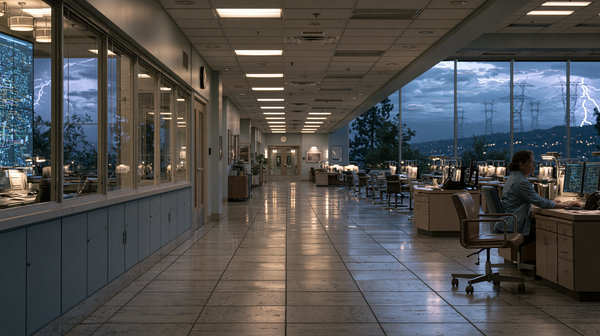
Now imagine the same yard, the same storm, but in the other 2040. The room is just as quiet and just as thinly staffed. The woman who might have been steadying it is not there, because the door she would have come through was never cut; the jobs at the bottom ended and nothing was built to carry anyone up from them. The conductor comes down on the same rural feeder, and the system that should wall it off does something wrong instead, because it is newer and cleverer than anything we run today and no one in the building ever learned it deep enough to know the shape of its mistakes. The power does not reroute. It goes out, and it stays out, and the two operators on shift reach for the phone to call the vendor.
And the lineman, a good one, gets a bad ping, a rough location and nothing isolated, so he drives to where the system thinks the fault is and finds nothing, and then works it the slow old way in the rain, with the feeder live and dangerous around him and the customers still dark. What was five minutes in the other 2040 is most of a day here. The report, when it comes, will call the night unforeseeable, and that will not be true.
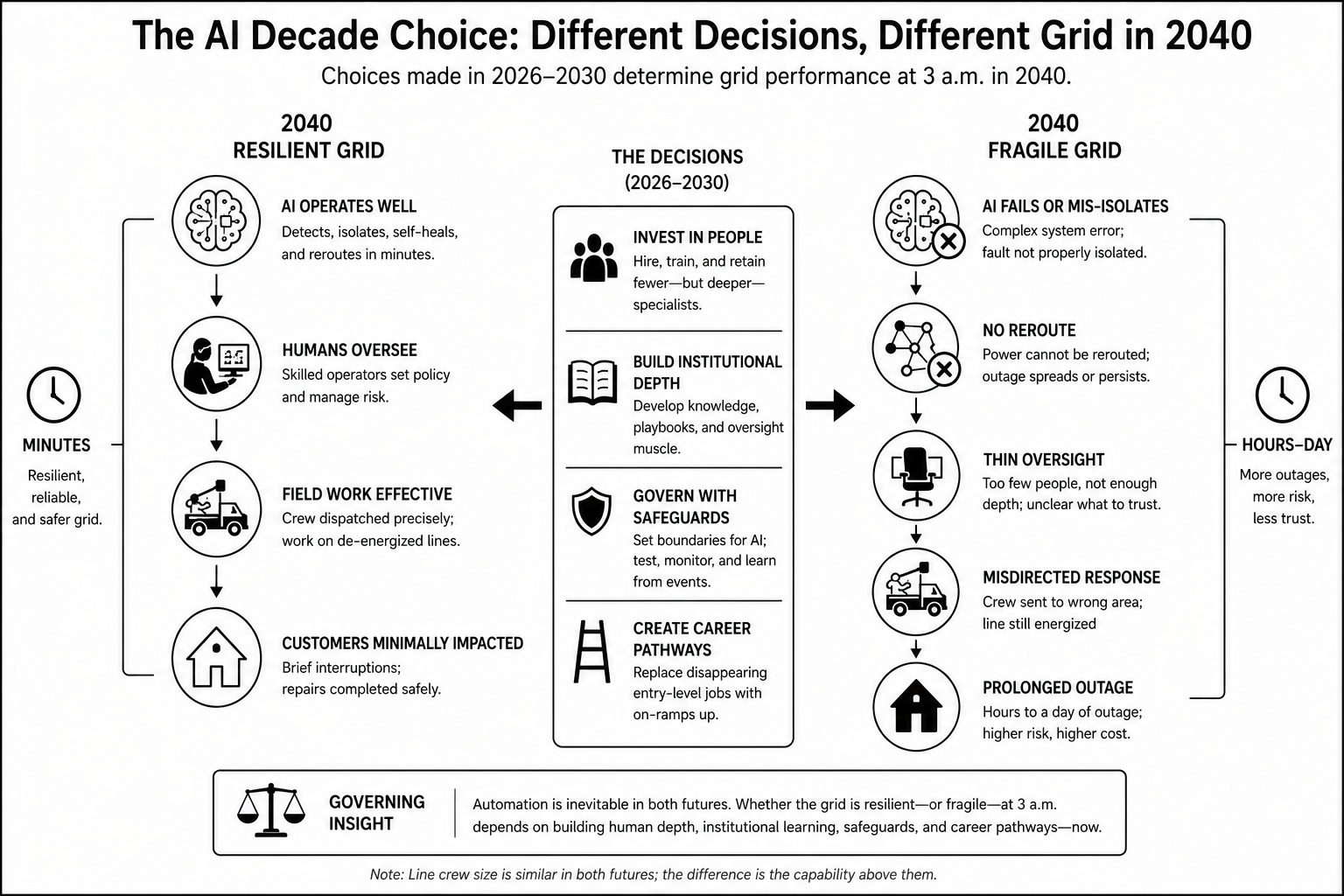
Neither of those futures is science fiction, and neither is collapse. Both grids run on more automation than we operate now, and both carry fewer people than 2026 does; the previous installments in this series traced that contraction, and by 2040 it has run its course in either version. The line crew is about the same size in both, because a pair of hands on an energized conductor is still the last thing to go. That much is not the variable. The variable is everything that stood, or failed to stand, in that room at three in the morning. And the uncomfortable truth about the two 2040s is that the second one is what arrives on its own. It is where the grid settles when each company and each regulator does the reasonable thing in front of it: buying a capable system without hiring the smaller number of people who can keep it running, approving a deployment faster than anyone on staff can learn to oversee it, letting the entry-level jobs disappear without opening new ways in. The better grid is the one that had to be built on purpose, against that near-term reasoning, by people willing to spend now for a payoff they would not see for years. That is why what follows is written as strategy rather than forecast, and why it goes actor by actor, because each of them holds one of those choices.
Utilities
Whether AI arrives in your workforce as a contained, one-time decision or as a decade-long institutional problem depends first on which kind of company you are. A generation-only merchant producer, a wires-only delivery company, and a vertically integrated utility that owns both face genuinely different versions of the same transition, and the differences are large enough that a single AI workforce strategy is not much use to any of them.
Merchant producers: sustain what you deploy
The merchant power producer has the most contained version of the transition. Its workforce is thin to begin with, and the roles AI touches first are the cognitive ones close to the market: the traders and scheduling coordinators who bid generation into day-ahead and real-time markets, whose forecasting and bid preparation are already being automated, and a small back office behind them. Plant operators are shrinking too, but mostly through fleet consolidation, not software. The roles that grow, in storage and power-electronics engineering and data analytics, are ones every part of the industry is trying to hire. With no field workforce and few licensing or staffing minimums to work through, the transition here is short and sharp. It reduces to one decision: build the optimization and trading layer that increasingly runs the business, or buy it.
The build-or-buy call looks like procurement and is really about workforce. Buy, and you are betting that a vendor keeps the tool current and that a lean internal team can cover the rest. Build, and you have to recruit and hold the small group of data scientists and machine-learning engineers who keep a model running in production. A grid operator did the cautionary version: it switched off a forecasting model that worked because it had never put dedicated staff on keeping the model retrained and validated. A merchant producer is more exposed to that than the operator was, because when the software degrades there is no field operation underneath to absorb the failure. So the real decision is not build-or-buy; it is whether you will staff to sustain what you deploy. Deploy what you cannot sustain and you get the worst outcome available: a system that goes dark after you have already thinned the desk that used to do its job.
Wires companies: the succession problem
The wires company has the harder version, because it owns the workforce most people picture when they picture a utility: line crews, substation and relay technicians, inspectors, cable splicers, vegetation crews. This is skilled physical work in unpredictable conditions, and it stays with people longest. AI thins the cognitive scaffolding around it well before it touches the headcount. At the same time the company runs the roles that contract fastest, customer service and billing, where automated systems already handle the first line, and the one operational role clearly growing, the distribution operator managing a more complex and more distributed grid. So a single payroll holds both extremes: durable field roles whose work is quietly changing, and clerical roles disappearing quickly, on different timelines.
For the wires company, the split becomes a succession problem stretched across a decade. The roles the company will need fewer of are held disproportionately by its most heavily unionized workers, who cannot simply be released. The roles it will need more of sit on pay scales that mostly do not exist inside a utility today and require talent it has never had to compete for. Plan from the current org chart and you end up overstaffed where work is contracting, unable to hire where it is growing, and you learn both at the same late moment.
Managing that succession is a matter of timing, not headcount. Take the relay technician, who tests and maintains the protective relays that isolate faults on the system. The license, the liability exposure, and the contract all keep that position in place, and they keep it in place while more of the diagnostic work moves into digital relays and automated test equipment that surface the problem and record the result. The person still signs off, because a person must, but the sign-off is increasingly what is left. The role is defended while the work inside it has already moved, and the headcount looks steady right up until the day the redefined job no longer needs as many people to do it. So the moment to open the conversation with labor is now, before any reduction is visible, while there is still something to bargain over besides loss. Wait until the contraction shows up in the numbers and you negotiate from the weak position that has produced the worst transitions in other industries. Start early, over the shape of the changed work and the routes from shrinking roles into growing ones, and you keep room the late mover has already lost.
Integrated utilities: plan the halves apart
The vertically integrated utility has both problems at once, inside one company, one rate case, one workforce plan. Its generation side wants to move quickly on optimization and market-facing AI; its wires side runs on the slow, safety-bound timeline where change is measured in decades. A single blended plan gets both wrong, too aggressive on the durable field roles and too cautious on the contracting back office, because the average sits between two things that are nowhere near each other.
The discipline is to plan the two workforces separately even under one roof: two timelines, two sets of growing and shrinking roles, two postures toward labor and toward build-or-buy, brought together only where capital is actually allocated. A real utility does not split cleanly down the middle, and no one should pretend it does. But the two halves are not really connected; averaging them just misreads both. Planning them apart refuses that misleading average; it does not pretend the company is two.
The bench beneath all three
Beneath all three actors is the same question: can the company keep the systems it deploys running once the demonstration is over and the pilot has closed? The forecasting model from earlier in this section is that question in miniature. Someone built a tool that worked, and it went dark not because it failed but because no one was ever dedicated to keeping it retrained and validated as conditions drifted. A demonstration proves a system can work once. Keeping it working means carrying the people who retrain it as conditions drift, catch it when it fails quietly, and validate it against a grid that never stops changing. That standing capacity is nearly invisible from outside and the easiest thing to defer, which is why it gets deferred until a working system goes dark for lack of it. Fund it before you need it. From outside, it is also the clearest signal of which companies can actually run what they buy.
Regulators and Governments
A state commission that shortens an interconnection study from months to days is trying to get power onto the grid faster, but a downstream effect is that it thins the work of the queue analysts and interconnection engineers. The same holds when a commission clears an operator to lean more heavily on automated dispatch: the aim is a faster and steadier grid, but a downstream effect is that the dispatchers and traders at the desk have less left to do. A regulator’s fastest effect on the workforce does not run through labor law; it runs through reliability decisions made for other reasons, and it arrives sooner than almost any other force in the sector.
Each of those decisions is made jurisdiction by jurisdiction, so regulators and states do not stand outside the transition’s unevenness; they are its cause. A tool that is cheap and quick to field under one commission waits behind a longer study or a stricter standard under the next, so the same capability reaches workers on a different schedule depending only on whose territory they work in. FERC, the reliability organization NERC, the seven regional grid operators that run the wholesale markets (only six of them under FERC’s authority), and the state commissions build that patchwork between them, and the pace each sets becomes a condition the rest of the sector has to answer to.
In December 2025, FERC found PJM’s tariff unjust and unreasonable and ordered it to write new rules for connecting data centers and other large loads to power plants (ferc.gov), following in 2026 with show-cause orders to all six grid operators it regulates (mcguirewoods.com). These orders are what most people mean by AI and the grid, and they are about load, not labor: how to connect enormous new demand without dumping the cost onto ratepayers. They touch the workforce question at only one point: the study processes they compress to move power faster are the same ones that gave queue analysts their work.
The slower wave belongs to the safety agencies
The line worker, the relay technician, and the reactor operator sit on a slower schedule, and a different set of bodies controls it. The National Labor Relations Board, OSHA, the Nuclear Regulatory Commission, and the state boards that license engineers and operators hold the defenses around the safety-critical roles, and they gate the second and longer wave of this transition, the one that reaches physical work only after the cognitive roles around it have thinned. Their timeline is set by licensing regimes and safety standards that move in years and decades, not in dockets. Where any of these agencies stands today will read as dated within a year, and it is beside the point. What lasts is that they, not the grid regulators, control the speed of the wave that has not yet crested, and how they set it decides whether it arrives gradually or all at once.
Every commission’s choice about speed
Each commission is left a real choice about speed. A commission that moves slowly, studying each deployment at length and approving with caution, does not hold still by doing so; it watches developers, large loads, and capital drift toward neighboring jurisdictions whose processes move faster, and then faces a hard catch-up on a timetable it no longer sets. A commission that moves fast draws that activity in but takes on the harder job of overseeing operations it approved more quickly than its capacity to supervise them grew. Either way the binding hire is the same. These agencies are automating their own analytical work even as they rule on everyone else’s, and the one role clearly growing inside them is the analyst who can judge whether a model is safe to approve and sound enough to keep running, the person a commission needs on staff before the deployments arrive rather than after the strain shows. Neither speed is free.
A model standard, not a mandate
Each commission’s mistake is to treat the pace of adoption as a private choice, because that is exactly what produces the patchwork. The seam between fast and slow jurisdictions is not something any single commission can close from inside its own borders, and it is that seam, more than any one commission’s pace, that decides how unevenly the transition lands on workers. Closing it is a coordination problem, and coordination has two levers here, split by the same federal-state line that runs through everything else. On the federal side, FERC can standardize the adoption pace where it already has authority, across the wholesale markets, transmission, and the interconnection processes it governs, so that the seam does not widen from region to region for no better reason than which operator moved first. What FERC cannot do is reach retail: the Federal Power Act draws a bright line that leaves end-use and distribution matters to the states, which is why the large-load orders themselves left retail cost protection to state commissions. And where FERC has pushed hardest on standardizing, the states have pushed back; NARUC called itself generally disappointed by the diminished state role in FERC’s Order 1920 on transmission planning (renewableenergyworld.com). A standard imposed from above is the version states fight.
The state-side lever is not a federal mandate but a model states can choose to take up, and NARUC and NASEO should build it. NARUC, the association of the state commissions, and NASEO, the association of the state energy offices, already build this kind of thing together, from joint working groups to shared tools for implementing FERC orders (naruc.org). A model standard for the pace and oversight of AI adoption, developed by those two bodies with federal technical expertise of the sort the standing FERC-NARUC Federal-State Current Issues Collaborative already supplies (ferc.gov), would hand a commission in any state a template to adopt or leave. A model rule spreads by being useful, not by being ordered, and it is the only form of coordination that narrows the seam without trampling the state authority the rest of the system rests on. What it buys is a transition whose timing is chosen rather than left to accident, so the same worker is not put on a far faster timeline in one state than across the border for no reason anyone decided.
Reliability can move fast; safety cannot
Running fast on reliability is often right. Running fast on safety is not, and the two look enough alike that the pressure to treat them the same never lets up, because a neighboring jurisdiction will always seem to gain by easing a staffing minimum or a licensing standard. A commission that lets that competition speed its safety decisions to match its reliability decisions gives away the protection that separates a managed transition from the grid that went dark at three in the morning, the one trusted past the point anyone on shift understood it. Moving fast on reliability is strategy. Moving fast on safety is how you get the second grid.
Investors and Capital Allocators
Two utilities announce the same thing in the same quarter: a serious AI program, real budget, named use cases, a timeline to production. From the outside the two announcements look nearly identical, and the market tends to price them the same way. Neither announcement says what separates the companies. Three years on, one utility is still running the systems it described and the other switched them off when the people who understood them left. The capacity that produces that difference is close to invisible from where an investor sits, and learning to read it is the whole task.
Read the institutional signal, not the press release
The market sorts these announcements on a rough axis, thoughtful against following the herd off a cliff, and the herd is easy to spot once you know what to look for. Herd signals are procurement theater: a press release, a pilot, a vendor logo, a humanoid-robot photo op. They are cheap to produce, and they are exactly what the consultancy productivity story rewards, because that story is pitched at this audience and it flatters buying over building. Thoughtful signals are institutional and harder to see from outside: real depth on the internal machine-learning and data-engineering bench, a workforce plan built around where the roles are going rather than where they sit, and governance that can carry a capability from pilot into operations without relitigating it at every desk. The institutional signals never appear in the announcement, and all of them decide whether it becomes anything.
A utility with a thin technical team and no real workforce plan will announce an ambitious program and put little of it into operation, because it cannot maintain what it deploys and cannot move its people toward the work that is growing. Its AI program is mostly presentation. A utility that has built the bench and done the planning will say less and deliver more. The institutional weight that reads as slowness to someone reviewing operations reads as durability to someone allocating capital, and that inversion is what an investor can use.
What the signal looks like in practice
PJM built the clearest cautionary case. In a paper published in November 2024, PJM described a net-interchange forecasting model, built with the machine-learning method called XGBoost, that came out of a volunteer team carrying the work alongside their regular jobs (pjm.com). Net interchange is the net flow of power across PJM’s borders, and the model worked: testing showed it performing well, and PJM planned to put it into production. PJM terminated it anyway, because the team had no dedicated staff to evaluate and maintain it. What ended it was not a build-versus-buy mistake but the absence of anyone to keep it running, a constraint that binds whether a utility builds or buys.
The missing staff that killed PJM’s model also, for now, protects the roles a working model would have thinned. A company that cannot deploy the system that would shrink a desk keeps that desk, not by choice but for lack of the capacity to change it. A thin bench can therefore look like a stable workforce and a low-risk operation when it is the opposite, the mark of a company that will neither capture the productivity it advertises nor manage the transition once a competitor forces it.
Enel shows what the thoughtful signal looks like in practice. The Italian multinational treats machine learning as part of how it runs the network rather than as a launch, and points it mostly at unglamorous maintenance. Enel’s own account describes applying AI across plant and grid operation and maintenance (enel.com); in practice that means sensors on turbines and lines feeding models that flag a failing part, a wearing gearbox bearing for instance, before it takes an asset down, so a crew goes out ahead of the outage rather than after (aveva.com). The value is in the accumulation, many small deployments kept running across a footprint that spans dozens of countries rather than one system unveiled and left to rot. Enel is not chasing a single transformational grid brain; it is sustaining many marginal tools, which is the harder thing and the more valuable one, and the thing the herd’s lone pilot cannot match.
PJM came back to the same problem from the other direction. Through ordinary automation of its interconnection process and added staff, PJM cut its backlog sharply, by roughly 60 percent on its own account (insidelines.pjm.com), and layered its April 2025 partnership with Google’s Tapestry project, a self-described moonshot for the grid, on top of that work (insidelines.pjm.com). An investor could read the moonshot as the transformational fix and stop there, but the unglamorous automation and staffing had done most of the work, and the partnership sits on capacity PJM built itself. A vendor partnership pays off only for an organization that can direct and integrate it, which is the bench question in another form. That order, capacity first and the moonshot on top of it, is the thing to look for.
Two habits for allocating capital
For anyone allocating capital in this sector, two habits matter most. Weigh the institutional barriers, not just the technical capability: the question is never whether a tool can work in a demonstration but whether this particular company can sustain it in production and move its workforce toward the roles the tool creates. And weigh both the marginal and the transformational, not just the end game. The compounding return tends to come from many maintained, unglamorous deployments rather than a single moonshot; PJM drew that lesson from its own experiments, concluding that smaller, productivity-focused tools can pay off with far less effort and risk and pave the way for the larger systems later (pjm.com). A company that can only point at the moonshot is usually the one that has skipped the marginal work, and the institutional work, underneath it. The transformation is real and it is coming, but it accrues to whoever built the capacity to run it, and that capacity is exactly what the announcement never shows.
Utilities, regulators, and investors hold real leverage over how fast this transition arrives and how well it goes; each one decides, from some position of strength, the shape of a change that is coming either way. The people who will live inside that shape have far less say in it. What workers can do from the weaker side of the table, and what is owed to the ones no strategy reaches at all, is the other half of this story.