• Annual minimums sit between $0.20 and $0.27 million per MW, so term length drives most of the spread.
• Security runs from $0.05 million per MW in Texas to an estimated $1.6 million under Duke’s proposal, and carrying it for 4.5 years at 7.5 percent costs about a third of principal.
• ERCOT Batch Zero is the only reviewed framework that ties flexibility directly to connection timing, and Oregon allows it to be weighed case by case.
• AEP Ohio reports 5,642 MW under signed binding contracts from about 30,000 MW of requests.
Large-load tariffs are usually compared by threshold and term: 50 MW or 100 MW, twelve years or twenty. A more telling comparison is what a reserved megawatt obliges a customer to pay and to post before it draws any power. In an illustrative case of 300 MW at an 85 percent load factor, the four tariffs that publish enough rate detail to price a minimum bill imply nominal minimum charges of $750 million to $1.58 billion, with $125 million to $479 million of security standing behind them.1 These are modeled figures, not quoted prices, and one of the four, Duke's North Carolina settlement, is a proposal that awaits a commission ruling.
The comparison covers 17 tariffs and frameworks drawn from orders, tariff sheets and settlement filings.1 Three were pending on November 1, 2026: the Duke settlement, Xcel Energy's Colorado tariff and Oklahoma Gas and Electric's proposal. They describe proposals, not rules.2, 3, 4 Pennsylvania's tariff is a commission model offered as guidance, not an adopted tariff.5
Where the terms have converged
Across recent orders the skeleton of the contract is similar. Minimum take clusters at 80 percent of contracted capacity: Evergy, Indiana Michigan Power (I&M), Consumers Energy, PPL and Pennsylvania's model use it for all or part of the term, and Xcel has proposed it.6, 7, 8, 9, 5, 3 The Duke settlement uses 75 percent and FPL 70, while the Oregon and Kentucky orders use 90.2, 10, 11, 12 Initial terms run from ten to thirty years, with fifteen the most common, and notice periods before a customer may reduce or leave run from 24 to 60 months. Several exit payments are limited to one to five years of the minimum charges that would otherwise have been paid.7, 5, 12
Part of the similarity is precedent. The Indiana Utility Regulatory Commission's February 2025 order on the I&M settlement was among the first to publish full numeric terms, and later records cite it. A collateral exemption for a customer rated A- or A3 with liquidity above ten times the requirement appears in I&M's tariff, in AEP Ohio's tariff and in Pennsylvania's model, and in a variant that adds a tangible-net-worth test in the We Energies decision.7, 13, 5, 14
Agreement on a percentage conceals disagreement about what it multiplies. Evergy sets both a Minimum Demand and a Minimum Monthly Bill, and the bill at minimum demand includes customer, grid and reactive charges and demand-based riders, so a rider approved later raises the floor.6 FPL applies 70 percent to its base demand charge but bills its incremental generation charge on the whole contract demand, so the headline understates the commitment.10 Dominion splits the minimum by component, at 85 percent for distribution and transmission and 60 percent for generation. Oregon sets 90 percent on transmission and generation demand and recovers distribution through a flat charge.15, 11 Kentucky Power applies its 90 percent to the highest established demand, whereas Oregon applies it to contracted capacity.12, 11
Ramp treatment is a second variable and often matters more than the percentage. FPL's twenty years include the ramp, AEP Ohio's twelve contain a ramp of up to four, and Evergy, I&M and Consumers run the full term after a ramp of up to five years.10, 13, 6, 7, 8 AEP Ohio steps its minimum through 50, 65, 80 and 90 percent of contract capacity, and Duke accrues no minimum billing demand charge in notice-period months that fall before energization.13, 2
The committed amount
To put the tariffs on one footing, a single hypothetical customer was priced: 300 MW of contract capacity at an 85 percent load factor, paying published demand-based rates at the published minimum take for the minimum term. The result is the committed amount. It excludes energy, fuel and most riders and takes no ramp credit, which overstates the early years of any tariff with a ramp, while leaving out Evergy's riders understates that floor. Present values use 7.5 percent, the illustrative cost of capital in the Duke settlement exhibit. All of it is an illustrative calculation.1
| Tariff | Minimum take | Term (years) | Annual minimum ($M) | Nominal total ($M) | Nominal ($M per MW) | PV at 7.5% ($M per MW) | Security posted ($M) |
|---|---|---|---|---|---|---|---|
| Evergy Kansas | 80% | 12 | 62.5 | 749.9 | 2.50 | 1.61 | 125 a |
| I&M Indiana | 80% | 12 | 73.9 | 886.8 | 2.96 | 1.91 | 148 a |
| Duke DEC (proposed) | 75% | 15 | 60.2 | 902.3 | 3.01 | 1.77 | 361 b |
| Duke DEP (proposed) | 75% | 15 | 79.8 | 1,196.8 | 3.99 | 2.35 | 479 b |
| FPL LLCS-1 | 70% of demand; generation charge on 100% | 20 | 78.8 | 1,576.6 | 5.26 | 2.68 | 210 c |
| Dominion GS-5 | 85 / 85 / 60% | 14 | not priced | not priced | not priced | not priced | 450 gross d |
| Texas / ERCOT | none in the rule | n/a | 0 | 0 | 0 | 0 | 15 |
Annual commitments sit closer together than the totals suggest. Per megawatt, the annual minimum falls between $0.20 million and $0.27 million in every priced tariff. Term does most of the spreading: nominal commitments run from $2.50 million per MW under Evergy's twelve years to $5.26 million under FPL's twenty, a factor of 2.1 against 1.3 on the annual figures, and discounting narrows the gap to 1.7. The settlement's own 500 MW example puts maximum liquidated damages at $587.4 million, or $1.175 million per MW, about $352 million at 300 MW.2
Thirteen of the 17 could not be priced. Rates for We Energies, Georgia Power and Black Hills sit in subscriptions, rules or confidential service agreements, and PPL's published charge is a customer charge alone.14, 16, 17, 9 Rate schedules for Consumers, Kentucky Power, Oregon, Dominion, Xcel and OG&E were not part of the reviewed filings. Pennsylvania's model carries no rates, and the Texas rule sets no minimum take. AEP Ohio's published minimum for a transmission-served customer reduces to a customer charge of $3,600 a month, about $43,000 a year, plus riders, so a tariff that is demanding on collateral carries almost no priced take-or-pay at that voltage.13
Collateral and the cost of waiting
Security per megawatt varies by more than a factor of thirty. The Texas rule requires $50,000 per MW before a customer enters the study process, and Evergy's two years of minimum bills comes to about $0.42 million per MW before any credit discount.18, 6 I&M's 24 months of the maximum monthly non-fuel bill is $0.49 million on the minimum-charge basis alone, and FPL's five years of generation charges for a customer that meets its credit requirements is $0.70 million undiscounted, doubling to ten years if it does not. The Duke estimate is $1.2 to $1.6 million, and Dominion's $1.5 million per MW falls to $0.45 million at its maximum credit reduction of 70 percent.7, 10, 2, 15
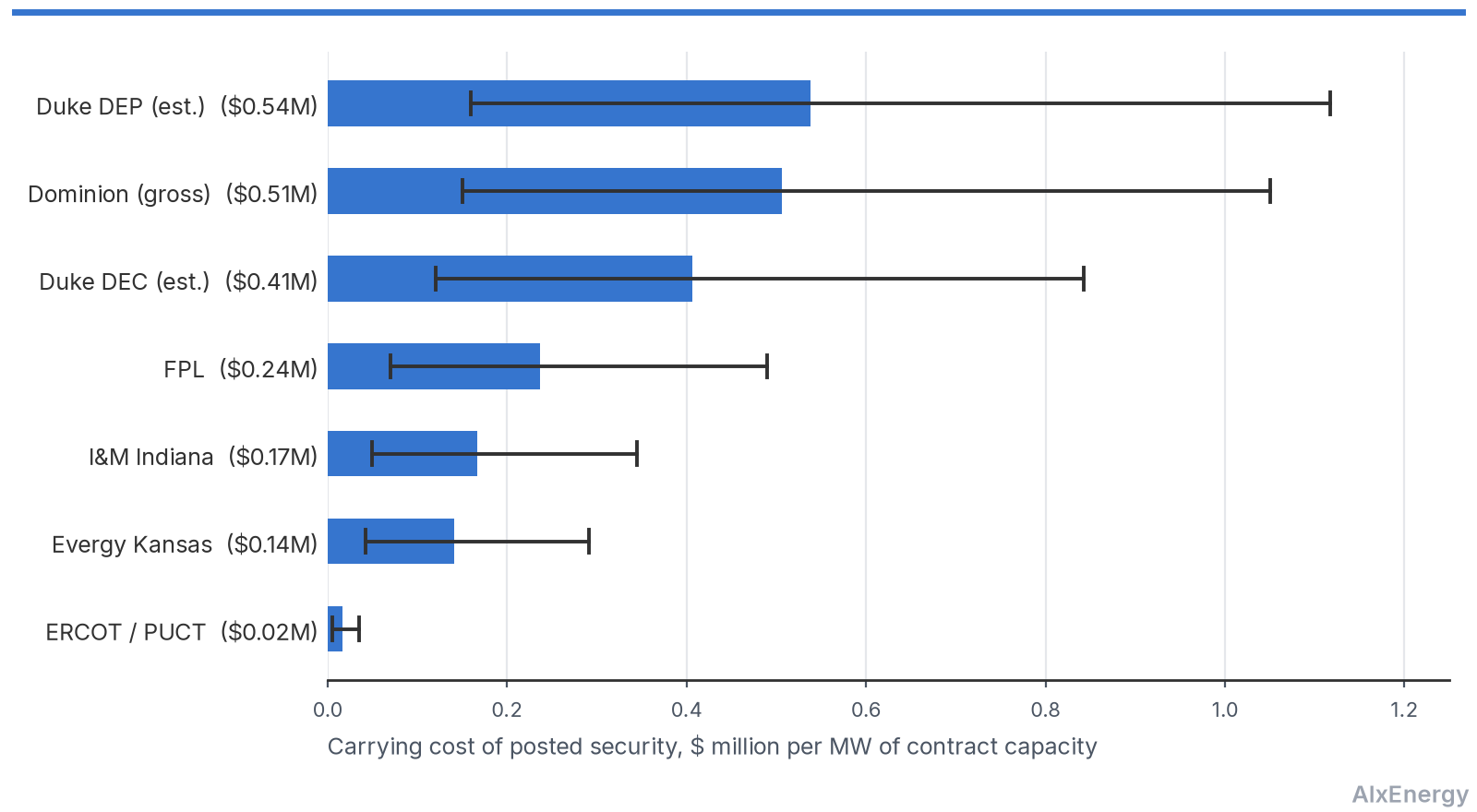
The cost of posting depends on how long the security sits. As a yardstick, Wood Mackenzie's commentary that a Virginia connection takes at least 54 months and an Ohio one 84 was used, and collateral was held for 4.5 years at 7.5 percent.19 That commentary is not tariff evidence, so the result indicates a magnitude only. The carry is 33.75 percent of principal: about $42 million for Evergy, $50 million for I&M, $71 million for FPL, $122 million and $162 million for Duke's two utilities, and $152 million for Dominion at its gross figure, against $5 million in Texas. At seven years and 10 percent, the top of the sensitivity range, the carry on the Duke Energy Progress estimate reaches $335 million.1 The contractual side of delay is examined in an earlier AIxEnergy analysis.20
Release schedules extend the carry past energization. Evergy considers release only after the customer has run above 100 MW for five years. Dominion releases one-fourteenth a year, and AEP Ohio reduces collateral by one year of minimum charges for each year energized. Duke reduces its network-upgrade letter of credit ratably once a year after three consecutive months at 75 percent or more of full contract demand.6, 15, 13, 2 Oregon refunds half of its deposit in each of the second and third years after energization, if the customer has met 80 percent of its allocated capacity and its flexibility plan.11
Posting dates differ as much as amounts. FPL's service agreement requires security five days after its effective date and the contribution in aid of construction within 45 days, failing which the agreement is void, although the minimum term runs from an in-service date that cannot precede the utility's having generation capacity.10 In the Duke exhibit, the maximum of the liquidated-damages schedule is labeled the basis for security, while liability in the same exhibit is about $331 million four years before energization.2
Flexibility and queues
ERCOT's Batch Zero is the only reviewed framework that ties flexibility directly to connection timing. Texas offers a pathway for customers that accept curtailment alongside a self-supply pathway, against requests above 438,000 MW, nearly 89 percent from data centers, with a final transmission plan expected in fall 2027.18 Oregon allows flexibility to be weighed case by case. It built its interconnection queue to encourage load flexibility but declined both a fast-track queue and a separate flexible subclass, stating that flexibility may be one element of a plan of service that allows energization and will be considered in special contracts.11 Elsewhere flexibility is a concession on the minimum or a reliability condition. PPL lowers the minimum take to 60 percent and then 30 percent for a voluntary interruptible customer, and the Duke settlement requires interruptibility of 95 percent of contract load for up to 50 hours a year, or 50 percent for up to 100, during the ramp plus one year.9, 2
Binding terms appear to thin queues. As of February 12, 2026, AEP Ohio reported about 30,000 MW of requests, 13,022.7 MW that had paid for a study and 5,642 MW under signed binding contracts, which is 19 percent of the requests and 43 percent of the studied load. Another 12,219 MW had been signed before the tariff, for 17,861 MW in total, coming online progressively through 2035.21 The release is utility-reported and does not show that the tariff caused the attrition. Dominion reports over 54 GW at various stages of contracting and over 12 GW under service agreements, but its GS-5 terms reach only agreements executed on or after January 1, 2027.22, 15
What moves the number
In tariffed jurisdictions the percentages and exit formulas are largely fixed, so the committed amount moves with the schedules, the timing and the structure of credit support. Six levers recur.
The start of the clock. FPL ties the in-service date to the later of completed facilities and available generation capacity, imposes only commercially reasonable efforts on the utility, and still calls for security within days.10
The form and release of credit support. Evergy's cash earns no interest, although in the first five years cash counts at a 25 percent premium against the first $40 million of the requirement ($30 million of cash meets $40 million), and Dominion's cash earns interest.6, 15 Evergy also treats a rating at its threshold as failing once the customer is on credit watch.6
Reduction and exit rights. I&M and Dominion allow a free 20 percent reduction in different ways, Duke one reduction of up to 20 percent and 200 MW after the sixth anniversary, and Consumers one reduction of 10 percent with four years' notice.7, 15, 2, 8
Reassignment and mitigation. I&M obliges the company to use reasonable efforts to mitigate through reassignment and pays any surplus to the customer or its designated successor. Oregon refunds an exit fee, in whole or in part and prorated, when capacity is reassigned within three years, and Dominion adds a further 30 percent reduction if another customer assumes the capacity.7, 11, 15 Michigan directs Consumers to mitigate but bars the customer from reassigning capacity on its own.8
Regulatory change. Evergy makes its provisions subject to changes ordered by the regulator, and FPL applies approved changes prospectively and measures the exit fee on the generation charge in effect at termination.6, 10 Whether a change reaches existing agreements differs by tariff.
Execution date. Duke's proposal would reach agreements executed on or after June 1, 2026 and exempt earlier ones, even if later assigned, renewed or extended, except for incremental load that meets the thresholds.2 FERC's June 2026 show-cause orders to six RTOs and ISOs change no tariff but begin a process that may alter interconnection rules.23 The Duke ruling is expected in mid-November, and the Xcel and OG&E proceedings remain open.2, 3, 4
Notes
- Brandon N. Owens, compilation of 17 large-load tariffs and tariff frameworks, with rate inputs, collateral bases and calculations, assembled October to November 2026 from the primary documents cited in these notes. Dollar figures that are not quoted from a source are the author’s illustrative calculations under the assumptions stated in the text. The compilation and method notes are held by the author. ↩
- North Carolina Utilities Commission, Docket Nos. E-7, Sub 1329 and E-2, Sub 1380, large load tariff settlement filing with Exhibits 1 and 2, filed October 6, 2026, docket records at https://www.ncuc.gov/; Duke Energy, “Duke Energy protects customers from data center costs,” news release, October 7, 2026, https://news.duke-energy.com/releases/duke-energy-protects-customers-from-data-center-costs. The tariff sheet is stated to take effect for service on and after January 1, 2027. The settlement is pending before the commission, and the release states that a decision is expected by mid-November. ↩
- Colorado Public Utilities Commission, Proceeding No. 26AL-0137E (Public Service Company of Colorado, Advice Letter No. 2018, large load tariff), pending; Xcel Energy, “Xcel Energy proposal protects customers from higher bills as data center demand grows,” news release, April 2, 2026, https://newsroom.xcelenergy.com/news/xcel-energy-proposal-protects-customers-from-higher-bills-as-data-center-demand-grows; Courtney Fieldman, Answer Testimony on behalf of Rewiring America and the Southwest Energy Efficiency Project, Hearing Exhibit 1101, August 19, 2026, https://earthjustice.org/wp-content/uploads/2026/08/hearing-exhibit-1101-answer-testimony-of-courtney-fieldman.pdf, which is the source for the 80 percent minimum monthly bill and is intervenor testimony describing the proposal; Mark Jaffe, “Colorado Utility Regulators to Decide Whether Xcel’s Data Center Tariff Proposal Protects Customers,” Colorado Sun, October 21, 2026, https://coloradosun.com/2026/10/21/xcel-data-centers-energy-colorado-puc/. ↩
- Oklahoma Corporation Commission, notice of hearing, Cause No. PUD 2026-000046 (Oklahoma Gas and Electric large load tariff), hearing set for November 3, 2026, https://www.kcnonline.com/wp/wp-content/uploads/2026/08/260819pud46.pdf. The date of the notice is not stated in the document. The proposal is pending. ↩
- Pennsylvania Public Utility Commission, Final Order adopting a model tariff for large load customers, Docket No. M-2025-3054271, public meeting of April 30, 2026 (released May 2026), https://www.puc.pa.gov/docket/M-2025-3054271. The model tariff is guidance to electric distribution companies and has not been adopted as a tariff of any utility. ↩
- Evergy Kansas Central, Schedule LLPS, Large Load Power Service, Kansas Corporation Commission Docket No. 25-EKME-315-TAR, effective November 6, 2025, https://www.evergy.com/-/media/documents/billing/kansas-central/commercial-and-industrial/ekc_large-load-power-service.pdf; Kansas Corporation Commission, news release, November 6, 2025, https://www.kcc.ks.gov/news-11-6-25. ↩
- Indiana Utility Regulatory Commission, Order, Cause No. 46097, February 19, 2025 (Indiana Michigan Power, Tariff IP), approving a settlement, https://www.in.gov/iurc/files/ord_46097_021925.pdf. The collateral exemption and the reduction and mitigation provisions cited are in the approved tariff. ↩
- Michigan Public Service Commission, Order, Case No. U-21859, November 6, 2025 (Consumers Energy data center tariff), https://mi-psc.my.site.com/sfc/servlet.shepherd/version/download/068cs00001Nipc9AAB; news release, https://www.michigan.gov/mpsc/commission/news-releases/2025/11/06/mpsc-approves-terms-of-service-between-consumers-energy-and-data-centers. The order permits a one-time reduction of up to 10 percent of contracted capacity on four years’ notice without commission approval, directs Consumers to mitigate and bars customer reassignment of capacity. ↩
- PPL Electric Utilities, Rule LP-6, Large Load Interconnections, effective July 1, 2026, https://pplelectric.com/site/-/media/PPLElectric/At-Your-Service/Docs/Current-Electric-Tariff/2026/August/LP-6---Large-Load-Interconnections.pdf; Pennsylvania Public Utility Commission, Docket No. R-2025-3057164, Opinion and Order entered June 11, 2026. ↩
- Florida Power & Light Company, Large Load Contract Service tariffs (LLCS-1) and form Service Agreement, Exhibit A to the compliance filing in Florida Public Service Commission Docket No. 20260149-EI, under Order No. PSC-2026-0022-S-EI, January 29, 2026 (Docket No. 20250011-EI), https://www.psc.state.fl.us/library/FILINGS/2026/07123-2026/07123-2026.pdf; FPL, LLCS overview, https://www.poweringflorida.com/content/dam/poweringflorida/us/en/pdf/FPL%20LLCS%20Overview.pdf. The tariff states that its rates are subject to change in a subsequent rate proceeding. ↩
- Oregon Public Utility Commission, Order No. 26-154, May 7, 2026, https://apps.puc.state.or.us/orders/2026ords/26-154.pdf, and Order No. 26-309 on reconsideration, August 31, 2026, https://apps.puc.state.or.us/orders/2026ords/26-309.pdf, Docket UM 2377 (Portland General Electric). ↩
- Kentucky Public Service Commission, Order, Case No. 2024-00305, March 18, 2025 (Kentucky Power), https://psc.ky.gov/pscscf/2024%20Cases/2024-00305/20250318_PSC_ORDER.pdf. ↩
- Public Utilities Commission of Ohio, Case No. 24-508-EL-ATA, order of July 9, 2025, and AEP Ohio, data center tariff page, https://www.aepohio.com/company/about/rates/data-center-tariff/. ↩
- Public Service Commission of Wisconsin, Docket No. 6630-TE-113 (We Energies), final decision received May 21, 2026, https://apps.psc.wi.gov/ERF/ERFview/viewdoc.aspx?docid=591873. ↩
- Virginia State Corporation Commission, Final Order, Case No. PUR-2025-00058, November 25, 2025 (Dominion Energy Virginia, Rate Schedule GS-5), https://www.scc.virginia.gov/docketsearch/DOCS/89g601!.PDF. ↩
- Georgia Public Service Commission, media advisory on data center rules, January 23, 2025, https://psc.ga.gov/site/assets/files/8617/media_advisory_data_centers_rule_1-23-2025.pdf, and data center fact sheet, September 2026, https://psc.ga.gov/site/downloads/datacenterfactsheet_202609.pdf. ↩
- Cheyenne Light, Fuel and Power Company d/b/a Black Hills Energy, Wyo. P.S.C. Tariff No. 14, Large Power Contract Service, Rate Schedule LPCS, Sheets 27 to 28 ff., issued November 26, 2025, https://www.blackhillsenergy.com/sites/blackhillsenergy.com/files/clfp_electric.pdf. ↩
- Public Utility Commission of Texas, 16 Tex. Admin. Code § 25.194, Project No. 58481, adopted September 18, 2026, effective October 8, 2026, https://ftp.puc.texas.gov/public/puct-info/agency/rulesnlaws/subrules/electric/25.194/25.194.pdf; Electric Reliability Council of Texas, news release on Batch Zero approval, June 18, 2026, https://www.ercot.com/news/release/06182026-puct-approves-ercots. ↩
- Simon Flowers, Wood Mackenzie, The Edge, post on speed-to-power solutions and US data centre challenges, October 30, 2026, https://www.woodmac.com/blogs/the-edge/speed-to-power-solutions-us-data-centres-challenges/. Analyst commentary; the post states no method. ↩
- AIxEnergy, “How Data Center Deals Allocate Delay Risk,” https://www.aixenergy.io/carrying-the-bill-how-data-center-deals-allocate-infrastructure-delay-risk/. ↩
- AEP Ohio, news release, February 13, 2026 (release ID 10753), https://www.aepohio.com/company/news/view?releaseID=10753. Counts are as reported by the utility. ↩
- “Dominion Energy (D) Q3 2026 Earnings Call Transcript,” The Motley Fool, October 30, 2026, https://www.fool.com/earnings/call-transcripts/2026/10/30/dominion-energy-d-q3-2026-earnings-call-transcript/. ↩
- Foley & Lardner LLP, “FERC Issues Six Tailored Show-Cause Orders to Accelerate Large Load Interconnection,” June 30, 2026, https://www.foley.com/insights/publications/2026/06/ferc-issues-six-tailored-show-cause-orders-to-accelerate-large-load-interconnection/. ↩
Bibliography
- Public Utilities Commission of Ohio, Case No. 24-508-EL-ATA, order of July 9, 2025, and AEP Ohio, data center tariff page, https://www.aepohio.com/company/about/rates/data-center-tariff/.
- AEP Ohio, news release, February 13, 2026 (release ID 10753), https://www.aepohio.com/company/news/view?releaseID=10753. Counts are as reported by the utility.
- AIxEnergy, “How Data Center Deals Allocate Delay Risk,” https://www.aixenergy.io/carrying-the-bill-how-data-center-deals-allocate-infrastructure-delay-risk/.
- Cheyenne Light, Fuel and Power Company d/b/a Black Hills Energy, Wyo. P.S.C. Tariff No. 14, Large Power Contract Service, Rate Schedule LPCS, Sheets 27 to 28 ff., issued November 26, 2025, https://www.blackhillsenergy.com/sites/blackhillsenergy.com/files/clfp_electric.pdf.
- Colorado Public Utilities Commission, Proceeding No. 26AL-0137E (Public Service Company of Colorado, Advice Letter No. 2018, large load tariff), pending; Xcel Energy, “Xcel Energy proposal protects customers from higher bills as data center demand grows,” news release, April 2, 2026, https://newsroom.xcelenergy.com/news/xcel-energy-proposal-protects-customers-from-higher-bills-as-data-center-demand-grows; Courtney Fieldman, Answer Testimony on behalf of Rewiring America and the Southwest Energy Efficiency Project, Hearing Exhibit 1101, August 19, 2026, https://earthjustice.org/wp-content/uploads/2026/08/hearing-exhibit-1101-answer-testimony-of-courtney-fieldman.pdf, which is the source for the 80 percent minimum monthly bill and is intervenor testimony describing the proposal; Mark Jaffe, “Colorado Utility Regulators to Decide Whether Xcel’s Data Center Tariff Proposal Protects Customers,” Colorado Sun, October 21, 2026, https://coloradosun.com/2026/10/21/xcel-data-centers-energy-colorado-puc/.
- “Dominion Energy (D) Q3 2026 Earnings Call Transcript,” The Motley Fool, October 30, 2026, https://www.fool.com/earnings/call-transcripts/2026/10/30/dominion-energy-d-q3-2026-earnings-call-transcript/.
- Evergy Kansas Central, Schedule LLPS, Large Load Power Service, Kansas Corporation Commission Docket No. 25-EKME-315-TAR, effective November 6, 2025, https://www.evergy.com/-/media/documents/billing/kansas-central/commercial-and-industrial/ekc_large-load-power-service.pdf; Kansas Corporation Commission, news release, November 6, 2025, https://www.kcc.ks.gov/news-11-6-25.
- Florida Power & Light Company, Large Load Contract Service tariffs (LLCS-1) and form Service Agreement, Exhibit A to the compliance filing in Florida Public Service Commission Docket No. 20260149-EI, under Order No. PSC-2026-0022-S-EI, January 29, 2026 (Docket No. 20250011-EI), https://www.psc.state.fl.us/library/FILINGS/2026/07123-2026/07123-2026.pdf; FPL, LLCS overview, https://www.poweringflorida.com/content/dam/poweringflorida/us/en/pdf/FPL%20LLCS%20Overview.pdf. The tariff states that its rates are subject to change in a subsequent rate proceeding.
- Foley & Lardner LLP, “FERC Issues Six Tailored Show-Cause Orders to Accelerate Large Load Interconnection,” June 30, 2026, https://www.foley.com/insights/publications/2026/06/ferc-issues-six-tailored-show-cause-orders-to-accelerate-large-load-interconnection/.
- Georgia Public Service Commission, media advisory on data center rules, January 23, 2025, https://psc.ga.gov/site/assets/files/8617/media_advisory_data_centers_rule_1-23-2025.pdf, and data center fact sheet, September 2026, https://psc.ga.gov/site/downloads/datacenterfactsheet_202609.pdf.
- Indiana Utility Regulatory Commission, Order, Cause No. 46097, February 19, 2025 (Indiana Michigan Power, Tariff IP), approving a settlement, https://www.in.gov/iurc/files/ord_46097_021925.pdf. The collateral exemption and the reduction and mitigation provisions cited are in the approved tariff.
- Kentucky Public Service Commission, Order, Case No. 2024-00305, March 18, 2025 (Kentucky Power), https://psc.ky.gov/pscscf/2024%20Cases/2024-00305/20250318_PSC_ORDER.pdf.
- Michigan Public Service Commission, Order, Case No. U-21859, November 6, 2025 (Consumers Energy data center tariff), https://mi-psc.my.site.com/sfc/servlet.shepherd/version/download/068cs00001Nipc9AAB; news release, https://www.michigan.gov/mpsc/commission/news-releases/2025/11/06/mpsc-approves-terms-of-service-between-consumers-energy-and-data-centers. The order permits a one-time reduction of up to 10 percent of contracted capacity on four years’ notice without commission approval, directs Consumers to mitigate and bars customer reassignment of capacity.
- North Carolina Utilities Commission, Docket Nos. E-7, Sub 1329 and E-2, Sub 1380, large load tariff settlement filing with Exhibits 1 and 2, filed October 6, 2026, docket records at https://www.ncuc.gov/; Duke Energy, “Duke Energy protects customers from data center costs,” news release, October 7, 2026, https://news.duke-energy.com/releases/duke-energy-protects-customers-from-data-center-costs. The tariff sheet is stated to take effect for service on and after January 1, 2027. The settlement is pending before the commission, and the release states that a decision is expected by mid-November.
- Oklahoma Corporation Commission, notice of hearing, Cause No. PUD 2026-000046 (Oklahoma Gas and Electric large load tariff), hearing set for November 3, 2026, https://www.kcnonline.com/wp/wp-content/uploads/2026/08/260819pud46.pdf. The date of the notice is not stated in the document. The proposal is pending.
- Oregon Public Utility Commission, Order No. 26-154, May 7, 2026, https://apps.puc.state.or.us/orders/2026ords/26-154.pdf, and Order No. 26-309 on reconsideration, August 31, 2026, https://apps.puc.state.or.us/orders/2026ords/26-309.pdf, Docket UM 2377 (Portland General Electric).
- Brandon N. Owens, compilation of 17 large-load tariffs and tariff frameworks, with rate inputs, collateral bases and calculations, assembled October to November 2026 from the primary documents cited in these notes. Dollar figures that are not quoted from a source are the author’s illustrative calculations under the assumptions stated in the text. The compilation and method notes are held by the author.
- PPL Electric Utilities, Rule LP-6, Large Load Interconnections, effective July 1, 2026, https://pplelectric.com/site/-/media/PPLElectric/At-Your-Service/Docs/Current-Electric-Tariff/2026/August/LP-6---Large-Load-Interconnections.pdf; Pennsylvania Public Utility Commission, Docket No. R-2025-3057164, Opinion and Order entered June 11, 2026.
- Pennsylvania Public Utility Commission, Final Order adopting a model tariff for large load customers, Docket No. M-2025-3054271, public meeting of April 30, 2026 (released May 2026), https://www.puc.pa.gov/docket/M-2025-3054271. The model tariff is guidance to electric distribution companies and has not been adopted as a tariff of any utility.
- Public Service Commission of Wisconsin, Docket No. 6630-TE-113 (We Energies), final decision received May 21, 2026, https://apps.psc.wi.gov/ERF/ERFview/viewdoc.aspx?docid=591873.
- Public Utility Commission of Texas, 16 Tex. Admin. Code § 25.194, Project No. 58481, adopted September 18, 2026, effective October 8, 2026, https://ftp.puc.texas.gov/public/puct-info/agency/rulesnlaws/subrules/electric/25.194/25.194.pdf; Electric Reliability Council of Texas, news release on Batch Zero approval, June 18, 2026, https://www.ercot.com/news/release/06182026-puct-approves-ercots.
- Virginia State Corporation Commission, Final Order, Case No. PUR-2025-00058, November 25, 2025 (Dominion Energy Virginia, Rate Schedule GS-5), https://www.scc.virginia.gov/docketsearch/DOCS/89g601!.PDF.
- Simon Flowers, Wood Mackenzie, The Edge, post on speed-to-power solutions and US data centre challenges, October 30, 2026, https://www.woodmac.com/blogs/the-edge/speed-to-power-solutions-us-data-centres-challenges/. Analyst commentary; the post states no method.