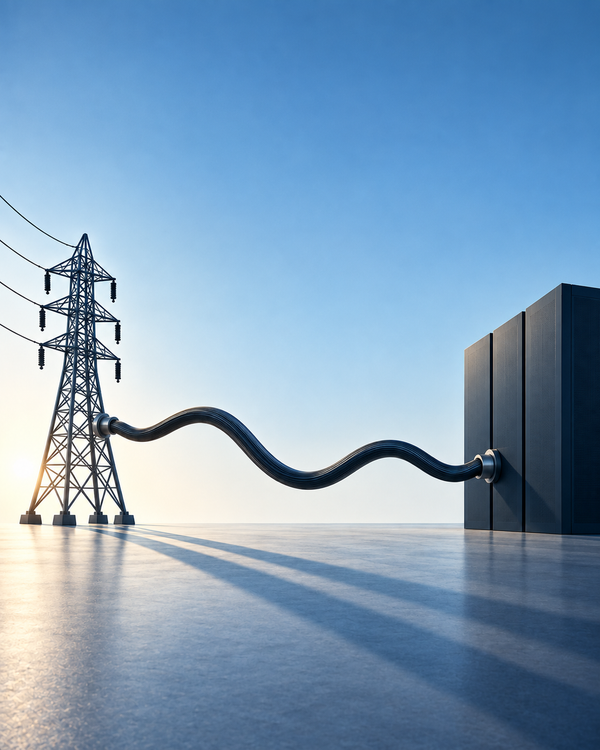
Artificial intelligence has made computation feel almost weightless. A paragraph appears in seconds. A memo rewrites itself. A market scan becomes a briefing note. A half-formed thought becomes a slide, an image, a policy comment, a product description, or a strategic plan before the user has fully decided whether the work needed to exist.
That is the magic of generative AI. It is also the trap. The easier it becomes to generate language, images, summaries, code, and analysis, the easier it becomes to confuse activity with value. AI can help people think more clearly, move faster, and reduce wasteful work. It can also help organizations produce more material than anyone needs, at a scale that quietly turns individual convenience into system-level demand.
The Visible Infrastructure
The energy debate around AI has focused, understandably, on visible infrastructure: data centers, substations, transmission corridors, cooling systems, backup generation, power purchase agreements, land use, water consumption, and carbon emissions.
That focus is justified. Data centers are no longer a quiet corner of the commercial building stock. They are becoming a new class of industrial load: fast-growing, geographically concentrated, power-hungry, and politically consequential.
The numbers explain why. The International Energy Agency estimates that global data center electricity consumption was about 415 terawatt-hours in 2024, or roughly 1.5 percent of global electricity use. By 2030, the IEA projects that data center electricity demand could more than double to around 945 terawatt-hours, slightly more than Japan’s total electricity consumption today.¹
In the United States, the increase is already visible. Lawrence Berkeley National Laboratory estimates that U.S. data center electricity use rose from 58 terawatt-hours in 2014 to 176 terawatt-hours in 2023, and could reach 325 to 580 terawatt-hours by 2028. Depending on overall electricity demand growth, that would put data centers at roughly 6.7 to 12 percent of total U.S. electricity consumption by 2028.²
This is no longer an abstract sustainability concern. It is showing up in real places, on real grids, and in real capital commitments. On May 26, 2026, Reuters reported that I Squared Capital acquired ten U.S. data center facilities from Cogent Fiber for $225 million, with plans to commit another $1 billion for upgrades, expansion, and acquisitions. The facilities provide 53 megawatts of power capacity across nine markets and are aimed in part at the growing demand for AI inference: the everyday use of trained AI models closer to customers, rather than only the massive centralized training runs that dominate the public imagination.³
That distinction matters. The AI infrastructure buildout is not only about a few giant training campuses. It is also about the diffusion of inference across the economy: more queries, more applications, more embedded AI features, more automated workflows, and more computation hidden inside ordinary digital life. The large training run may be the dramatic event, but inference is the habit. And routine is where demand accumulates.
The Invisible Infrastructure of Use
The infrastructure story is only half the story. The other half begins at the prompt box, where millions of small human decisions determine how much useful work AI performs and how much low-value computation it creates.
AI is usually described as a technology. That description is incomplete. AI is also a behavioral system. It changes how people ask questions, produce documents, make decisions, avoid decisions, communicate authority, and scale work. Its environmental footprint is shaped not only by chips, cooling towers, transformers, and clean-energy contracts, but also by habits. The physical infrastructure matters enormously. So does the culture of use that infrastructure enables.
The analogy is the automobile. The environmental impact of cars does not end at the factory gate. Manufacturing a car matters. Fuel efficiency matters. Battery chemistry matters. Road infrastructure matters. But so does how people drive. A household that combines trips, avoids unnecessary travel, maintains the vehicle, and chooses walking or transit when appropriate produces a different environmental outcome than a household that treats every impulse as a separate car trip.
AI is moving through the economy in a similar way. Model efficiency matters. Data center design matters. Clean electricity procurement matters. Water stewardship matters. But use also matters. A prompt can substitute for work that would otherwise require more time, travel, meetings, analysis, or administrative overhead. It can also multiply work that never needed to exist.
Substitution or Expansion?
That distinction may become one of the most important sustainability questions in the AI economy: is AI substituting for activity, or expanding it?
If AI substitutes intelligently, it can be an efficiency tool. It can compress research time, improve building operations, reduce unnecessary meetings, optimize logistics, support grid planning, and improve the quality of consequential decisions.
If it expands indiscriminately, it becomes a rebound machine. Energy economists have long understood the rebound effect. When a technology becomes more efficient, the cost of using it often falls. When the cost falls, people often use more of it. Sometimes efficiency gains dominate, and society still saves energy overall. Sometimes additional use erodes the savings.
AI has its own version of this problem. As the cost of generating language, images, code, summaries, and analysis approaches zero, the amount of generated output can explode.
That is the paradox of AI sustainability. The environmental impact of a single prompt may be small, and in some systems it is becoming smaller. Google recently estimated that a median Gemini Apps text prompt consumes about 0.24 watt-hours of electricity, emits 0.03 grams of carbon dioxide equivalent, and consumes 0.26 milliliters of water.⁴ Those numbers are far smaller than many popular estimates of AI use, but they do not settle the system question.
A single prompt is not the system. The system is the number of prompts, the complexity of the model invoked, the length of the context window, the length of the output, the hardware used, the data center’s power usage effectiveness, the cooling method, the local water context, the carbon intensity of electricity at the time of computation, and the downstream work the AI output causes people to create. A drop of water is negligible. A culture of infinite prompting is not.
Efficiency Is Not Enough
For the energy sector, this requires a conceptual shift. We tend to think in terms of supply-side interventions: build cleaner generation, improve data center efficiency, site loads near low-carbon resources, recover waste heat, add storage, strengthen transmission, and use advanced cooling.
All of that matters. A data center with a power usage effectiveness, or PUE, of 1.1 uses far less overhead energy for cooling and power distribution than a facility with a PUE of 1.6. PUE measures total facility energy divided by IT equipment energy. A PUE of 1.1 means that for every 1.0 megawatt used by servers, about 0.1 megawatts are used for supporting infrastructure. A PUE of 1.6 means 0.6 megawatts of overhead for every 1.0 megawatt of IT load.
That difference matters at hyperscale. But technical efficiency alone cannot settle the question. If each unit of computation becomes cleaner and cheaper while total computation grows faster, absolute electricity demand can still rise.
The result is familiar across energy history: efficiency improves the machine, while behavior determines the system. AI will be no different.
Demand Architecture
Sustainable AI needs a better vocabulary. The next frontier is not only green data centers. It is demand architecture: the deliberate design of interfaces, workflows, defaults, procurement standards, and organizational norms that shape how much AI computation is actually used and whether that use creates value.
Today’s AI interfaces are optimized for ease, speed, and engagement. They invite the user to ask anything, regenerate endlessly, and produce more. That is understandable from a product-growth perspective, but from an energy-systems perspective the interface is not neutral. A tool that encourages vague prompting, repeated regeneration, maximal output, and low-purpose content is shaping load.
The prompt box is an energy device. That may sound strange, but so did the idea that thermostats were grid assets. Then utilities learned that millions of small behavioral signals — a degree of cooling here, a delayed water heater there, an electric vehicle charging session shifted by two hours — could add up to system-level consequences. AI usage will follow a similar pattern. No single user is the grid. But aggregated behavior becomes demand.
Low-Value AI Use at Scale
The sustainability field risks making this too moralistic. The point is not to shame people for using AI. Used well, AI can reduce waste. It can help planners understand interconnection queues, help building operators detect drift, help utilities summarize regulatory filings, help engineers compare scenarios, and help organizations move faster with fewer meetings and less duplication.
The problem is not AI use. The problem is low-value AI use at scale. A utility planner who uses AI to identify inconsistencies across load forecasts may improve institutional learning. A sustainability team that uses AI to synthesize hundreds of pages of disclosure requirements may save real labor. A project developer who uses AI to compare interconnection alternatives may reach better decisions faster. A writer who uses AI to test an argument, sharpen structure, and identify missing evidence may produce clearer work with fewer wasted cycles.
The same tool can also create institutional drag. It can generate ten versions of a memo nobody needed. It can flood inboxes with synthetic prose. It can replace judgment with volume. It can encourage more reports, more dashboards, more updates, more drafts, and more meetings simply because the marginal cost of producing them has collapsed. That is not intelligence. It is throughput without discipline.
The Substitution Test
The sustainability question is not simply, “Should I use AI?” It is, “What is this AI use replacing?” If AI replaces unnecessary travel, duplicative analysis, low-value administrative labor, or a week of fragmented research, the environmental ledger may be favorable. If AI merely adds more content to a world already drowning in content, the ledger changes.
The output may be digital, but the inputs are physical: electricity, cooling, water, land, chips, steel, concrete, substations, transformers, and generation capacity. AI has made language cheap. It has not made infrastructure free.
Four Principles for Purposeful AI Use
My friend and colleague Zach Ayvazian, Founder and CEO of SureWay AI, has developed a simple but powerful set of principles for using AI with more discipline. They are not rules of abstinence. They are rules of better use: a way to make AI more useful, less wasteful, and more aligned with the work that actually needs to be done.
1. Iterate Instead of Regenerating
“Try again” is the AI equivalent of throwing away a nearly finished draft and ordering a new one. A better approach is to say what should change: make it shorter, preserve the argument, add a counterexample, remove jargon, strengthen the opening, or test the claim against evidence. Iteration keeps the work anchored. Regeneration often produces novelty without improvement.
2. Right-Size the Task
Not every task warrants AI. If the answer is obvious, write it yourself. If the problem requires judgment rather than generation, use AI as a sparring partner, not a substitute. If the output will not be read, used, or acted upon, do not generate it. The greenest AI output is the one that never needed to exist.
3. Use AI to Reduce Work
Before prompting, ask whether the output will replace something you would otherwise have done or simply create a new obligation. The best use cases compress effort, improve decisions, or reduce downstream waste. The worst ones create synthetic work products that require more human review, more coordination, and more storage while adding little value.
4. Move From Personal Habit to Platform Design
These principles should not remain personal habits. They should become design principles for AI platforms, procurement standards, and institutional norms.
Enterprise AI systems could make model selection more transparent, routing simple tasks to smaller models and reserving frontier models for higher-value work. Interfaces could encourage clarification before generation. Tools could display approximate energy or carbon ranges, not as scolding devices, but as feedback. Organizations could define when to summarize, when to draft, when to search, when to use retrieval, when to use a smaller model, and when not to use AI at all.
This matters because inference is likely to become more distributed, embedded, and ordinary. The next wave of AI demand may not look like one dramatic supercomputer. It may look like millions of small decisions made by people and software agents every hour: summarize this, rewrite that, generate another image, compare these options, draft a response, search again, make it more polished, make it more executive, make it more human.
From Personal Habit to Platform Design
These principles should not remain personal habits. They should become design principles for AI platforms and procurement standards for institutions.
Enterprise AI systems could make model selection more transparent, routing simple tasks to smaller models and reserving frontier models for higher-value work. Interfaces could encourage clarification before generation. Tools could display approximate energy or carbon ranges, not as scolding devices, but as feedback. Organizations could define when to summarize, when to draft, when to search, when to use retrieval, when to use a smaller model, and when not to use AI at all.
This matters because inference is likely to become more distributed, embedded, and ordinary. The next wave of AI demand may not look like one dramatic supercomputer. It may look like millions of small decisions made by people and software agents every hour: summarize this, rewrite that, generate another image, compare these options, draft a response, search again, make it more polished, make it more executive, make it more human. Each action is small. The pattern is not.
Purposeful Computation
There is a deeper lesson here for the energy transition. Sustainability is rarely achieved by improving one component in isolation. A more efficient car can still increase vehicle miles traveled. A more efficient light bulb can still contribute to more illuminated space. A more efficient AI model can still enable a flood of low-value computation.
This does not mean efficiency is futile. It means efficiency must be paired with governance, design, and culture. For AI, the physical system and the behavioral system are now coupled. Data center developers, utilities, regulators, hyperscalers, enterprise customers, and individual users are all part of the same demand chain. The server hall and the prompt box belong to one system. One is made of concrete, copper, silicon, water loops, switchgear, and fiber. The other is made of habits, incentives, defaults, deadlines, curiosity, anxiety, and ambition.
The environmental cost of AI will not be solved only by cleaner electrons or better chips. It will also be shaped by whether we learn to use intelligence intelligently. That is the standard AI now has to meet: not less use, but better use; not digital abundance for its own sake, but purposeful computation; not endless generation, but substitution, judgment, and restraint.
AI is here to stay. The question is whether we build a culture of use worthy of the infrastructure now being built to support it.
Endnotes
- International Energy Agency, Energy and AI (Paris: IEA, 2025), “Energy Demand from AI,” accessed May 26, 2026. The IEA estimates global data center electricity consumption at about 415 TWh in 2024 and projects demand could reach about 945 TWh by 2030, slightly more than Japan’s current electricity consumption.
- Arman Shehabi et al., 2024 United States Data Center Energy Usage Report (Berkeley, CA: Lawrence Berkeley National Laboratory, December 2024). The report estimates U.S. data center electricity use at 176 TWh in 2023 and projects 325–580 TWh by 2028, equal to roughly 6.7–12 percent of total U.S. electricity consumption depending on demand growth.
- Milana Vinn, “I Squared Bets on AI Inference with $225 Million Data Center Buy from Cogent,” Reuters, May 26, 2026. The deal includes ten U.S. data center facilities across nine markets, 53 MW of power capacity, and a planned $1 billion commitment for upgrades, expansion, and acquisitions.
- Jeff Dean et al., “Measuring the Environmental Impact of AI Inference,” Google Cloud Blog, August 21, 2025. Google estimates that a median Gemini Apps text prompt consumes 0.24 Wh of electricity, emits 0.03 gCO₂e, and consumes 0.26 mL of water.