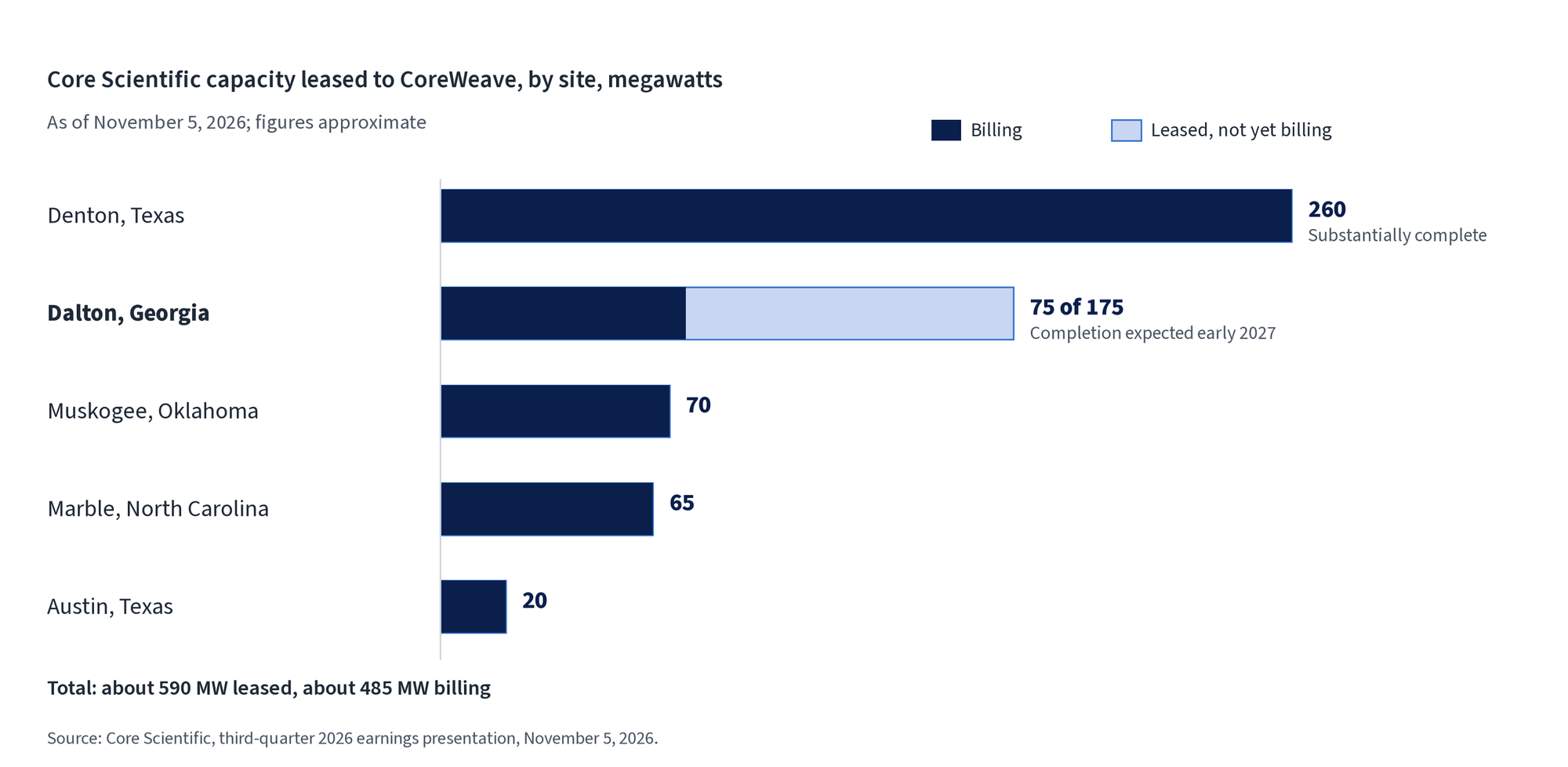
- At Core Scientific's five CoreWeave sites, about 485 of roughly 590 leased megawatts were billing on November 5, and almost all of the gap sat at one campus in Dalton, Georgia.
- U.S. data center securitization reached $21.9 billion through November 20, down 18.6 percent from 2025, with nearly all of the decline in mortgage-backed deals rather than lease-backed ones.
- A wider spread raises a borrower's cost; a smaller loan forces it to find more equity, and the second can do more to delay a building.
- SpaceX's contracts with Anthropic and Google would bill about $48 billion a year at full delivery, but both can be cancelled on 90 days' notice after early 2027.
- For utilities, the useful forecasting unit is the next financed block of load, not a haircut applied to announced megawatts.
In Dalton, Georgia, a hundred megawatts separate a signed lease from a paying customer. Core Scientific, which builds and runs data centers, has leased about 175 MW there to CoreWeave, which rents out computing power. On November 5 about 75 MW was billing, and the rest was due for completion in early 2027. Across the two companies' relationship of roughly 590 MW, the Georgia site accounted for nearly all of the gap between capacity leased and capacity earning rent. Twenty days later, the yield on CoreWeave's bonds due in October 2031 reached 17.91 percent.12
Read quickly, the two numbers look like a verdict on the whole industry. Their timing points to a narrower question. The Dalton halls were on the construction schedule before the November sell-off. The coupons on CoreWeave's fixed-rate notes did not change when their prices fell, and less than two weeks before the slide the company told investors that its cash and short-term investments, together with what it can still borrow under existing facilities, should cover its obligations for the coming year. What November's credit market changes is the price and size of the money available for the next block of machines. For an electric utility trying to forecast demand, that decision matters more than either company's share price.3
Where the money went
The most revealing figure in the credit market is the composition of the decline. Through November 20, U.S. data center securitization totaled $21.9 billion, about $5 billion below the whole of 2025. Roughly $4.7 billion of that shortfall came from commercial mortgage-backed securities, which are secured by mortgages on the buildings. Asset-backed securities, which typically rest on the leases and the rent they produce, were down only slightly. Two markets drawing on much the same appetite for computing power were having quite different years.4
Table 1
U.S. data center securitization: issuance and pricing
| 2025 | 2026 to Nov. 20 | Change | |
|---|---|---|---|
| Total data center securitization | $26.9bn | $21.9bn | -18.6% |
| Asset-backed securities | $15.7bn | $15.3bn | -2.4% |
| Commercial mortgage-backed securities | $11.3bn | $6.6bn | -41.4% |
| Five-year single-A ABS spread over Treasuries | 195 bp | 257 bp | +62 bp |
No data center deal priced between November 20 and the end of 2025, so the 2025 column equals the full year. Category totals for 2025 are calculated from the reported 2026 levels and percentage changes and are approximate; rounding affects sums. Spreads compare the first-quarter 2026 average (eight deals) with the average for the three months to November 20 (five deals). The series excludes bank loans, private credit and unsecured corporate bonds. Source: CRE Finance Council, November 24, 2026 (note 4).
An owner hoping to borrow in December should take little comfort from the year-to-date asset-backed total. The fourth quarter had produced $2.1 billion of data center deals by November 20, against $7.7 billion in the same quarter of 2025, and the four weeks to that date passed without a single reported pricing. On November 26 Data Center Dynamics, citing Bloomberg, reported that Compass Datacenters planned to put off a $380 million asset-backed sale until 2027 after investors pulled back following a data center outage. Compass had not confirmed the report. Bondholders in these deals are paid from tenant rent, so an interruption that a customer experiences as lost service can reach an investor as doubt about the income behind the debt. A single postponed sale is still a thin basis for declaring the market closed.45
A higher interest rate and a shortage of debt have different consequences. At a constant Treasury yield, the 62-basis-point widening in the table would add $4.34 million a year to the cost of $700 million of interest-only borrowing. Now suppose lenders will advance only $550 million on a $1 billion campus that previously qualified for $700 million. The sponsor must find another $150 million up front, and its equity requirement rises by half. These are illustrations, not observed loan terms. They explain why a developer might accept a higher coupon yet postpone a building when its lender cuts the size of the cheque.
Six businesses behind one substation
The first owner in the chain may never operate a computer. A powered-land developer secures a site and advances the utility work, hoping to sell it, or grant a ground lease, to a builder. Its greatest asset in a shortage is a credible delivery date that a buyer can inherit. If the service agreement cannot transfer, or if the buyer cannot fund the required upgrades, that date is worth considerably less. The developer usually feels a credit squeeze when the purchaser asks for more time and the next land or utility deposit falls due anyway.
A build-to-suit landlord has a tenant and a different exposure. In Hawesville, Kentucky, TeraWulf has leased about 401 MW to Anthropic for 20 years, in leases it values at roughly $19 billion. Anthropic's rent begins as each data hall is delivered, with deliveries expected from late 2027 through the second quarter of 2028. On November 4 Google agreed to backstop certain of Anthropic's obligations, but under each of the three leases that protection takes effect only when the final hall commences. The first hall can therefore earn rent while the landlord still carries construction risk on the last and tenant credit risk on the first. At Core Scientific, by contrast, the parent gave the holders of its subsidiary's $3.3 billion of secured notes an uncapped guarantee that specified data center projects will be completed. For a construction lender, the signature on that guarantee can matter more than the name on the front door.67
A colocation operator rents powered and cooled space to many customers. An established building can support debt from a collection of occupied suites, while the empty hall next door must win enough customers to cover its own costs. Diversification also deserves a closer look in AI than a tenant list provides. Several cloud companies selling capacity to the same model developer may each sign a lease, and a cut in that developer's budget can reach all of them at once.
A GPU cloud, often called a neocloud, buys the processors and sells access to them. Its landlord may own a useful building long after the first generation of chips has been replaced. The cloud operator has to earn back the cost of those chips while customers still want them. A multiyear take-or-pay contract protects it against weak utilization, but the obligation may start only when the cluster is delivered. Nscale, which filed to go public in September, says its contract terms "commence upon successful delivery of GPU compute clusters" and average about 5.7 years. Once the commitment ends, a lender is exposed to what older machines can earn at the prices then prevailing. The timing of the last protected customer payment, relative to the last loan payment, is a better guide to risk than the face value of the order book.8
A hyperscaler building for its own cloud can fund a campus from earnings elsewhere and assign customers to it later. Its vulnerability is the competition for capital inside the firm. An attractive site can slip a year because another region has more urgent customers or cheaper power. The European Central Bank reported in November that free cash flow turned negative at most large American cloud providers in 2026, as capital spending on AI infrastructure exceeded operating cash flow. A utility may have ample confidence in the credit of the company requesting service and rather less in where that company will spend its next dollar.9
The sixth business combines the roles of cloud operator and customer. SpaceX trains its own Grok models at its Memphis-area campuses while selling compute from the same sites to outside customers. That flexibility has value when competing projects lose access to credit, because buyers that expected to move into their own halls may need someone else's computers for another six months. It is also costly flexibility to exercise. When an outside customer leaves, the cash a lender expects has to come from Grok, either as revenue or as an expense SpaceX no longer has to pay someone else.10
What an eight-month payback would require
Ron Baron, a SpaceX investor, wrote on November 25 that SpaceX builds a data center comparable to a rival's gigawatt for an estimated $35 billion, rents its capacity for more than $50 billion a year and so earns back "their entire data center investment in eight months." The customer disclosures make the scale of the revenue claim plausible. Anthropic has agreed to pay about $3.1 billion a month once all its contracted SpaceX capacity is delivered, which it expects in December. Google agreed to pay $920 million a month from October 2026 through June 2029. Together those fees would come to about $48.2 billion over twelve months at full delivery. They span several agreements, Anthropic's alone covers capacity at both Memphis-area campuses, and the disclosures give no allocation that sets the entire sum against one $35 billion facility.111213
Even at $50 billion a year, gross billings take 8.4 months to reach $35 billion. Recovering the same investment in eight months after operating costs would require $4.375 billion of net cash a month. SpaceX's chief financial officer, Bret Johnsen, told investors in August that current economics gave the company "a less than one-year payback" on new capital deployed for compute. Adding processors to a building that already has power may well clear that hurdle. Spreading the same investment over a new grid connection and an unbuilt hall is a different calculation.14
The more immediate test of Baron's thesis will come from customer behavior. After initial non-cancellable periods ending in January and March 2027, Anthropic's SpaceX agreements can be cancelled by either side on 90 days' notice; Google's can be ended the same way after December 31, 2026. If rival construction slows while those customers keep their capacity at strong prices, scarce credit will have raised the value of an early start. If buyers release machines or win steep price cuts at renewal, the squeeze will have reached demand. A rising cost of borrowing is compatible with either outcome.1213
When a delay reaches the grid
The AIxEnergy Map shows why a nationwide haircut to announced megawatts would produce a poor load forecast. Its three xAI entries around Memphis and Southaven carry 2,595 MW of announced IT load. A single Mississippi complex accounts for 2,000 MW, or 77 percent. Applying an illustrative 20 percent cut to all three would remove 519 MW without identifying a single building that had lost its financing. The reverse shortcut also fails. The two Memphis entries carry 595 MW between them, while SpaceX describes its two campuses as providing about 1.0 gigawatt of compute power. These records describe different scopes and dates. Neither is a meter reading.1510
The utility's own records offer a better unit of analysis. In May 2025 Memphis Light, Gas and Water reported that xAI was receiving 150 MW at its Paul Lowry Road site and had requested a second 150 MW, with a new substation under construction to serve it. A lender could withdraw from a second phase like that without switching off a single machine in the first. The first question for a planner is what remains to be paid for before the next block can draw power. For one customer the answer will be a substation; for another it will be the final hall that switches on a guarantee.16
Dalton offers a useful test for 2027. If its remaining halls enter billing on schedule while proposed campuses elsewhere struggle to secure construction loans, the credit squeeze will be sorting projects by their distance from a paying customer. If completed halls across the industry start losing tenants, planners will have to revisit the demand itself. Earlier Journal pieces on how data center deals allocate delay risk and what a data center owes when it leaves trace the same question through utility contracts. A utility deciding whether to order a transformer would spend its next hour well finding out who has committed the money for the equipment on the other side of it.
Reporting cutoff: November 26, 2026. Market observations and project milestones are dated individually.
Underlying data
Journal members can download the AIxEnergy workbook behind this article: securitization volumes and spreads, megawatts leased and billing by site, disclosed contract terms and the Map records for xAI, each with its source.
Become a Journal memberNotes
- Core Scientific, Inc., "Third Quarter 2026 Earnings Call," investor presentation, exhibit 99.2 to Form 8-K, November 5, 2026, slides 4 and 9, https://www.sec.gov/Archives/edgar/data/1839341/000183934126000028/q3fy26earningsdeckvfinal.htm. All megawatt figures are approximate as presented.
- Tom Westbrook and Sruthi Shankar, "Jensen Huang's Second Coming Offers Little Relief to AI Credits," Reuters, November 25, 2026, https://www.reuters.com/business/media-telecom/global-markets-ai-cds-urgent-2026-11-25/; Louis Juricic, "CoreWeave Bonds Plunge as 2031 Yield Surges to 17.91%; Shares Drop 10%," Investing.com, November 25, 2026, citing Tradeweb data, https://www.investing.com/news/stock-market-news/coreweave-bonds-plunge-as-2031-yield-surges-to-1791-shares-drop-10-5051151.
- CoreWeave, Inc., Form 10-Q for the quarter ended September 30, 2026, filed November 12, 2026, "Liquidity and Capital Resources" and note 10, "Debt," https://www.sec.gov/Archives/edgar/data/1769628/000176962826000465/crwv-20260930.htm.
- CRE Finance Council, "CRE Securitized Debt Update," November 24, 2026, section on data center ABS and CMBS, https://www.crefc.org/cre/content/News/Items/Research_and_Data/2026/CRE_Securitized_Debt_Update_11_24_26.aspx.
- Barney Dixon, "Compass Could Pause $380m ABS Transaction Due to Investor Rout after Outage," Data Center Dynamics, November 26, 2026, https://www.datacenterdynamics.com/en/news/compass-could-pause-380m-abs-transaction-due-to-investor-rout-after-outage-report/.
- TeraWulf Inc., Form 8-K, November 4, 2026, item 1.01, https://www.sec.gov/Archives/edgar/data/1083301/000162828026069810/wulf-20261104.htm; TeraWulf Inc., "TeraWulf Secures Google Credit Backstop for Project Financing in Support of $19 Billion Anthropic Lease," press release, exhibit 99.1, November 4, 2026, https://www.sec.gov/Archives/edgar/data/1083301/000162828026069810/wulfhawesvillecsaandepcmpr.htm.
- Core Scientific, Inc., Form 10-Q for the quarter ended September 30, 2026, filed November 5, 2026, notes on the 7.75% Senior Secured Notes due 2031, https://www.sec.gov/Archives/edgar/data/1839341/000183934126000030/core-20260930.htm.
- Nscale Limited, Form S-1 registration statement, September 18, 2026, prospectus summary, https://www.sec.gov/Archives/edgar/data/2110365/000119312526395475/ck0002110365-20260918.htm.
- European Central Bank, Financial Stability Review, November 2026, 49, https://www.ecb.europa.eu/press/financial-stability-publications/fsr/pdf/ecb.fsr202611~e03b919d36.en.pdf.
- Space Exploration Technologies Corp., prospectus filed pursuant to Rule 424(b)(4), June 12, 2026, definitions of COLOSSUS and COLOSSUS II and business overview, https://d18rn0p25nwr6d.cloudfront.net/CIK-0001181412/590df001-1c6e-4932-b4c1-07685e3d0351.html.
- Badar Shaikh, "'Exceptionally Well-Prepared': Ron Baron Says Elon Musk Could Turn SpaceX AI Data Centers into a $50 Billion Revenue Machine," Benzinga, November 26, 2026, quoting Baron's post on X of November 25, 2026, https://www.benzinga.com/markets/tech/26/11/63660255/ron-baron-elon-musk-could-turn-spacex-ai-data-centers-50-billion-revenue-machine.
- Anthropic, PBC, prospectus filed pursuant to Rule 424(b)(4), November 19, 2026, "Contractual Obligations and Commitments," https://www.sec.gov/Archives/edgar/data/2130357/000162828026074944/anthropicpbc-424b4.htm.
- Space Exploration Technologies Corp., free writing prospectus describing the Cloud Service Agreement with Google LLC, June 5, 2026, https://www.sec.gov/Archives/edgar/data/1181412/000162828026041150/spacexagreementfwp.htm.
- "SpaceX Slides as AI Spending Worries Overshadow Early Returns," Reuters, August 5, 2026, https://www.reuters.com/business/media-telecom/spacex-slides-ai-spending-worries-overshadow-early-returns-2026-08-05/; Space Exploration Technologies Corp., second-quarter 2026 earnings call, August 4, 2026, transcript, The Motley Fool, https://www.fool.com/earnings/call-transcripts/2026/08/11/spacex-spcx-q2-2026-earnings-call-transcript/.
- AIxEnergy Map, project records for Colossus 1, Colossus 2 and the xAI Mississippi complex, accessed November 27, 2026, https://map.aixenergy.io/operator/xai. Shares calculated from announced IT load.
- Memphis Light, Gas and Water, "MLGW Is Providing This Update to the Public Regarding Utility Support for xAI," May 5, 2025, https://www.mlgw.com/images/content/files/pdf/new/5-5-25%20xAI%20Update.pdf.
Bibliography
- AIxEnergy Map. Project records for Colossus 1, Colossus 2 and the xAI Mississippi complex. Accessed November 27, 2026. https://map.aixenergy.io/operator/xai.
- Anthropic, PBC. Prospectus filed pursuant to Rule 424(b)(4). November 19, 2026. https://www.sec.gov/Archives/edgar/data/2130357/000162828026074944/anthropicpbc-424b4.htm.
- CoreWeave, Inc. Form 10-Q for the quarter ended September 30, 2026. Filed November 12, 2026. https://www.sec.gov/Archives/edgar/data/1769628/000176962826000465/crwv-20260930.htm.
- Core Scientific, Inc. Form 10-Q for the quarter ended September 30, 2026. Filed November 5, 2026. https://www.sec.gov/Archives/edgar/data/1839341/000183934126000030/core-20260930.htm.
- Core Scientific, Inc. "Third Quarter 2026 Earnings Call." Investor presentation, exhibit 99.2 to Form 8-K, November 5, 2026. https://www.sec.gov/Archives/edgar/data/1839341/000183934126000028/q3fy26earningsdeckvfinal.htm.
- CRE Finance Council. "CRE Securitized Debt Update." November 24, 2026. https://www.crefc.org/cre/content/News/Items/Research_and_Data/2026/CRE_Securitized_Debt_Update_11_24_26.aspx.
- Dixon, Barney. "Compass Could Pause $380m ABS Transaction Due to Investor Rout after Outage." Data Center Dynamics, November 26, 2026. https://www.datacenterdynamics.com/en/news/compass-could-pause-380m-abs-transaction-due-to-investor-rout-after-outage-report/.
- European Central Bank. Financial Stability Review. November 2026. https://www.ecb.europa.eu/press/financial-stability-publications/fsr/pdf/ecb.fsr202611~e03b919d36.en.pdf.
- Juricic, Louis. "CoreWeave Bonds Plunge as 2031 Yield Surges to 17.91%; Shares Drop 10%." Investing.com, November 25, 2026. https://www.investing.com/news/stock-market-news/coreweave-bonds-plunge-as-2031-yield-surges-to-1791-shares-drop-10-5051151.
- Memphis Light, Gas and Water. "MLGW Is Providing This Update to the Public Regarding Utility Support for xAI." May 5, 2025. https://www.mlgw.com/images/content/files/pdf/new/5-5-25%20xAI%20Update.pdf.
- Nscale Limited. Form S-1 registration statement. September 18, 2026. https://www.sec.gov/Archives/edgar/data/2110365/000119312526395475/ck0002110365-20260918.htm.
- Reuters. "SpaceX Slides as AI Spending Worries Overshadow Early Returns." August 5, 2026. https://www.reuters.com/business/media-telecom/spacex-slides-ai-spending-worries-overshadow-early-returns-2026-08-05/.
- Shaikh, Badar. "'Exceptionally Well-Prepared': Ron Baron Says Elon Musk Could Turn SpaceX AI Data Centers into a $50 Billion Revenue Machine." Benzinga, November 26, 2026. https://www.benzinga.com/markets/tech/26/11/63660255/ron-baron-elon-musk-could-turn-spacex-ai-data-centers-50-billion-revenue-machine.
- Space Exploration Technologies Corp. Free writing prospectus describing the Cloud Service Agreement with Google LLC. June 5, 2026. https://www.sec.gov/Archives/edgar/data/1181412/000162828026041150/spacexagreementfwp.htm.
- Space Exploration Technologies Corp. Prospectus filed pursuant to Rule 424(b)(4). June 12, 2026. https://d18rn0p25nwr6d.cloudfront.net/CIK-0001181412/590df001-1c6e-4932-b4c1-07685e3d0351.html.
- Space Exploration Technologies Corp. Second-quarter 2026 earnings call, August 4, 2026. Transcript, The Motley Fool. https://www.fool.com/earnings/call-transcripts/2026/08/11/spacex-spcx-q2-2026-earnings-call-transcript/.
- TeraWulf Inc. Form 8-K and exhibit 99.1. November 4, 2026. https://www.sec.gov/Archives/edgar/data/1083301/000162828026069810/wulf-20261104.htm.
- Westbrook, Tom, and Sruthi Shankar. "Jensen Huang's Second Coming Offers Little Relief to AI Credits." Reuters, November 25, 2026. https://www.reuters.com/business/media-telecom/global-markets-ai-cds-urgent-2026-11-25/.