- North Carolina's November 16 order sets a data center schedule at 50 megawatts, with 15-year terms at 100 megawatts and above and a minimum bill of 75 percent of contracted demand.
- It adds a stranded generation charge that runs to the 35th year of service; for a 300 megawatt campus on a 15-year term, it is worth about $72 million in present value.
- In an illustrative exit after six years, the cost of leaving ranges from about 19 to 67 months of full demand charges across five tariffs.
- Georgia's 2025 rule leaves minimum bills and terms to individual contracts, which go to the Public Service Commission before signing.
- Lenders and site selectors should check whether a tariff reaches contracts already signed, and who carries charges that outlast a tenant's lease.
On November 16 the North Carolina Utilities Commission did something few regulators have tried. Asked to approve a large-load tariff that Duke Energy had settled with the state's Public Staff and several of its largest prospective customers, it declined and wrote its own. The resulting DC Schedule applies to any data center of 50 megawatts or more that starts service after November 15, 2026, whenever its contract was signed. It requires terms of at least 15 years at 100 megawatts and above, bills demand at no less than 75 percent of the contracted amount, and adds a charge that runs past the end of the contract, to the 35th year of service.1
That last provision changes what a 15-year promise means. It also shows where the decisive terms for a data center's power bill are now being set. Federal regulators decide how large loads connect to the transmission system. State commissions decide what a customer commits to pay once connected, and, more and more, what it owes when it leaves.
Two jurisdictions, two questions
On June 18 the Federal Energy Regulatory Commission ordered all six regional grid operators to justify or reform their rules for connecting data centers and other large users, covering study processes, cost shifting, co-location and new services for flexible loads.2 Those proceedings, whose filings this Journal previewed in a scorecard, concern transmission service. The Federal Power Act leaves retail sales to the states, and with them the contract a utility signs with a campus: how long it runs, how much demand is billed regardless of use, what collateral stands behind it and what leaving costs.3
Most of the money sits on the state side. A minimum bill on several hundred megawatts for 15 years is a nine-figure obligation, and the exit terms decide how much of it survives a change of plan. An earlier AIxEnergy analysis, What a Megawatt Really Costs to Reserve, priced the floor that a customer commits to by reserving capacity. This piece looks at the other end of the contract.
Six tariffs, one skeleton
The six tariffs compared in Table 1 differ in detail but share a structure. Each sets a size threshold, a minimum term, a floor on billed demand, a form of credit support and a price for leaving early. Four of the six are in force, one has been ordered but takes effect only on January 1, and one is a proposal.
Table 1
Six large-load tariffs compared
| Utility and status | Threshold | Minimum term | Minimum bill | Ramp | Credit support | Leaving early |
|---|---|---|---|---|---|---|
| Duke Energy Carolinas (N.C.) Ordered Nov. 16, 2026 | Data centers, 50 MW | 10 years; 15 years at 100 MW or more (or 10 years plus ramp, if longer) | 75% of contract demand | Within contract period | Security equal to liquidated damages before energization; letter of credit for network upgrades; security for stranded generation charge | 24 to 48 months’ notice by size; notice-period minimums plus 25% of remaining minimums; stranded generation charge to year 35 |
| Georgia Power (Ga.) Rule approved Jan. 23, 2025 | New loads, 100 MW | Set by contract; rule allows up to 15 years | Allowed; set by contract | Set by contract | Set by contract; customers pay upstream costs as construction proceeds | Set by contract; contracts go to the PSC before signing |
| AEP Ohio (Ohio) Ordered July 9, 2025 | Data centers, 25 MW | Ramp plus 8 years | Up to 85% of contract capacity | Up to 4 years, at least 50, 65, 80 and 90% of contract | 50% of total minimum charges, unless rated A-/A3 with liquidity above 10x | After 5 post-ramp years: 36 months of minimum charges; 3 years’ notice after the term |
| Indiana Michigan Power (Ind.) Ordered Feb. 19, 2025 | 70 MW at a site or 150 MW aggregated | 12 years after ramp | 80% of contract capacity | Up to 5 years | 24 months of maximum non-fuel bill, unless rated A-/A3 with liquidity above 10x | After year 5: 20% cut with 42 months’ notice; beyond that, remaining minimum charges over 1 to 5 years |
| Dominion Energy Virginia (Va.) Ordered Nov. 25, 2025; from Jan. 1, 2027 | 25 MW, 75% load factor | 14 years including ramp | 85% distribution and transmission; 60% generation | Up to 4 years, at least 20% a year | $1.5m per MW, cut by up to 70% for credit; released 1/14 a year | Remaining minimum charges; 20% cut free and 30% more if reassigned, 36 months’ notice each |
| Wisconsin Power and Light (Wis.) Proposed Sept. 4, 2026 | 100 MW, affiliates aggregated | 15 years, then 5-year renewals | 80% of baseline firm demand, plus adders | Baseline schedule in service agreement | 3 months of minimum bills in cash or letter of credit, plus full exit fee | 24 months’ notice plus generation and transmission termination charges, net of mitigation |
MW is megawatts. Minimum-bill floors are simplified: each tariff defines billing demand differently, and Ohio’s post-ramp floor is the greater of 85 percent of the 11-month high and a schedule capped at 85 percent of contract capacity. Wisconsin’s other approved tariff, We Energies’ Very Large Customer tariff (effective June 1, 2026), sets a 15-year term at 100 MW. Sources: commission orders and filings cited in notes 1 and 4 to 8.
The thresholds range from 25 megawatts in Ohio4 and Virginia5 to 100 megawatts in Georgia6 and in the Wisconsin proposal,7 and Indiana applies its terms at 70 megawatts at a single site or 150 megawatts across premises it chooses to aggregate.8 Minimum terms run from 8 to 17 years depending on the ramp, and most fall between 12 and 15. Floors sit between 75 and 85 percent of contracted demand, with Virginia splitting its floor by function at 85 percent for distribution and transmission and 60 percent for generation.5
Georgia is the outlier. Its rule, approved in January 2025, lets Georgia Power require minimum bills and terms of up to 15 years from customers of 100 megawatts or more, but sets no figures; each contract must be filed with the Public Service Commission.9 The commission's protections have instead come through specific agreements. When staff reviewed a 3,200 megawatt contract in August, Georgia Power agreed not to seek recovery from residential and small business customers of any incremental cost tied to a data center that ends its contract early, for the unfulfilled term.10
The charge that outlasts the contract
North Carolina's stranded generation charge is the newest element. The commission reasoned that generation built for data centers would be paid for over its useful life, so a customer that leaves before that life ends should cover the remainder. It took as its proxy Duke's planned 1,365 megawatt combined-cycle plant in Anderson County, South Carolina, with an estimated overnight cost of $3.218 billion, or $2.36 million per megawatt. Spread over 35 years, that is $67,357 per megawatt-year.11
A departing customer owes the net present value of that figure, multiplied by its contract demand, for each year between the end of its initial term and the 35th year of service, discounted at the utility's cost of capital. Security must be posted by the later of November 16, 2029 or 60 days after energization. The charge shrinks for each year a customer stays beyond its initial term and disappears at 35 years.12
For a 300 megawatt campus on a 15-year term, the remainder is 20 years. Undiscounted, the charge comes to about $404 million. Discounted to the start of service at the 7.34 percent rate of return approved in the same order, it is about $72 million. Both figures are illustrative applications of an interim formula: the commission has asked a stakeholder group to propose a standard method based on system modeling, and any lower charge it approves would replace the estimate.13
A 300 megawatt campus that changes its plans
To show how the exit terms compare, consider one campus under five of the tariffs. It contracts for 300 megawatts, takes full load from the first day with no ramp, and decides at the end of its sixth year to leave as soon as the contract allows. The result is expressed in months of demand charges at full contracted load, which strips out differences in rate levels. A dollar column applies a single assumed charge of $20,000 per megawatt-month, a round figure chosen for illustration and close to the $22,280 that Duke's new schedule sets for transmission-voltage service.14
Table 2
What leaving costs a 300 MW campus: an illustration
| Tariff | How the exit is charged | Months of full demand charges | At $20,000 per MW-month, $m | On leaving after the full minimum term, $m |
|---|---|---|---|---|
| North Carolina (Duke) | 36 months at 75%, plus 25% of the remaining 72 months at 75% | 40.5 | 243 | About 72, stranded generation charge |
| Ohio (AEP Ohio) | 36 months of minimum charges at 85% | 30.6 | 184 | None |
| Indiana (I&M) | 42 months’ notice at 80%, plus about 30 months’ exit fee on 80% of capacity at 80% | 52.8 | 317 | None |
| Virginia (Dominion) | 96 remaining months at a blended 70% | 67.2 | 403 | None |
| Wisconsin (WPL, proposed) | 24 months’ notice at 80%, before termination charges | 19.2 | 115 plus charges | None |
| Georgia (Georgia Power) | Set by contract | n/a | n/a | Set by contract |
Illustrative only. Assumes 300 MW contracted, full load from day one, no ramp, and notice to leave at the end of year six; free reductions, reassignment and mitigation are ignored. Months are expressed at full contracted demand; the dollar column applies one assumed charge to all tariffs, so it shows the structure of exposure rather than actual bills. Virginia blends its 85 and 60 percent floors on an assumed 40/60 split between wires and generation. Indiana’s Minimum Charge is approximated by its 80 percent floor. North Carolina’s stranded generation charge is the present value at the start of service, at 7.34 percent, of $67,357 per MW-year for years 16 to 35; it also applies to an early exit. Sources: AIxEnergy calculations from the tariffs in Table 1.
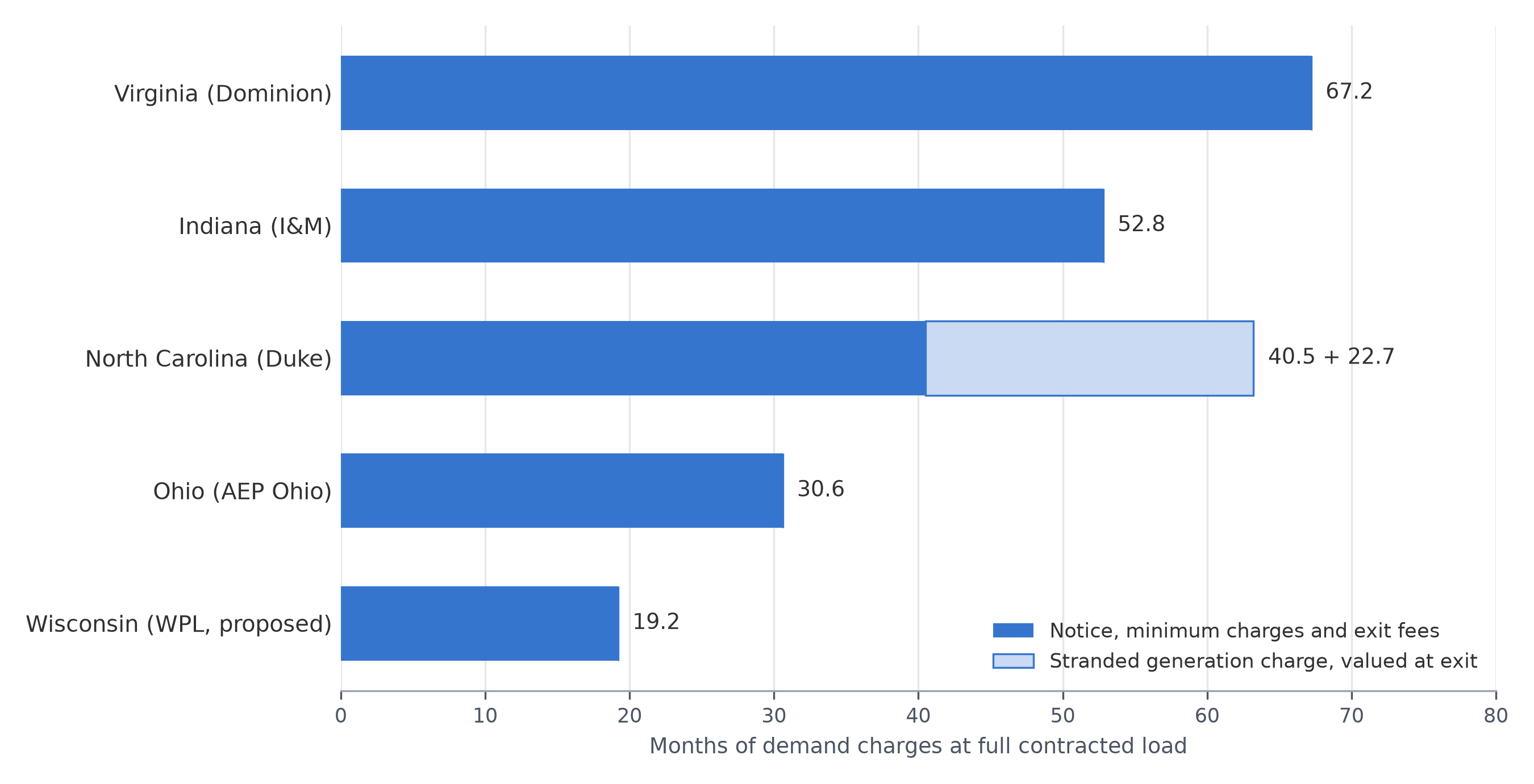
The spread runs from about 19 months under the Wisconsin proposal, before its termination charges, to 67 months in Virginia. The order of the rankings owes as much to timing as to severity. Without a ramp, Ohio's initial term is eight years, and both routes out, an exit fee or three years' notice, cost 36 months of minimum charges. Virginia charges every remaining month of a 14-year term at its minimum unless capacity is reassigned. Indiana's 42-month notice period carries most of its cost. North Carolina's liquidated damages are moderate on their own, but its stranded generation charge applies on top, worth about $136 million at the date of an exit in year nine on the same assumptions.
The Ohio figure needs a further caution. Ohio's retail market is open, and the AEP Ohio contract capacity can include either the utility's standard offer for generation or supply from a competitive retailer. What the 85 percent floor is worth in dollars therefore depends on how the customer buys its energy.4 The Ohio order has also been appealed to the Supreme Court of Ohio.15
What site selectors and lenders should price
The first item is timing. North Carolina's schedule reaches any customer energized after November 15, including those that signed agreements earlier; customers with pre-existing agreements must post security for liquidated damages by March 16, 2027 or 12 months before planned energization, whichever is earlier.12 Virginia's terms, by contrast, apply only to agreements signed on or after January 1, 2027.5 A site that looked cheaper on a term sheet in October may carry obligations that a pending or new order has since changed.
The second is collateral, which costs money while it is posted. Virginia sets $1.5 million per megawatt, or $450 million for a 300 megawatt campus, reducible by up to 70 percent for strong credit and released at one-fourteenth a year.5 Ohio requires 50 percent of total minimum charges over the term4 and Indiana 24 months of the maximum non-fuel bill.8 Both waive the requirement for customers rated at least A- and A3 that also hold liquidity above ten times it, and Indiana halves it, up to $250 million, for unrated customers that meet the liquidity test alone. Wisconsin's proposal requires three months of minimum bills in cash or letters of credit regardless of rating, plus the full exit fee.7 North Carolina requires security equal to the liquidated damages before energization, a letter of credit for the full estimated cost of transmission network upgrades within 60 days of signing, and security for the stranded generation charge.12
The third is the gap between a lease and a tariff. A hyperscale tenant may sign for a shorter period than the utility contract, and a lender looking at a campus financed on that lease should ask who carries the tail. In North Carolina the tail can extend two decades beyond the initial term.
The AIxEnergy Map sets more than 2,800 documented data center projects against the power, gas pipeline and water infrastructure around them, a first screen before the tariff question is asked of any one site. It is at map.aixenergy.io.
Questions the commissions have left open
Several issues that matter to buyers remain unsettled, and none has an obvious answer.
One is load that arrives early. A campus that energizes ahead of its schedule helps the utility recover costs sooner, yet most tariffs credit nothing for it. North Carolina's billing floor applies until billed demand first reaches the contracted amount,1 and Ohio's floor during the ramp is 85 percent of each year's ramp capacity.4 None of these orders says whether early arrival should earn anything, such as a shorter term or lower collateral.
Another is capacity shared across campuses. North Carolina aggregates commonly owned facilities to test whether the threshold is met,1 Wisconsin's proposal does the same for affiliates,7 and Indiana counts 150 megawatts across aggregated premises.8 Virginia allows totalization at contiguous locations but not aggregation at the account level for minimum demands, and lets a customer cut a further 30 percent of capacity if another customer takes it on.5 No order yet sets terms for moving a reservation between a developer's sites in the same territory, which would let one campus's delay become another's head start.
The last is flexible load. North Carolina requires interim curtailment during the ramp and one year beyond, either 95 percent of contract load for up to 50 hours a year or 50 percent for up to 100,1 and has asked stakeholders to identify alternatives.13 FERC's orders ask grid operators to consider new transmission services for flexible loads.2 Whether a customer that accepts curtailment should get easier contract terms in return is a retail question that most commissions have yet to answer. The answer will help decide whether flexibility becomes a priced product or remains a condition of connection.
Underlying data
Journal members can download the workbook behind Tables 1 and 2: terms of the six tariffs with links to the primary orders and filings, and the exit illustration with editable inputs.
Become a Journal memberNotes
- North Carolina Utilities Commission, Order Accepting Stipulations in Part, Granting Partial Rate Increase, Granting Accounting Order, and Requiring Public Notice, docket nos. E-7, Sub 1329 and E-7, Sub 1355, November 16, 2026, findings of fact 85–97 and appendix A, "Schedule DC," sections on applicability, contract period, minimum billing demand and reliability, https://www.selc.org/wp-content/uploads/2026/11/2026-Duke-Energy-Carolinas-Rate-Adjustment-Order.pdf. ↩︎
- Federal Energy Regulatory Commission, "FERC Launches Aggressive Targeted Action to Speed Large Load Integration," news release, June 18, 2026, https://www.ferc.gov/news-events/news/ferc-launches-aggressive-targeted-action-speed-large-load-integration. ↩︎
- Federal Power Act § 201(b)(1), 16 U.S.C. § 824(b)(1), https://www.law.cornell.edu/uscode/text/16/824. ↩︎
- Public Utilities Commission of Ohio, Opinion and Order, case no. 24-508-EL-ATA, July 9, 2025, as filed in Supreme Court of Ohio case no. 2025-1458, https://www.supremecourt.ohio.gov/pdf_viewer/pdf_viewer.aspx?pdf=993580.pdf&subdirectory=2025-1458%5CDocketItems. Ohio Power Company, Schedule DCT (Data Center Tariff), P.U.C.O. No. 21, original sheet nos. 223-1 to 223-8, https://ohiocapitaljournal.com/wp-content/uploads/2025/11/modified-tariff-data-centers.pdf. AEP Ohio, "Data Center Tariff," accessed November 23, 2026, https://www.aepohio.com/company/about/rates/data-center-tariff/. ↩︎
- Virginia State Corporation Commission, Final Order, case no. PUR-2025-00058, November 25, 2025, section on Rate Schedule GS-5, https://www.scc.virginia.gov/docketsearch/DOCS/89g601!.PDF. ↩︎
- Georgia Public Service Commission, "PSC Approves Rule to Allow New Power Usage Terms for Data Centers," news release, January 23, 2025, https://psc.ga.gov/site/assets/files/8617/media_advisory_data_centers_rule_1-23-2025.pdf. ↩︎
- Wisconsin Power and Light Company, Application for Approval of Large Load Power Service Tariff, Public Service Commission of Wisconsin docket no. 6680-TE-119, received September 4, 2026, https://apps.psc.wi.gov/ERF/ERFview/viewdoc.aspx?docid=609289. ↩︎
- Indiana Utility Regulatory Commission, Order of the Commission, cause no. 46097, February 19, 2025, https://www.in.gov/iurc/files/ord_46097_021925.pdf. ↩︎
- Georgia PSC, "PSC Approves Rule to Allow New Power Usage Terms." Georgia Public Service Commission, Data Center Fact Sheet, September 2026, https://psc.ga.gov/site/downloads/datacenterfactsheet_202609.pdf. ↩︎
- Georgia PSC, Data Center Fact Sheet, September 2026, entry for August 26, 2026. ↩︎
- NCUC, Order Accepting Stipulations in Part, finding of fact 96 and accompanying discussion, citing the commission's September 28, 2026 order in docket no. E-7, Sub 1357 on the Anderson combined-cycle unit. ↩︎
- NCUC, Order Accepting Stipulations in Part, appendix A, "Schedule DC," sections on stranded generation charge, security, liquidated damages and transmission network upgrades. ↩︎
- NCUC, Order Accepting Stipulations in Part, findings of fact 12 and 97. Calculations by AIxEnergy: 300 megawatts × $67,357 × 20 years ≈ $404 million; the same stream for years 16 through 35 discounted to year zero at 7.34 percent ≈ $72 million. ↩︎
- NCUC, Order Accepting Stipulations in Part, appendix A, "Schedule DC," monthly rate (demand charge of $22.28 per kilowatt for transmission-voltage service). ↩︎
- Supreme Court of Ohio, case no. 2025-1458, appeal from PUCO case no. 24-508-EL-ATA. The status of the appeal was not confirmed for this article. ↩︎
Bibliography
- AEP Ohio. "Data Center Tariff." Accessed November 23, 2026. https://www.aepohio.com/company/about/rates/data-center-tariff/.
- Federal Energy Regulatory Commission. "FERC Launches Aggressive Targeted Action to Speed Large Load Integration." News release, June 18, 2026. https://www.ferc.gov/news-events/news/ferc-launches-aggressive-targeted-action-speed-large-load-integration.
- Federal Power Act § 201, 16 U.S.C. § 824. https://www.law.cornell.edu/uscode/text/16/824.
- Georgia Public Service Commission. Data Center Fact Sheet. September 2026. https://psc.ga.gov/site/downloads/datacenterfactsheet_202609.pdf.
- Georgia Public Service Commission. "PSC Approves Rule to Allow New Power Usage Terms for Data Centers." News release, January 23, 2025. https://psc.ga.gov/site/assets/files/8617/media_advisory_data_centers_rule_1-23-2025.pdf.
- Indiana Utility Regulatory Commission. Order of the Commission. Cause no. 46097. February 19, 2025. https://www.in.gov/iurc/files/ord_46097_021925.pdf.
- North Carolina Utilities Commission. Order Accepting Stipulations in Part, Granting Partial Rate Increase, Granting Accounting Order, and Requiring Public Notice. Docket nos. E-7, Sub 1329 and E-7, Sub 1355. November 16, 2026. https://www.selc.org/wp-content/uploads/2026/11/2026-Duke-Energy-Carolinas-Rate-Adjustment-Order.pdf.
- Ohio Power Company. Schedule DCT (Data Center Tariff). P.U.C.O. No. 21, original sheet nos. 223-1 to 223-8. Filed pursuant to order of July 9, 2025, case no. 24-508-EL-ATA. https://ohiocapitaljournal.com/wp-content/uploads/2025/11/modified-tariff-data-centers.pdf.
- Public Service Commission of Wisconsin. "PSC Overhauls We Energies’ Data Center Tariff, Makes Improvements to Protect Existing Customers." News release, April 24, 2026. https://psc.wi.gov/Documents/PressReleases/04.24.2026PressRelease.PDF.
- Public Utilities Commission of Ohio. Opinion and Order. Case no. 24-508-EL-ATA. July 9, 2025. Filed in Supreme Court of Ohio case no. 2025-1458. https://www.supremecourt.ohio.gov/pdf_viewer/pdf_viewer.aspx?pdf=993580.pdf&subdirectory=2025-1458%5CDocketItems.
- Virginia State Corporation Commission. Final Order. Case no. PUR-2025-00058. November 25, 2025. https://www.scc.virginia.gov/docketsearch/DOCS/89g601!.PDF.
- Wisconsin Electric Power Company. "Final Tariff Filing, Amendment No. 814." Letter to the Public Service Commission of Wisconsin, docket no. 6630-TE-113. September 28, 2026. https://apps.psc.wi.gov/ERF/ERFview/viewdoc.aspx?docid=613335.
- Wisconsin Power and Light Company. Application for Approval of Large Load Power Service Tariff. Public Service Commission of Wisconsin docket no. 6680-TE-119. Received September 4, 2026. https://apps.psc.wi.gov/ERF/ERFview/viewdoc.aspx?docid=609289.