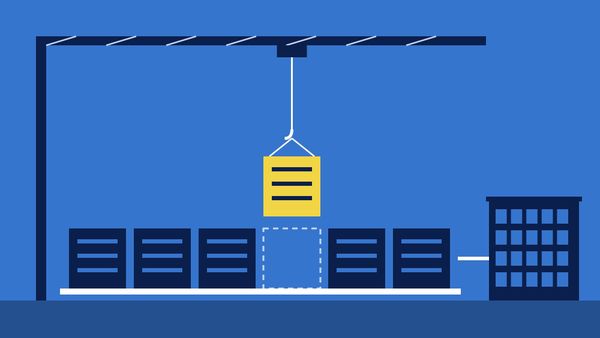
- Black Hills Energy will serve Google's planned Cheyenne data center from a 2.7-gigawatt resource mix: 564 megawatts of new gas generation owned by a Black Hills affiliate, 26 megawatts of market and tariff power, and about 2.1 gigawatts of third-party plants that the utility will manage through a private microgrid.
- The utility earns a return on its plant and a management fee for the microgrid, with contracts running to 2048 and terms intended to keep Google's costs off other customers' bills.
- The model sits between a utility that owns everything and a customer that builds its own power, as Anthropic's reported $3.4 billion purchase of generators and New Mexico's proposed 2.46-gigawatt fuel cell microgrid show.
- Emergency dispatch, resource adequacy counting and carbon capture rates are not yet public, and they are the questions regulators elsewhere will need answered before copying Cheyenne.
Microsoft's data center in Cheyenne keeps backup generators on site, as almost every large data center does, in case the grid fails. For most of their lives such machines sit idle. Black Hills Energy, the local utility, saw an asset where others saw insurance. Rather than build a power plant to serve Microsoft's growing load, it negotiated the right to call on those backup units when demand on its own system peaked. In exchange it bought wholesale power, including renewable energy, on Microsoft's behalf at a negotiated price. Wyoming's regulators turned the arrangement into a tariff, the Large Power Contract Service, open to any Black Hills customer in the state with more than 13 megawatts of load and its own dispatchable generation.1
That modest bargain over spare engines has become the legal frame for one of the more unusual power arrangements yet signed for an American data center. On October 6 Black Hills Corp. announced agreements, effective September 30 and running to 2048, to serve a planned Google campus in Cheyenne.2 A month later Google put the price of its first Wyoming data center at $17 billion.3 The utility will build gas-fired generation for the site and sell it some market power. It will also coordinate the output of about 2.1 gigawatts of generators that it does not own, through what it calls a privately managed microgrid, and collect a fee for doing so.
For the past two years the argument over powering AI has often been framed as a choice between the grid and going it alone. A hyperscaler could wait for the local utility to build, or it could put turbines behind its own fence and take its chances. Cheyenne suggests a third path, in which the utility neither owns nor ignores most of the supply. Whether it is a model for other states depends on questions the announcements leave open. The most important concern who keeps the lights on in an emergency and which megawatts count toward reliability. The carbon accounting is unsettled too.
Three ways to own a megawatt
The first model is the familiar one. A regulated utility builds or buys generation and recovers the cost through tariffs, with a commission deciding what is prudent. What has changed is how much of the risk the newest tariffs push onto the large customer. Xcel Energy's proposed large-load tariff in Colorado, filed in April, would apply to new loads of 50 megawatts or more and require contracts of 15 years or longer, minimum monthly payments and exit fees that recover the remaining cost of project-specific upgrades.4 The Tennessee Valley Authority, a federal utility outside the West, began applying a new tariff for data centers above 5 megawatts on October 1. One unnamed customer has agreed to pay it about $1.7 billion, with capacity commitment charges based on roughly $1.5 million per megawatt of requested capacity above 5 megawatts.5 In both cases the utility still owns the plant. The customer's contract is what keeps other ratepayers from holding the bill if the load never arrives.
The third model sits at the other extreme. The customer, or a developer working for it, owns the generation outright and the utility, if it is involved at all, supplies backup or a modest grid connection. In southern New Mexico a developer called Yucca Growth Infrastructure has asked for an air permit for a microgrid of Bloom Energy fuel cells with 2,462 megawatts of nameplate capacity to serve Project Jupiter, a data center development that the state's attorney general describes as anchored by Oracle. The developer has offered an enforceable cap of 1,600 megawatts on operation.6 The permit is contested, and the attorney general has backed emergency petitions challenging how state agencies handled it.7 At this extreme the customer gains control over timing and design and takes on the risk of an asset built around a single load.
Cheyenne is the middle case. Table 1 sets the three side by side.
Table 1
Three ways to supply a data center
| Utility-owned | Utility-managed private microgrid | Customer-owned onsite power | |
|---|---|---|---|
| Western example | Xcel Energy's proposed large-load tariff, Colorado | Black Hills Energy and Google, Cheyenne, Wyoming | Project Jupiter fuel cell microgrid, New Mexico (proposed) |
| Who owns the generation | Regulated utility | Utility affiliate for 564 MW; third parties for about 2.1 GW | Customer or its developer |
| Who carries stranded-asset risk | Large customer through minimum bills, long terms and exit fees; other ratepayers if those fail | Customer, through full cost recovery over the contract term to 2048 | Customer and its developer |
| Who dispatches | Utility or regional grid operator | Utility manages the private microgrid; emergency protocols not public | Customer or its operator; utility only at the point of connection |
| How emissions are judged | Utility resource plan and state targets | Contract terms and air permits; capture rates not yet disclosed | Air permit for the plant |
| What the utility earns | Return on rate base | Return on its plant plus a microgrid management fee | Little or nothing beyond any grid service |
Xcel's tariff was pending before the Colorado Public Utilities Commission at the time of writing, and the New Mexico air permit was contested. Sources: company filings and announcements, state notices and permit filings cited in notes 2, 4, 6, 8 and 9.
Inside the Cheyenne arrangement
The numbers come from Black Hills' filings with the Securities and Exchange Commission. The project is to be served by a resource mix of 2.7 gigawatts, a figure that includes reserve margins. Service is due to begin in late 2027 and reach peak load by the end of 2030. The peak itself, and the pace of the ramp, are confidential.8
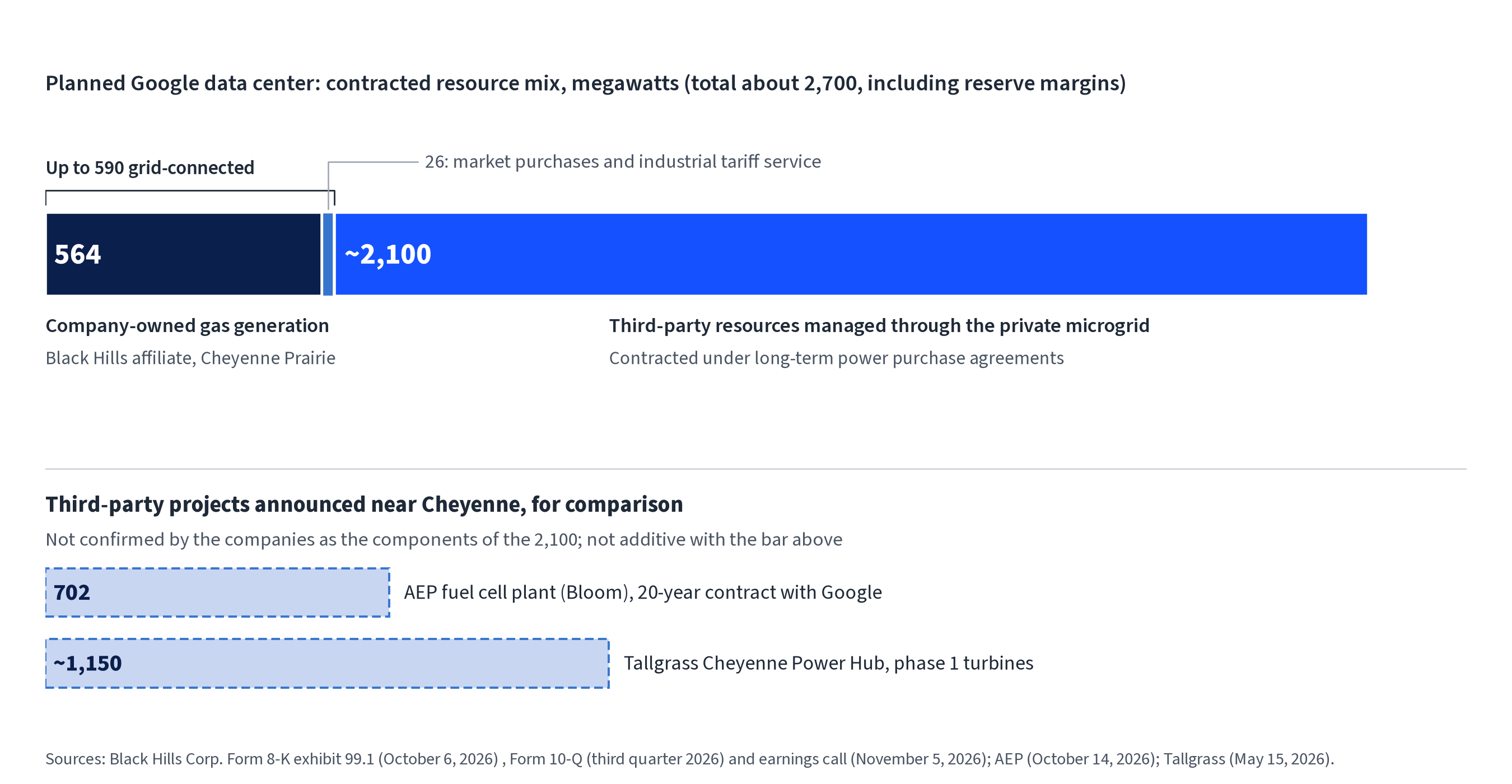
Of the 2.7 gigawatts, up to 590 megawatts is what Black Hills calls grid-connected service. To supply most of it, the company plans to spend $1.8 billion between 2027 and 2029 on 564 megawatts of nameplate gas-fired capacity at its existing Cheyenne Prairie Generating Station. The plant will be owned by a non-regulated affiliate, not by the utility, and sold to the utility under a power purchase agreement; on its November earnings call the company said the investment would earn a "risk-adjusted utility-like return" billed directly to Google rather than to other customers.9 The remaining 26 megawatts are to come from market purchases and the utility's ordinary industrial tariff. The state siting application, filed by Black Hills Electric Generation, describes three simple-cycle combustion turbines and 24 reciprocating engines adding 552 megawatts, taking the station from 140 to 692 megawatts.10 The company's own figure is 564 megawatts of nameplate capacity. Neither document explains the 12-megawatt difference, which may reflect different rating conventions.
The other 2.1 gigawatts belong to third parties. Black Hills describes them as Wyoming-based, co-located resources contracted through long-term power purchase agreements with the regulated utility and Google, interconnected through the private microgrid that the utility will manage.9 Google has named some of its suppliers. American Electric Power plans to invest about $4 billion in a 702-megawatt plant of Bloom fuel cells near Cheyenne, owned about 92 percent by AEP, selling to Google under a 20-year contract and due to be fully operating by the end of 2028.11 Google also says it is buying power from gas generators operated by Tallgrass Energy and by Black Hills.3 Tallgrass has said that the first phase of its Cheyenne Power Hub, about 1,150 megawatts from two Mitsubishi turbines, will supply dedicated power to a large data center in the Switchgrass Industrial Park.12 Neither Black Hills nor AEP has said publicly which projects make up the 2.1 gigawatts, so the figures in Figure 1 should not be added together as if they were one inventory.
What Black Hills earns from the microgrid is a management fee. The company describes it as a negotiated rate tied to a contracted minimum peak load, starting in late 2027 and rising on a fixed schedule.2 Together with the return on the gas plant, the company expects the project to contribute about $150 million of net income in 2030 and roughly $2.4 billion of unlevered free cash flow through 2048, after the $1.8 billion of capital spending.2 Its executives told analysts that the important terms are contracted rather than dependent on how much power Google actually uses.9 Google has also advanced $398.8 million, refundable by June 30, 2027, to reserve long-lead equipment.8
The structure is designed to keep Google's costs away from the utility's other 1.37 million gas and electric customers in eight states. The agreements provide for cost pass-throughs, full recovery of the generation investment over the contract term, early-termination protection and collateral requirements.2 Readers of the AIxEnergy analysis of what a data center owes when it leaves will recognize the menu. The difference in Cheyenne is that most of the supply never enters a rate base at all.
Why buyers are buying machines
The appeal of the middle model owes much to equipment shortages. A utility that wants to build large gas turbines joins a queue at the factory, then another at the transmission planner. In September Anthropic bought commitments for 1.7 gigawatts of heavy-duty gas generators from OnePWR Solutions, a Texas equipment supplier, in a deal worth about $3.4 billion, according to the Financial Times, as reported by CNBC.13 Data Center Dynamics, also citing the FT, reported that the deal took over orders for Caterpillar generator sets that OnePWR had placed two years earlier and needed financing to complete, and that the units are expected within the next two years.14 Anthropic has not said where they will run. For a buyer of this size, owning generators is no longer only a matter of backup.
Fuel cells answer a related problem. They are assembled from small modules, so capacity can be added in steps rather than in single machines of several hundred megawatts. AEP says Bloom's technology "can be deployed rapidly."11 The New Mexico project illustrates the scale this implies. The state's attorney general counts 2,275 fuel cells generating 2.46 gigawatts, "an unprecedented concentration of this technology anywhere in the world."7 A modular design changes what a regulator has to review. A conventional plant concentrates its exhaust in a few large stacks, while a fleet of fuel cells spreads it across many small ones, and opponents of the New Mexico permit have argued over how such a fleet should be monitored.6
Speed is the shared argument. The AIxEnergy analysis of gas turbines serving data centers found that fleets built to run a small share of the year become different assets when asked to serve a campus that runs almost every hour. The same holds for fuel cells and reciprocating engines. Customer-owned power can arrive sooner, but its owner carries the operating risk that a utility would otherwise spread across a system.
Who answers in an emergency
In a conventional arrangement the answer to "who keeps the lights on?" is written into reliability standards. A balancing authority matches supply and demand in its area and can order generators up or load down when the system is stressed. Black Hills told South Dakota regulators in February that, once the federal power agency that had provided its balancing services joined the Southwest Power Pool's market in April, Black Hills Power would run its own balancing authority. Its customers include Cheyenne Light, Fuel and Power, the Black Hills utility in Cheyenne. For real-time trading the company chose the Western Energy Imbalance Market, run by California's grid operator.15 Neither Black Hills nor Google has published how dispatch inside the private microgrid will interact with that authority during an emergency. Black Hills says its fee covers "coordinating grid operations, reliability services, and energy dispatch."2
Precedence is the obvious question. If Wyoming's system runs short on a cold night, can the utility call on microgrid resources contracted to Google, as it once arranged to call on Microsoft's backup units? Counting is the subtler one. A planner needs to know whether megawatts sold to one customer under a private contract also appear in the utility's resource adequacy calculations for everyone else.
Failure raises the stakes. If a large third-party plant trips, someone has to cover the shortfall, whether from reserves inside the microgrid or from the utility's wider system, unless the data center itself is curtailed. The contracts decide which, and they are not public.
These are not abstract concerns for a utility of this size. The Google project's 2.7-gigawatt resource mix is almost 20 times the 140-megawatt capacity of the Cheyenne Prairie station today. The rules are partly before the Wyoming Public Service Commission now. In docket 20003-273-EM-26 the utility has asked to create a transmission cost mechanism for large customers and to amend the Large Power Contract Service tariff itself; Google and Microsoft are among the parties.16 The filings in that case are the place to look for how the tariff's obligations will scale.
Counting the carbon
Google describes its Wyoming supply as using fuel cells and carbon capture to minimize emissions and water use, and says the capture equipment will permanently store "a large majority" of the fuel cell plant's carbon emissions at Tallgrass's Eastern Wyoming Sequestration Hub.3 AEP calls the goal "near-zero-emissions power."11 Neither company has published a guaranteed capture rate. Data Center Frontier noted in November that AEP had not named the capture equipment supplier or detailed how the carbon dioxide would be moved and stored.17 For the Tallgrass turbines, Google has committed to a front-end engineering and design study of capture, which is a step short of a commitment to install it.3
There is, however, a reporting system that can test these claims. The Environmental Protection Agency approved a monitoring, reporting and verification plan for the Eastern Wyoming Sequestration Hub in 2025 under subpart RR of its Greenhouse Gas Reporting Program. The hub is designed to store 116.8 million metric tons of carbon dioxide, and subpart RR requires operators to report the quantities injected and stored each year.18 What subpart RR cannot show is how much carbon was captured relative to how much was produced, or how much methane leaked upstream of the fuel cells. A commission or a buyer that wants to verify an emissions claim would need the capture rate written into a contract and reported against the plant's measured output. Upstream methane would need its own accounting.
Colorado's debate shows where this is heading. The Colorado Energy Office has proposed that Xcel's custom contracts for large loads be barred from relying on gas generation without a zero-emissions pathway such as carbon capture, and Xcel has said that a scenario relying mainly on new gas would be "extremely unlikely."19 Wyoming has no equivalent emissions target, but buyers with their own climate commitments will face the same scrutiny from customers and investors.
Before copying Cheyenne
Other utilities are already watching. Black Hills told analysts that its Wyoming pipeline includes about 600 megawatts of data center load in its current plan, largely Microsoft and a Meta data center due to begin service in early 2027, a further 600 megawatts in negotiation and at least 2.5 gigawatts of earlier-stage interest.9 Colorado's proposed tariff contains a "speed to market" pathway, renamed "custom contracts," under which Xcel and a developer could negotiate terms for commission review within 120 days. The state's consumer advocate has warned that so short a review, with much of the detail confidential, would limit outside scrutiny.19
For a commission weighing a Cheyenne-style arrangement, the threshold question is who holds the obligation to serve. Black Hills has framed the microgrid as preserving its "right and obligation to serve" as the franchise utility.9 That claim is worth testing against two cases: a third-party supplier that fails, and a hyperscaler that leaves before 2048.
The management fee deserves the same scrutiny. A fee tied to a contracted minimum load protects shareholders if the campus is smaller than planned; it says less about who pays if third-party plants run short. Resource adequacy rules may also need to catch up. Private supply that sits outside the utility's plan can relieve pressure on everyone else, or it can conceal a dependence that shows up only during a heat wave or a cold snap.
For utilities, the attraction is clear enough. The model lets a company earn on a smaller balance sheet and leave much of the construction risk with partners such as AEP and Tallgrass. The AIxEnergy analysis of hyperscalers buying power like utilities argued that technology companies are absorbing risks once held by utilities. Cheyenne shows the reverse movement as well, with a utility taking a fee for coordination rather than owning the plant.
Wyoming's tariff began as a way for a utility to borrow a customer's spare generators at times of peak demand. The same tariff is now being amended while the utility prepares to coordinate gigawatts of other companies' generation for a single customer. Whether other states follow will depend less on the size of the deal than on the details that the Wyoming commission and the parties settle in the dockets now open. The locations of the projects discussed here, and the transmission lines that connect them, can be explored on the AIxEnergy Map.
Notes
- Black Hills Energy, "Energy Solutions for Data Centers," May 2020, https://datacenters.blackhillsenergy.com/resources/energy-solutions-data-centers. The tariff is described there as open to Wyoming retail customers with more than 13 megawatts of load and as requiring customer-owned, behind-the-meter dispatchable generation; amendments are pending (note 16).
- Black Hills Corp., "Black Hills Corp. Executes Definitive Agreements to Serve Google's Planned Data Center in Cheyenne, Wyoming," exhibit 99.1 to Form 8-K, October 6, 2026, https://www.sec.gov/Archives/edgar/data/1130464/000119312526415597/bkh-ex99_1.htm.
- Steve Walter, "Investing in Wyoming's Infrastructure, Energy and Workforce," Google (blog), November 5, 2026, https://blog.google/innovation-and-ai/infrastructure-and-cloud/global-network/wyoming-data-center/.
- Xcel Energy, "Xcel Energy Proposal Protects Customers from Higher Bills as Data Center Demand Grows," news release, April 2, 2026, https://newsroom.xcelenergy.com/news/xcel-energy-proposal-protects-customers-from-higher-bills-as-data-center-demand-grows.
- Utility Dive, "TVA Announces $1.7B Data Center Deal under New Large Load Tariff," November 24, 2026, https://www.utilitydive.com/news/tva-announces-17b-data-center-deal-under-new-large-load-tariff/875630/, quoting TVA's November 12, 2026, filing with the Securities and Exchange Commission.
- Yucca Growth Infrastructure, response to New Energy Economy's motion to dismiss, New Mexico Environment Department, No. AQB 26-57 (Air Quality Permit Application No. 10883), October 19, 2026, https://www.env.nm.gov/opf/wp-content/uploads/sites/13/2026/07/2026-10-19-AQB-26-57-YGI-Resp-to-NEE-2026-10-14-MTD-App-w-Exs-filed-1.pdf. The response describes a maximum nameplate capacity of 2,462 megawatts, a proposed enforceable cap of 1,600 megawatts and Bloom Energy as operator.
- New Mexico Department of Justice, "Attorney General Raúl Torrez Files Responses Backing Emergency Petitions Challenging Project Jupiter Permitting Decisions," news release, September 3, 2026, https://nmdoj.gov/press-release/attorney-general-raul-torrez-files-responses-backing-emergency-petitions-challenging-project-jupiter-permitting-decisions/.
- Black Hills Corp., Form 10-Q for the Quarterly Period Ended September 30, 2026, "Google Data Center Agreements," https://www.sec.gov/Archives/edgar/data/1130464/000119312526449130/bkh-20260930.htm. The amended generation reservation agreement raised permitted refundable advances to $398.8 million and extended repayment to June 30, 2027.
- Black Hills Corp., third-quarter 2026 earnings call, November 5, 2026, transcript, The Motley Fool, https://www.fool.com/earnings/call-transcripts/2026/11/05/black-hills-bkh-q3-2026-earnings-call-transcript/. See also Black Hills Corp., third-quarter 2026 results, exhibit 99 to Form 8-K, November 4, 2026, https://www.sec.gov/Archives/edgar/data/1130464/000119312526447656/bkh-ex99.htm.
- Wyoming Department of Environmental Quality, "Courtesy Public Notice of Request for a Permit, Hearing Filing Information and Notice to Participate in Industrial Siting Permit Proceedings before the Wyoming Industrial Siting Council; Cheyenne Prairie Generating Station Expansion Project; DEQ/ISC 25-05," July 14, 2026, https://content.govdelivery.com/accounts/WYDEQ/bulletins/4208f2f.
- American Electric Power, "AEP Advances Innovative Energy Solution for Google with 702MW of Bloom Fuel Cells," news release, October 14, 2026, https://www.aep.com/news/stories/view/12314/.
- Tallgrass, "Tallgrass and Mitsubishi Power Americas Announce Turbine Allocation for Cheyenne Power Hub," news release, May 15, 2026, https://tallgrass.com/newsroom/press-releases/tallgrass-and-mitsubishi-power-americas-announce-turbine-allocation-for-cheyenne-power-hub-051526.
- Reuters, "Anthropic Secures $3.4 Billion Generator Deal for AI Data Centers, FT Reports," CNBC, November 8, 2026, https://www.cnbc.com/2026/11/08/anthropic-generator-deal-ai-data-centers.html. Neither Anthropic nor OnePWR commented.
- Sebastian Moss, "Anthropic Signs $3.4bn Gas Generator Deal to Support 1.7GW of Data Center Power," Data Center Dynamics, November 9, 2026, https://www.datacenterdynamics.com/en/news/anthropic-signs-34bn-gas-generator-deal-to-support-17gw-of-data-center-power/.
- Eric M. Egge, direct testimony on behalf of Black Hills Power, Inc., South Dakota Public Utilities Commission, Docket No. EL26-003, February 19, 2026, 3–6, https://puc.sd.gov/commission/dockets/electric/2026/EL26-003/Vol2Section6/EEgge.pdf.
- Wyoming Public Service Commission, public notice, July 7, 2026, Docket No. 20003-273-EM-26 (Record No. 18157), https://psc.wyo.gov/home/public-notices. Intervention orders for Google and Microsoft were issued August 27, 2026.
- David Chernicoff, "AEP, Google Advance $4 Billion Fuel-Cell Project to Power Cheyenne Data Centers," Data Center Frontier, November 4, 2026, https://www.datacenterfrontier.com/energy/article/55413102/aep-google-advance-4-billion-fuel-cell-project-to-power-cheyenne-data-centers.
- U.S. Environmental Protection Agency, "Greenhouse Gas Reporting Program Decision: Subpart RR Monitoring, Reporting, and Verification Plan for the Eastern Wyoming Sequestration Hub," October 2025, https://www.epa.gov/system/files/documents/2025-10/ewsh_decision.pdf.
- Mark Jaffe, "Colorado Utility Regulators to Decide Whether Xcel's Data Center Tariff Proposal Protects Customers," Colorado Sun, October 21, 2026, https://coloradosun.com/2026/10/21/xcel-data-centers-energy-colorado-puc/.
Bibliography
- American Electric Power. "AEP Advances Innovative Energy Solution for Google with 702MW of Bloom Fuel Cells." News release, October 14, 2026. https://www.aep.com/news/stories/view/12314/.
- Black Hills Corp. "Black Hills Corp. Executes Definitive Agreements to Serve Google's Planned Data Center in Cheyenne, Wyoming." Exhibit 99.1 to Form 8-K, October 6, 2026. https://www.sec.gov/Archives/edgar/data/1130464/000119312526415597/bkh-ex99_1.htm.
- Black Hills Corp. Form 10-Q for the Quarterly Period Ended September 30, 2026. https://www.sec.gov/Archives/edgar/data/1130464/000119312526449130/bkh-20260930.htm.
- Black Hills Corp. Third-quarter 2026 earnings call. November 5, 2026. Transcript, The Motley Fool. https://www.fool.com/earnings/call-transcripts/2026/11/05/black-hills-bkh-q3-2026-earnings-call-transcript/.
- Black Hills Corp. Third-quarter 2026 results. Exhibit 99 to Form 8-K, November 4, 2026. https://www.sec.gov/Archives/edgar/data/1130464/000119312526447656/bkh-ex99.htm.
- Black Hills Energy. "Energy Solutions for Data Centers." May 2020. https://datacenters.blackhillsenergy.com/resources/energy-solutions-data-centers.
- Chernicoff, David. "AEP, Google Advance $4 Billion Fuel-Cell Project to Power Cheyenne Data Centers." Data Center Frontier, November 4, 2026. https://www.datacenterfrontier.com/energy/article/55413102/aep-google-advance-4-billion-fuel-cell-project-to-power-cheyenne-data-centers.
- Egge, Eric M. Direct testimony on behalf of Black Hills Power, Inc. South Dakota Public Utilities Commission, Docket No. EL26-003, February 19, 2026. https://puc.sd.gov/commission/dockets/electric/2026/EL26-003/Vol2Section6/EEgge.pdf.
- Jaffe, Mark. "Colorado Utility Regulators to Decide Whether Xcel's Data Center Tariff Proposal Protects Customers." Colorado Sun, October 21, 2026. https://coloradosun.com/2026/10/21/xcel-data-centers-energy-colorado-puc/.
- Moss, Sebastian. "Anthropic Signs $3.4bn Gas Generator Deal to Support 1.7GW of Data Center Power." Data Center Dynamics, November 9, 2026. https://www.datacenterdynamics.com/en/news/anthropic-signs-34bn-gas-generator-deal-to-support-17gw-of-data-center-power/.
- New Mexico Department of Justice. "Attorney General Raúl Torrez Files Responses Backing Emergency Petitions Challenging Project Jupiter Permitting Decisions." News release, September 3, 2026. https://nmdoj.gov/press-release/attorney-general-raul-torrez-files-responses-backing-emergency-petitions-challenging-project-jupiter-permitting-decisions/.
- Reuters. "Anthropic Secures $3.4 Billion Generator Deal for AI Data Centers, FT Reports." CNBC, November 8, 2026. https://www.cnbc.com/2026/11/08/anthropic-generator-deal-ai-data-centers.html.
- Tallgrass. "Tallgrass and Mitsubishi Power Americas Announce Turbine Allocation for Cheyenne Power Hub." News release, May 15, 2026. https://tallgrass.com/newsroom/press-releases/tallgrass-and-mitsubishi-power-americas-announce-turbine-allocation-for-cheyenne-power-hub-051526.
- U.S. Environmental Protection Agency. "Greenhouse Gas Reporting Program Decision: Subpart RR Monitoring, Reporting, and Verification Plan for the Eastern Wyoming Sequestration Hub." October 2025. https://www.epa.gov/system/files/documents/2025-10/ewsh_decision.pdf.
- Utility Dive. "TVA Announces $1.7B Data Center Deal under New Large Load Tariff." November 24, 2026. https://www.utilitydive.com/news/tva-announces-17b-data-center-deal-under-new-large-load-tariff/875630/.
- Walter, Steve. "Investing in Wyoming's Infrastructure, Energy and Workforce." Google (blog), November 5, 2026. https://blog.google/innovation-and-ai/infrastructure-and-cloud/global-network/wyoming-data-center/.
- Wyoming Department of Environmental Quality. "Courtesy Public Notice of Request for a Permit . . . Cheyenne Prairie Generating Station Expansion Project; DEQ/ISC 25-05." July 14, 2026. https://content.govdelivery.com/accounts/WYDEQ/bulletins/4208f2f.
- Wyoming Public Service Commission. Public notice, Docket No. 20003-273-EM-26 (Record No. 18157). July 7, 2026. https://psc.wyo.gov/home/public-notices.
- Xcel Energy. "Xcel Energy Proposal Protects Customers from Higher Bills as Data Center Demand Grows." News release, April 2, 2026. https://newsroom.xcelenergy.com/news/xcel-energy-proposal-protects-customers-from-higher-bills-as-data-center-demand-grows.
- Yucca Growth Infrastructure. Response to New Energy Economy's motion to dismiss. New Mexico Environment Department, No. AQB 26-57, October 19, 2026. https://www.env.nm.gov/opf/wp-content/uploads/sites/13/2026/07/2026-10-19-AQB-26-57-YGI-Resp-to-NEE-2026-10-14-MTD-App-w-Exs-filed-1.pdf.