This analysis complements the Payne Institute’s discussion of data center development on sovereign Tribal lands, available here: https://payneinstitute.mines.edu/the-future-of-ai-runs-through-indian-country/
In AI infrastructure, a gigawatt can describe several very different things: a long-range development target, capacity covered by a commercial agreement, a financed project phase, a facility under construction, or an operating electrical load. Those states are not interchangeable.
That distinction has become central to the federal government's experiment with using public land for AI data centers. Since April 2025, the Department of Energy and the military services have opened federal energy sites and military installations to private data center development. The policy theory is straightforward. The federal government already controls large parcels of land, some near substantial energy infrastructure, and it can coordinate federal review in ways that a private developer assembling a conventional site cannot. But land control is only the beginning of the development chain.
Most of the federal projects remain in solicitation, proposal evaluation, conditional selection, or lease negotiation. Portsmouth, Ohio, has advanced further in public view, but even there the distinction between a 10-gigawatt full-buildout plan and the first project phase matters. The real test of the federal-land strategy is therefore not how many nominal gigawatts can be attached to federal parcels. It is whether those parcels can move from announcement to firm power, environmental clearance, financing, construction, commissioning, and operation faster than comparable projects elsewhere.
DOE Opened a Large Pipeline. Most of It Is Still a Pipeline.
The Department of Energy began the current federal-land push on April 3, 2025, when it identified 16 potential sites for data center and energy infrastructure development. DOE said the sites offered advantages that could include existing energy infrastructure and opportunities to accelerate permitting for new generation. The agency set a target of commencing operations at selected sites by the end of 2027. That was a program goal attached to a request for information, not a finding that the 16 sites were uniformly shovel-ready.
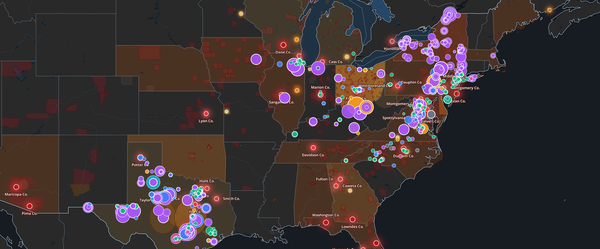
AIxEnergy Project Tracker
Federal AI infrastructure remains mostly a development pipeline
Portsmouth is the most advanced visible federal-land project. Most other sites remain in solicitation, selection or lease negotiation.
| Project | Scale | Status | Commercial model | Next proof point |
|---|---|---|---|---|
| Portsmouth AI campus DOE · Ohio · SoftBank and SB Energy | 10 GW 800 MW initial phase reported | Early development Groundbreaking completed | Private data center, generation and transmission investment | First-phase financing, transmission construction and commissioned load |
| DOE solicitation portfolio Idaho, Oak Ridge, Paducah and Savannah River | Not disclosed | Solicitation | Privately funded development on DOE land | Developer selection, executed agreements and firm power arrangements |
| Initial Air Force portfolio Five installations across TN, AZ, CA, NJ and GA | >100 MW each Minimum qualifying size | Closed solicitation No public award identified | Commercial leasing with monetary consideration | Developer awards, executed leases and site-level power plans |
| Alaska Air Force portfolio JBER, Eielson and Clear Space Force Station | 4,700 acres Capacity not disclosed | Solicitation | Enhanced-use leasing at fair-market value | Developer selection, generation plan and interconnection approval |
| Fort Bliss US Army · Texas · Carlyle | 2.5–3 GW Secondary reporting | Conditional selection | Developer-financed facility with cash, in-kind or compute consideration | Final lease, environmental review, firm power and financing |
| Dugway Proving Ground US Army · Utah · CyrusOne | ~1 GW Secondary reporting | Conditional selection | Developer-financed facility with potential government compute access | Final lease, environmental clearance, power and financing |
| AI Arsenal Separate Defense Department compute program | $29.5B FY2027 request | Budget request | Proposed federal investment in data centers, GPUs and supercomputers | Appropriation, acquisition plan, site selection and contract awards |
| Stargate Private-sector comparator · OpenAI and partners | >10 GW secured $500B initial investment intention | Mixed portfolio | Private corporate and infrastructure investment | Site-level disclosure of construction, commissioning and operating load |
In July 2025, DOE selected four locations for the next phase: Idaho National Laboratory, the Oak Ridge Reservation in Tennessee, the Paducah Gaseous Diffusion Plant site in Kentucky, and the Savannah River Site in South Carolina. DOE then issued site-specific solicitations between September and November 2025. The public documents describe prospective, privately funded developments and, in the cases of Oak Ridge and Paducah, expressly place responsibility for utility interconnection agreements, regulatory requirements, and permitting plans on applicants.
Portsmouth is the important exception to the otherwise early-stage DOE portfolio. In March 2026, DOE announced an arrangement under which SoftBank Group and SB Energy plan a 10-gigawatt data center development supported by 10 gigawatts of new generation, including at least 9.2 gigawatts of natural gas generation. The announcement also included a planned $4.2 billion transmission program involving SB Energy and AEP Ohio, $33.3 billion in announced Japanese funding for the 9.2-gigawatt gas-generation component, and a $40 million Community Benefits Agreement.
Officials held a groundbreaking ceremony at the site on March 20. DOE's March 24 account said development of the data center was expected to begin during 2026 with an initial phase on 189 acres. Local public-media reporting described that first phase as an 800-megawatt data center expected, according to a DOE official's estimate, to come online in about two years. The 10 GW number is therefore best understood as the campus's full-buildout plan, not the amount of capacity now operating or a measure of the first construction phase.
This makes Portsmouth more important as a test. Its progress can now be measured against concrete development milestones: cleanup and site preparation, power-project financing, transmission construction, the first 800-megawatt phase, commissioning, and actual load.
Military Land Is Following More Than One Business Model
The Department of the Air Force has pursued a largely commercial real-estate model. In October 2025, it issued a request for lease proposals covering AI data center development at Arnold Air Force Base in Tennessee, Davis-Monthan Air Force Base in Arizona, Edwards Air Force Base in California, Joint Base McGuire-Dix-Lakehurst in New Jersey, and Robins Air Force Base in Georgia. The solicitation required qualifying projects to exceed 100 megawatts of new load and involve at least $500 million in capital expenditures; the Department of the Air Force sought monetary lease consideration from selected developers. The opportunity is now marked closed on the service's partnership page, but that page does not identify a project award.
The Air Force subsequently expanded the concept to Alaska. After a February request for information, it issued a formal request for lease proposals on April 10, 2026, for approximately 4,700 acres across Joint Base Elmendorf-Richardson, Eielson Air Force Base, and Clear Space Force Station. The announced model is again commercial development through enhanced-use leasing, with the service receiving at least fair-market-value cash consideration.
The Alaska opportunity should not be conflated with separate military microreactor initiatives. The data center solicitation itself is an opportunity to develop facilities with associated utility infrastructure and generation; the official materials reviewed for this article do not establish that nuclear microreactors have been selected as the power source for the proposed data centers.
The Army's emerging model is different. On March 26, 2026, the Army conditionally selected Carlyle for a proposed development on about 1,384 acres at Fort Bliss, Texas, and CyrusOne for a project on approximately 1,201 acres at Dugway Proving Ground, Utah. The developers are to finance, build, operate, maintain, and eventually decommission the facilities. But the agreements are not final. The Army said the selections begin an exclusive negotiation period for leases and other terms.
The Army projects initial operating capability at Fort Bliss in fiscal 2027 and at Dugway in fiscal 2029. Those are schedules, not completed outcomes. The US Army Corps of Engineers is involved in lease negotiations, technical work, and environmental review. The arrangement is being pursued under 10 USC § 2667, which authorizes leases of qualifying non-excess military property and generally requires consideration of at least fair-market value, which may be paid in cash or in kind.
Secondary reporting has described the Fort Bliss plan as a 2.5- to 3 GW development and the Dugway project as approximately 1 gigawatt. Those figures are useful indications of developer ambition, but they should not be treated as final leased or operating capacity while commercial terms remain under negotiation. Reporting also indicates that the Army expects to receive access to a portion of the resulting compute capacity, making the concept more than a conventional cash-rent real-estate transaction.
The Pentagon's Own Compute Program Is a Separate Transaction
The military leasing initiatives also need to be separated from the Pentagon's proposed AI Arsenal spending. The fiscal year 2027 budget justification includes a $29.5 billion mandatory funding request under “Next Generation Technology and Autonomy.” The justification says the funding would support the AI Arsenal initiative, moving from scattered graphics-processing-unit clusters toward a coordinated portfolio that includes hardened, sensitive compartmented information facility-accredited data centers at multiple sites and the procurement and installation of GPUs and AI supercomputers. This is a budget request, not an enacted appropriation.
That program is conceptually different from opening federal land to commercial developers. One is a proposed government compute and data-center portfolio. The other uses federal real estate and lease authority to attract privately financed development, sometimes with government access or other consideration built into the transaction.
Private Development Is Larger, but the Comparison Still Requires Stage Discipline
The private AI infrastructure market is unquestionably enormous. But the same project-status discipline that should govern federal claims must also govern private-sector claims.
OpenAI announced Stargate in January 2025 with a stated intention to invest $500 billion over four years and secure 10 gigawatts of AI infrastructure in the United States. By September 2025, OpenAI said its portfolio had reached nearly 7 gigawatts of planned capacity and more than $400 billion of investment over the following three years. On April 29, 2026, the company said it had surpassed its initial 10-gigawatt secured-capacity goal.
Those disclosures show extraordinary scale. They do not justify treating every gigawatt in the portfolio as simultaneously operating or under construction. OpenAI itself describes a mixed portfolio in which some facilities are operating while other sites are being developed, expanded, secured, or evaluated.
That is why adding Portsmouth's 10-gigawatt full-buildout target to a reported Fort Bliss capacity estimate and calling the result a federal commitment is not analytically sound. It combines different sponsors, financing models, project stages, power arrangements, and contractual statuses.
Dollar comparisons create a similar problem. The federal-land programs are deliberately structured to mobilize private capital. They cannot be compared cleanly with hyperscaler corporate capital expenditure as though every dollar on one side were public spending and every dollar on the other side funded the same asset class. Morgan Stanley's roughly $2.9 trillion estimate through 2028, for example, is an estimate of global data-center construction cost, not projected spending by the five technology companies cited in the original draft.
Federal Land Solves the Land Problem. The Harder Problems Remain.
The strongest case for federal sites is not that the federal government can outspend Microsoft, Amazon, Alphabet, Meta, Oracle, OpenAI, SoftBank, or private infrastructure investors. It is that federal land can eliminate some costly steps at the beginning of a project.
A federal owner can offer a large contiguous site through one process rather than forcing a developer to assemble dozens of parcels. Some energy sites have existing transmission corridors, substations, industrial infrastructure, security perimeters, site characterization, or environmental records that may be useful to a new development. The administration has also directed agencies to identify applicable National Environmental Policy Act categorical exclusions, use FAST-41 permitting coordination where available, and pursue other measures to expedite federal reviews.
DOE's own Oak Ridge and Paducah solicitations place responsibility for securing utility interconnection agreements and completing regulatory and permitting plans on applicants. The Army says Fort Bliss and Dugway still require lease negotiations and environmental review. The Air Force's Alaska process is a commercial lease opportunity, not a federal guarantee that a developer has financing, power, construction equipment, network connectivity, customers, or a commissioning date.
Federal ownership can create an option on speed. Whether that option becomes actual speed is now an empirical question. The answer will be visible in a much less dramatic set of numbers than the headline gigawatt totals: executed leases, completed environmental reviews, binding power arrangements, interconnection milestones, financed construction phases, energization dates, commissioned megawatts, and operating compute.
Portsmouth is the first major federal-land project against which that scorecard can be applied. Fort Bliss and Dugway may become the next tests once final terms are executed. The Air Force and DOE solicitation portfolios remain earlier in the sequence.
Washington does not need to win a land-based scale race against the hyperscalers. It needs to prove that land it already controls can move infrastructure through the development chain faster, with transparent cost and risk allocation, than would otherwise be possible. Until that happens, the federal AI land rush should be measured by conversion, not announcements.
Notes and Sources
1. US Department of Energy. “DOE Identifies 16 Federal Sites Across the Country for Data Center and AI Infrastructure Development.” April 3, 2025.
https://www.energy.gov/articles/doe-identifies-16-federal-sites-across-country-data-center-and-ai-infrastructure
2. US Department of Energy. “DOE Announces Site Selection for AI Data Center and Energy Infrastructure Development on Federal Lands.” July 24, 2025.
https://www.energy.gov/articles/doe-announces-site-selection-ai-data-center-and-energy-infrastructure-development-federal
3. US Department of Energy. “Site-specific solicitation announcements for Idaho National Laboratory, Savannah River Site, Oak Ridge Reservation, and Paducah.” 2025.
https://www.energy.gov/ne/articles/energy-department-seeks-proposals-ai-data-centers-energy-projects-idaho-national
4. US Department of Energy. “Fact Sheet: Department of Energy Ensuring Affordable Energy Access in Ohio While Powering the Future.” March 20, 2026.
https://www.energy.gov/articles/fact-sheet-department-energy-ensuring-affordable-energy-access-ohio-while-powering-future
5. US Department of Energy Office of Environmental Management. “Partnership Ensures Affordable Energy, Powers AI Future at Portsmouth Site.” March 24, 2026.
https://www.energy.gov/em/articles/partnership-ensures-affordable-energy-powers-ai-future-portsmouth-site
6. Department of the Air Force, Office of Energy Assurance. “Partnership Opportunities.” accessed July 8, 2026.
https://www.afcec.af.mil/Energy/Opportunities/
7. US Army. “Army reaches conditional agreement with private industry for hyperscaled data centers.” March 26, 2026.
https://www.army.mil/article/291360/army_reaches_conditional_agreement_with_private_industry_for_hyperscaled_data_centers
8. US House of Representatives, Office of the Law Revision Counsel. “10 USC § 2667: Leases: non-excess property of military departments and Defense Agencies.” current through review date.
https://uscode.house.gov/view.xhtml?req=(title:10%20section:2667%20edition:prelim)
9. Financial Times. “Reporting on proposed Fort Bliss and Dugway project scale and commercial structure.” 2026.
https://www.ft.com/content/332c1134-18c4-4e80-a9c3-06aa0c20513e
10. US Department of Defense Comptroller. “FY2027 Procurement, Defense-Wide Budget Justification.” FY2027.
https://comptroller.war.gov/Portals/45/Documents/defbudget/FY2027/budget_justification/pdfs/02_Procurement/PROC_OSD_PB_2027.pdf
11. OpenAI. “The Stargate Project and subsequent site disclosures.” 2025-2026.
https://openai.com/index/announcing-the-stargate-project/
12. Federal Register. “Executive Order 14318, Accelerating Federal Permitting of Data Center Infrastructure.” July 23, 2025.
https://www.federalregister.gov/documents/2025/07/28/2025-14212/accelerating-federal-permitting-of-data-center-infrastructure
13. The White House. “Executive Order 14347, Restoring the United States Department of War.” September 5, 2025.
https://www.whitehouse.gov/presidential-actions/2025/09/restoring-the-united-states-department-of-war/
14. Morgan Stanley. “AI Is Now a Macro Variable. Are You Positioned?.” March 9, 2026.
https://www.morganstanley.com/insights/articles/ai-market-trends-institute-2026